
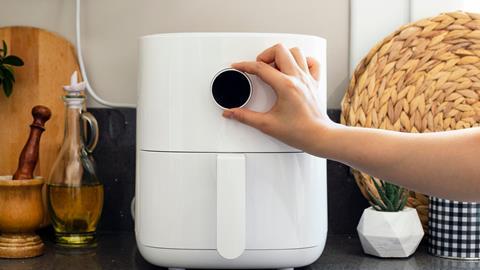
One does not simply perform molecular biology experiments in kitchen appliances. Sounds fair, doesn’t it? The biosafety requirements, combined with the precision and automation of molecular biology instruments, pose limits to running experiments in the kitchen. But what if recent developments in appliance technologies have already surpassed the precision and automation bottlenecks of kitchen appliances, making the unlikely more plausible? Let’s dig into the heart of that question.
An instrument in a molecular biology lab is often programmable and automatic, serving scientists as a hands-free and precise means of reproducing experimental conditions. The conditions could be physical, such as 1000 spin rounds per minute in a centrifuge, or thermal, like 95°C for 45 seconds in a thermocycler. In fact, incubation at 95°C is the temperature at which double-stranded DNA denatures into perfect single strands, making it the backbone of many biological experiments.
The denaturation of double-stranded DNA is the starting step of the polymerase chain reaction (PCR), but what does PCR do? PCR amplifies a DNA molecule and the biological signal conveyed in the DNA that can be translated into scientific insights. Molecular-level nucleotide variations in DNA sequences convey biological signals. Indeed, that kind of signal in a DNA molecule is invisible to the naked eye and is even too meek for machine readability. Therefore, to acquire, process, and interpret the biological signal encoded in DNA, many current workflows rely on the ability to amplify the DNA. Do you remember the PCR-based SARS-CoV-2 tests? Evaluating the infection positivity in a sample required converting the SARS-CoV-2 target into DNA and subsequent PCR amplification, as the amount of viral RNA in the sample alone did not produce a strong enough signal. One may ask how PCR amplifies DNA molecules.
In the PCR, template DNA is mixed with primers targeting specific DNA sequences that mark the left and right boundaries of the region of interest, free nucleotides that form DNA sequences, and DNA polymerase that synthesizes new DNA molecules. In Figure 1, you can see a simplified schema of the technique. In short, when the mixture is heated to 95°C, the double-stranded DNA denatures into single strands (1). Then, at around 60°C, primers anneal to the target DNA sequence (2). Followingly, at 72°C, DNA polymerase elongates the target sequence by adding free nucleotides to the end of the primer annealed to the target DNA sequence (3). At the end of this 3-step cycle, 2 target DNA molecules arise from a single template DNA molecule. Repeating the 3-step cycle 35 times results in 34 billion target DNA molecules, the signal of which is far more robust, machine-readable, and interpretable than that of a single DNA molecule. Clearly, PCR requires unique thermal cycling conditions provided by the laboratory instrument “thermocycler”.

A simplified figure illustrating a 3-step cycle of PCR. At the end of each 3-step cycle, the amount of target DNA sequence doubles (adapted from Tytgat, 2022)
Apart from their precision time and temperature control, don’t you think thermocyclers seem like glorified ovens or air fryers, with price tags ranging from €3000 to + €15000? In the end, a PCR protocol of 95°C for 45 seconds, 60°C for 60 seconds, 72°C for 45 seconds, repeated 35 times, appears to be from a super precise cookbook. That is the page on which Pavlo Hrab and I met, while we were reflecting on thermocyclers. At that point, we asked, “Can we perform PCR-relevant thermal cycles in an oven or air fryer?” That question quickly unfolded into “Can we perform PCR-relevant thermal cycles in an air fryer?” rather than in an oven, due to hypothetically better thermal control in an air fryer, thanks to its smaller volume compared to an oven.
An air fryer costs around 100 times less than a PCR thermocycler, with prices starting from €30. However, thermocycling in an air fryer seemed reasonable and relevant, only if it is applicable in an experimental molecular biology context. Precision, programmability, and automation lie at the heart of the applicability question. However, manually setting time and temperature at 30 to 60-second intervals is quite laborious, ineffective, and unreliable. On one hand, attempting thermocycling in analogous air fryers was pointless. On the other hand, digital, “smart” air fryers that offer programmability and automation exist. Consequently, we turned our heads to the field of smart air fryers to find a suitable target for our thermocycling attempt.
Many smart air fryers on the market offer an app for remote control of the air fryer and saving custom air fryer programs. However, all the air fryers we came across only offered single-step programs, i.e., 95°C for 5 minutes, and upon completion of a step, one must run a new cycle of 60°C, followed by a 72°C step to complete a thermocycle cycle, a clear hurdle to automation. Moreover, by default, no air fryer on the market allows programming recipes at the scale of seconds, like 95°C for 45 seconds, posing another obstacle to PCR-relevant thermocycling in an air fryer. We understood we needed “smarter” air fryers that we could program to run cycles, with steps under a minute. Thereupon, we developed an interest in re-programming our own smart fryer to precisely run seconds-long steps.

We were not alone in reprogramming smart home appliances. A group of developers under the Open Home Foundation has noted that despite the tremendous expansion of smart home technologies, from the kitchen to the bathroom, from laundry to pet care, from delivery orders to entertainment, the customizability and user choice in the smart home field lag behind the expansion of smart technologies. To overcome the lag in the customizability of smart home appliances, Open Home Foundation developed the Home Assistant operating system, enabling users to customize the functions of their smart appliances. However, not all smart appliances are integrable with the Home Assistant. A Home Assistant integration code pairing the smart appliance with the Home Assistant must exist, which poses a bottleneck to our thermocycling attempt in an air fryer.
Shortly after realizing the bottleneck, we discovered Tsung Lung’s GitHub directory, which contains scripts for pairing Xiaomi’s Mi Smart Air Fryers with the Home Assistant. This discovery marked our air fryer hardware choice for the trial of thermocycling in an air fryer. Bearing in mind that smaller volumes improve thermal control, we selected the smallest volume Mi Smart Air Fryer, 3.5L, which has a price tag of €52, for our trial. Tsung Lung’s code enables users to run thermal loops in the Mi Smart Air Fryer 3.5L, with different target temperatures in seconds-long intervals. Tsung Lung’s code, Home Assistant operating system, Mi Smart Air Fryer 3.5L, and our enthusiasm combined, evoked in us that we were close to thermocycling in an air fryer.
There were only a few steps left between us and thermocycling in an air fryer: ordering the air fryer, setting up the Home Assistant operating system, and trying it out. Upon ordering a Mi Smart Air Fryer 3.5L, we played with setting up the Home Assistant. The setup seemed straightforward if we bought hardware like Home Assistant Yellow/Green or Raspberry Pi, which already had the operating system installed, each costing around €100. However, we decided not to go that way because we aimed to keep the costs of our attempt low. As a result, Pavlo rebooted an old laptop of his and installed the Home Assistant operating system in it. Then, we decided on an arbitrary thermocycling protocol that captured the essence of a PCR thermocycling protocol: a 94°C denaturation step for 45 seconds, a 55°C annealing step for 60 seconds, and a 72°C elongation step for 30 seconds. We ran that protocol in the air fryer, and the air fryer target temperature graph beautifully emerged on the user interface of the Home Assistant. We achieved PCR-like thermocycles in an air fryer:
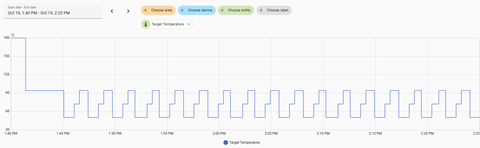
Our thermal curves showed that our humble attempt in an air fryer allowed us to program thermal cycles simulating PCR-like conditions. The hard lines between molecular biology instruments and kitchen appliances have already become blurrier, thanks to Internet of Things technologies, which allow integrating and customizing smart devices, like the Home Assistant, further intellectualizing smart appliances. What was next then?
Obviously, we wanted to run a PCR in our air fryer, but an automated, programmable air fryer-thermocycler was not enough for running a PCR; we needed thermal precision. However, as we did not measure the inside temperature of our air fryer, the target temperature setting of our fryer might not have represented the internal temperature. Measuring and controlling the air fryer’s internal temperature stands as the next obstacle between us and running a PCR in an air fryer. Stay tuned for our next story, where we attempt to measure the internal temperature of an air fryer with smart appliances. All in all, our claim stays the same: Has the line between molecular technology instruments and home appliances become blurrier?



No comments yet