
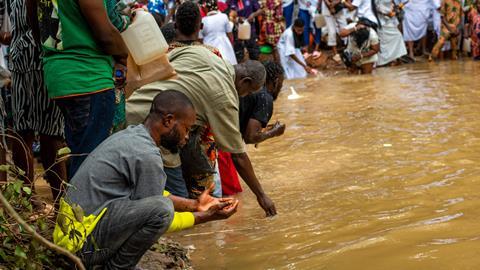
In many communities across Nigeria, clear water is assumed to be safe. Transparency, both literal and visual, has become shorthand for purity. A glass without visible particles reassures. A sachet boldly labeled pure water suggests protection, as though clarity alone were a certificate of safety. Yet water does not reveal its secrets so easily. Beneath that reassuring clarity may exist a complex microbial ecosystem, shaped by environmental contamination, human activity, aging infrastructure, and even antimicrobial exposure. What looks clean can, microbiologically speaking, be busy.
My recent research in Ede, southwestern Nigeria, began with a simple but uncomfortable question: what are people actually drinking? By examining rivers, boreholes, wells, sachet water, and bottled water, the study revealed a convergence of diverse environmental bacteria and detectable antibiotic residues within commonly consumed water sources. The findings challenge not only assumptions about water safety but also how antimicrobial resistance is understood outside hospital walls. While the study was conducted in one locality, its implications extend far beyond Ede. They reflect broader structural and ecological realities of water quality in Nigeria and, more widely, across Africa.
Mapping Nigeria’s water landscape
Water quality in Nigeria is far from uniform. Conditions vary across ecological zones, population densities, and patterns of urban development. In coastal and highly industrialized cities such as Lagos and Port Harcourt, surface waters are influenced by industrial discharge, high population pressure, and aging distribution systems. In many northern regions, groundwater accessed through boreholes serves as the primary drinking source, sometimes drilled in close proximity to sanitation infrastructure. Peri-urban settlements often depend on informal vendors and sachet water, particularly where municipal systems operate intermittently.
These regional differences shape exposure pathways and contamination risks. Urban surface waters may carry industrial pollutants and wastewater effluents. Groundwater systems can accumulate contaminants through seepage from septic systems or agricultural runoff. Distribution networks, where present, introduce additional complexity through pipe corrosion, intermittent flow, and biofilm development. To speak of “water quality in Nigeria” as a single condition is therefore an oversimplification. It is a mosaic influenced by geography, infrastructure, and human activity.
Nigeria continues to face persistent challenges in providing consistent access to safely managed drinking water. Rapid urban expansion has outpaced infrastructure development, stretching municipal systems beyond their intended capacity. In rural communities, many households rely on untreated surface water, shallow wells, or privately drilled boreholes, often without routine quality monitoring. Even in major cities, piped water systems may function intermittently, compelling households to supplement their supply with sachet water or alternative sources. Water, in this context, becomes less of a guaranteed service and more of a daily negotiation.

How water quality is tracked
Water quality oversight in Nigeria involves multiple institutions working across policy, regulation, and outbreak response. The Federal Ministry of Water Resources provides policy direction, while the Standards Organization of Nigeria (SON) establishes benchmark standards. The National Agency for Food and Drug Administration and Control (NAFDAC) regulates packaged drinking water, including sachet water. During public health crises such as cholera outbreaks, the Nigeria Centre for Disease Control intensifies microbial surveillance and coordinates response efforts.
Routine monitoring typically prioritizes physicochemical parameters and microbial indicators such as coliform bacteria. These metrics provide valuable baseline protection. However, antibiotic residues and antimicrobial resistance markers are not consistently incorporated into standard surveillance frameworks. Environmental antimicrobial exposure is therefore often assessed indirectly, if at all. In practice, surveillance systems tend to capture acute contamination events more readily than gradual ecological shifts.
Sachet water has become the backbone of urban survival in Nigeria, filling a critical gap where municipal systems fall short. It is affordable, portable, and widely trusted. Yet production standards and monitoring practices vary considerably, and pureness is not always a microbiological guarantee.

Boreholes, often perceived as the safer alternative to surface water, are not immune to risk. They may sit uncomfortably close to septic systems, agricultural fields, or informal waste disposal sites, allowing contaminants to travel invisibly through soil and groundwater. Rivers and streams face even heavier burdens, frequently receiving untreated domestic discharge and, in some cases, hospital effluent.
In this landscape, water quality is rarely about a single contamination event. It reflects cumulative environmental pressures. Microorganisms enter aquatic systems through multiple routes, including fecal discharge, soil runoff, animal waste, industrial activity, and biofilm formation within distribution networks. When antibiotics enter these same waters, they do not arrive quietly. They introduce an additional selective force, subtly reshaping microbial communities and encouraging the persistence of resistant strains.
Nigeria compared with Africa
Across Africa, rapid urbanization, limited wastewater treatment infrastructure, and widespread antibiotic accessibility contribute to environmental antimicrobial exposure. Nigeria reflects many of these structural pressures. However, it also possesses substantial academic and laboratory capacity. Universities and research institutes generate significant data on microbial contamination and resistance patterns in water systems.
The distinction lies not in the absence of knowledge, but in its integration. Environmental antimicrobial resistance data are frequently produced within research settings, yet remain loosely connected to centralized national surveillance platforms. Compared to some neighboring contexts where data scarcity is the primary constraint, Nigeria’s challenge is coordination and harmonization. This presents not only a gap, but an opportunity.

The microbial cast of characters beyond indicator organisms
Traditional water quality testing often relies on indicator organisms such as Escherichia coli to signal faecal contamination. While useful, this approach offers only a partial picture. Aquatic systems harbor far more diverse microbial communities, many of which persist independently of recent fecal input and contribute to the spread of antimicrobial resistance (AMR). In this Ede study, bacteria isolated from various water sources included genera such as Enterobacter, Bacillus, Acinetobacter, Aerococcus, Brevibacillus, Lactobacillus, Paenibacillus, Corynebacterium, Staphylococcus, Micrococcus, Arthrobacter, and Streptococcus. Some of these organisms are environmental saprophytes. Others are opportunistic pathogens capable of causing infections under favorable conditions.
Aquatic environments are not passive reservoirs; they are active meeting grounds where microorganisms interact, adapt, and occasionally collaborate in ways that would impress even the most strategic negotiators. Within biofilms lining pipes, storage tanks, and boreholes, bacteria embed themselves in protective matrices that shield them from environmental stress, disinfectants, and fluctuating nutrient levels. These slim, often invisible communities function as microbial apartment complexes, facilitating nutrient exchange and horizontal gene transfer.
When antibiotic residues enter these systems, they introduce another layer of ecological influence. In this study, antibiotics such as ciprofloxacin, chloramphenicol, sulfamethoxazole, tetracycline, and metronidazole were detected in various water sources. Even at sub-inhibitory concentrations – levels too low to kill bacteria outright – these compounds can exert selective pressure. They may not eliminate susceptible populations dramatically, but they favor resistant strains and can stimulate gene exchange mechanisms, accelerating the spread of antimicrobial resistance (Wang et al., 2020). In this way, water becomes a selective environment where microbial survival strategies are refined. In environments where diverse microbial communities coexist, the presence of antibiotics creates conditions favourable for the maintenance and spread of resistance genes. Environmental bacteria can act as reservoirs, harbouring resistance determinants that may later be transferred to clinically relevant pathogens.

What the regulations see and what the microbes know
Across Africa, water systems are navigating the pressures of rapid urbanization, expanding populations, limited wastewater treatment infrastructure, and widespread access to antibiotics that are often easier to obtain than clean tap water. The result is a persistent environmental exposure to antimicrobial compounds. Surveillance efforts exist, but they are frequently fragmented, and antibiotic residues are rarely included in routine water quality testing frameworks. In many cases, what is measured determines what is seen, and what is not measured remains comfortably invisible.
Nigeria reflects many of these regional realities. The National Action Plan on antimicrobial resistance has made important strides, particularly within clinical and veterinary sectors. However, environmental surveillance, especially systematic monitoring of drinking water systems, remains comparatively underdeveloped. The microbes, it seems, have a broader ecological stage than our surveillance systems currently acknowledge.
Water quality regulation in Nigeria operates through multiple institutions, including the Federal Ministry of Water Resources, the Standards Organization of Nigeria, and the National Agency for Food and Drug Administration and Control. Existing standards address physicochemical parameters and conventional microbial indicators such as coliforms, providing an important baseline for public health protection. Yet antibiotic residues and antimicrobial resistance markers are rarely incorporated into routine surveillance frameworks. As a result, part of the microbial story remains outside the official checklist.
Aquatic systems do not respect institutional boundaries. They serve as convergence points for human waste, agricultural runoff, pharmaceutical residues, and environmental microorganisms. Within these shared spaces, bacteria carrying resistance genes can persist, exchange genetic material, and quietly expand the environmental resistomes. Some environmental species function as genetic reservoirs, maintaining resistance determinants even in the absence of clinical disease. This continuum challenges binary notions of “safe” versus “unsafe” water. Water safety is better understood as a gradient shaped by microbial diversity, chemical residues, infrastructure integrity, and cumulative exposure over time.

Local data, local decisions
Meaningful assessment requires local data. Assumptions drawn from other regions cannot fully capture Nigeria’s hydrogeological diversity, urban density, sanitation patterns, and water use practices. Local microbial profiling reveals what is actually present in community water sources, not what models predict should be present. When risk assessment frameworks are grounded in such data, they move from theoretical reassurance to practical relevance.
Strengthening surveillance will require formally incorporating environmental reservoirs into national antimicrobial resistance strategies. Routine testing for antibiotic residues in high-risk areas should be prioritized, alongside the use of molecular tools capable of detecting resistance markers even when culturable pathogens are absent. Wastewater regulation must be reinforced to reduce pharmaceutical discharge into aquatic systems, and cross-sector collaboration under a One Health framework should move from concept to operational reality.





No comments yet