
The COVID-19 pandemic was one of the deadliest events in modern history. Estimated to have killed over 25 million people worldwide and caused trillions of dollars in economic damage, the devastation caused by this virus was both astronomical and unforgettable.
To combat the unprecedented devastation, scientists performed what once seemed impossible: they designed, tested, and licensed vaccines in less than a year. Traditionally, vaccine development has taken decades. The speed of the COVID-19 response therefore represented a quantum leap for science, but it also raised an intriguing question: could we go even faster? Specifically, could we create a vaccine against the next unknown threat - the next “Disease X” - in just 100 days?
The idea is no longer science fiction. It has become a global ambition. With a steady rise in deadly disease outbreaks, including Ebola, Nipah, Rift Valley fever, and Chikungunya over the past few years, there is an urgent need to deliver on this goal.
The 100 Days Mission
After the COVID-19 pandemic escalated, the Coalition for Epidemic Preparedness Innovations (CEPI) – a leading organisation spun out during the West African Ebola epidemic to supercharge the development of vaccines against emerging diseases - launched the 100 Days Mission. The bold moonshot aims to develop safe and effective vaccines against a new pandemic threat within 100 days of the virus being identified.
Championed by the G7 and G20 and backed by major pharmaceutical leaders, the mission aims to outpace emerging viral threats and prevent future outbreaks from spiraling into pandemics.
For comparison, the first COVID-19 vaccines were approved just over 320 days after the publication of the virus’s genetic sequence. While record-breaking, this was still far too slow. Modelling research suggests that had this timeline been condensed by two thirds during the COVID-19 pandemic, more than eight million people could have been saved. The greatest impact would be on people in the Global South: by containing outbreaks quickly and at their source, those most in need can access life-saving doses, and we can avoid a repeat of the vaccine inequity seen during COVID-19.
Over the past few years, CEPI has been closing in on achieving this ambitious target. Our new strategy, launched in February, solidifies how to make this plan a reality.
Sign up for our monthly newsletter for tailored content from The Microbiologist.
Promoting new innovations
One of the biggest breakthroughs from COVID-19 was the newly validated and highly effective messenger RNA (mRNA) vaccines designed by Pfizer-BioNTech and Moderna, which use the host’s cellular manufacturing capabilities to become its own vaccine-making factory.
Elsewhere, Oxford’s ChAdOx platform was already being used to make a vaccine against MERS, another coronavirus, allowing the research team to quickly pivot their programme to COVID.
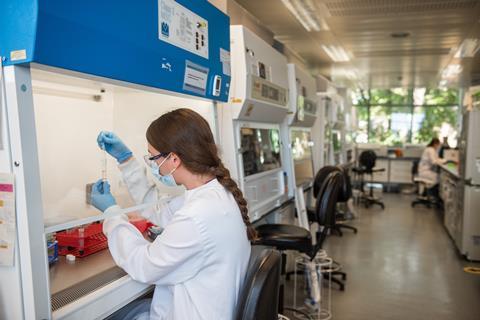
This work has served as ‘proof of concept’ for a prototype vaccine approach for entire families of viruses, such as the deadly coronaviruses or paramyxoviruses. Here, the genetic code for the emerging virus can be quickly swapped into the reusable platform’s ’backbone’, drastically cutting development time as vaccine development does not have to start from scratch.
So, while we can’t predict which specific virus will cause the next pandemic, so we can’t create a bespoke vaccine in advance, we can use these speedy and flexible vaccine platforms along with our growing knowledge of the top viral family threats to develop prototype vaccines.
And to avoid relying on a single technology, CEPI is investing in a diverse portfolio of platforms, including mRNA, protein-based vaccines, and viral vectors. A broad toolkit avoids putting all our eggs in one basket and increases the chances that at least one approach will be suited to tackling whatever emerges next.
The next stage is then embedding these technologies with local manufacturers so that countries around the world can develop vaccines quickly when outbreaks appear.

Scientific ties
As we saw from the global partnerships formed rapidly between biotechs, pharmaceutical companies, and governments during the COVID-19 pandemic, collaboration will be crucial to the success of the 100 Days Mission.
Having networks of epidemiologists, laboratory scientists, clinicians, manufacturers, and regulators working together will enable the world to respond quickly when a new viral emergency arises. Together, these interconnected systems form the global “operational backbone” required to detect new threats early, generate data quickly, and ensure vaccine candidates can be tested, approved, and produced without delay.
Manufacturing is core to this plan. We’re building flexible, regional facilities that can switch rapidly to scaling up production as soon as a new threat emerges. Under its new strategy, we have committed to securing access to 1–2 billion doses of regional manufacturing capacity to enable fast and fair outbreak response.
The role of AI
Artificial intelligence could be transformational for pandemic preparedness. AI tools can accelerate scientific discovery, reduce attrition, and design better-performing vaccines.
A new CEPI supported tool, the Pandemic Preparedness Engine, is being developed as a safe, secure AI system trained on vast scientific datasets to help researchers rapidly synthesize information, test hypotheses, and design new potential vaccines. It could be game-changing: what now takes developers months or years could be done in days or hours through this new virtual scientific collaborator.
Preparing for the unknown
Ultimately, the 100 Days Mission represents a shift from reactive crisis response to planning for emerging threats before they occur—pandemic preparedness and pandemic readiness.
Crucially, safety lies at the heart of this vision. The goal is to strengthen the systems that underpin vaccine development long before a crisis hits. Speed will be achieved through readiness, not risk.
As the epidemiologist Larry Brilliant famously said,
“Outbreaks are inevitable, but pandemics are optional.”
- Larry Brilliant
The question, then, is not whether we can build a vaccine in 100 days, but whether the world is willing to invest in the systems, collaboration, and trust required to ensure that speed translates into lives and economies saved when the next Disease X appears. To see our new strategy succeed, CEPI is now calling on governments and organisations worldwide to invest $2.5 billion in its plans and make the 100 Days Mission a reality.
We have the tools. We know the agenda. Now it’s time to act – and the clock is already ticking.
For further reading and to support CEPI’s work and the 100 Days Mission, please visit Securing the Future.




No comments yet