
All Microbes of the Earth articles
-
 News
NewsHidden DNA in medieval gospels reveal history of deadly livestock virus
New research shows that some of Europe’s most well-known historic manuscripts, including the York Gospels, have proven to be biological time capsules for uncovering the 3,500-year history of the sheeppox virus (SPPV).
-
 News
NewsThe SETI Institute and ETH Zurich join forces to search for the origin of life
ETH Zurich and the SETI Institute have announced a strategic scientific partnership investigating the origins of life on planet Earth.
-
 News
NewsEarthly microbes could survive on the moon
Microbes likely to hitch a ride to space with human explorers could survive in shady spots in the moon’s south pole region.
-
 News
NewsUnique symbiosis bestows magnetic sense to single-celled organism
An international team has discovered a previously unknown magnetotactic ciliate that pursues an unusual strategy: partnership with two other organisms inside its cell.
-
 Features
Advancing animal disease outbreak management in support of a One Health approach
Animal health is often overlooked, with global expenditure reaching just a fraction (around 0.4 percent) of total human health spending, yet it is a crucial component of the World Health Organization’s (WHO) One Health approach. The One Health initiative highlights the commonalities between human, animal and environmental health and aims ...
-
 Features
Soil microbes and the hidden network connecting plants, animals, and humans
Coevolution has shaped Earth’s ecosystems for over a billion years. However, climate change and unprecedented anthropogenic activities have placed immense pressure on the soil ecosystem over the past few decades.
-
 News
NewsUnder the Lens: Plant microbiomes could cut agriculture’s dependence on chemicals, says Davide Bulgarelli
Understanding the hidden microbial communities that surround plant roots could pave the way for more sustainable farming, according to award-winning plant microbiologist Dr Davide Bulgarelli in conversation with Professor Emmanuel Adukwu.
-
 Video
VideoThe Microbiologist: Under the Lens | Episode 4
The microscopic organisms living around plant roots may hold the key to reducing agriculture’s reliance on chemical fertilisers and other non-renewable inputs, according to plant microbiome researcher Dr Davide Bulgarelli.
-
 News
NewsBreakthrough study could unlock key to more reliable truffle cultivation
A pioneering study has revealed that growing truffles depends not just on soil conditions, but on a complex underground ecosystem that the truffles may help to engineer themselves.
-
 Features
Azotobacter: a microbial route to green and sustainable ammonia
Ammonia is one of the most important chemicals in modern society. It plays a central role in global food production as the key ingredient in fertilizers that sustain nearly half of the world’s population. Beyond agriculture, ammonia has recently attracted growing attention as a potential carbon-free energy carrier and hydrogen ...
-
 News
NewsA soil bacterium turns electricity and carbon dioxide into acetate
A new study shows that a soil bacterium can directly reduce Fe(III) minerals, exchange electrons with electrodes, and use electrode-derived electrons to convert carbon dioxide into acetate under autotrophic conditions.
-
 Opinion
Fungi that inspired The Last of Us may hold the key to a pesticide-free agriculture
They may be the stuff of our nightmares, but Aditya Singh Ranout reveals how invisible allies underneath our feet in the form of entomopathogenic fungi are transforming agriculture - and why these fascinating microbes may hold the key to a pesticide-free agriculture.
-
 News
NewsSoil bacteria reveal hidden arsenic stress in brick kilns
Researchers collected soils from a shut-down brick kiln area. As arsenic levels increased, bacterial richness and diversity declined, while arsenic-tolerant groups became more abundant. The study also found that bacteria strengthened stress-response pathways and upregulated arsenic-resistance genes.
-
 News
NewsThree interlinked factors are needed to sustainably grow microbes for MICP
A new review investigates cost-effective and greener ways to grow microorganisms for use in Microbially Induced Calcium Carbonate Precipitation (MICP), a microbial process that precipitates calcium carbonate, and identifies three interlinked factors that determine success or failure.
-
 Features
Under the microscope: extremophiles of the Earth
Extremophiles are microbial organisms that live in extreme environments normally considered uninhabitable. Over the past few decades, extremophiles have been discovered in increasingly bizarre and unexpected environments around the globe, including within acid lakes, plastic recycling centres and even in radioactive sites such as Chernobyl.
-
 News
NewsThe greener the street view, the richer the microbiota?
A new study investigates how the Green View Index (GVI) relates to the richness and diversity of bacteria in the Taipei metropolitan area in Taiwan. The more vegetation in the area, the richer its microbial community.
-
 News
NewsNew biobank decodes survival secrets of extreme acid mine drainage microbes
Over 97 percent of microorganisms in acid mine drainage have never been cultured, leaving their metabolism and adaptation strategies locked as “microbial dark matter.” Now, a new culturomics‑driven resource called the Microbial Biobank of AMD (mbAMD) changes that.
-
 News
NewsÖtzi and his microbiome: a 5,300-year-old relationship
Researchers have obtained a detailed picture of the microbial community associated with the Iceman mummy Ötzi. The study provides insights into a complex microbiome, ranging from the gut flora of a Copper Age human to cold-adapted yeasts.
-
 News
News‘Baked’, printed, ready – premiere of architecture made from yeast
Researchers have developed a new, entirely bio-based material from a somewhat unexpected ingredient: yeast. The material is 3D printed and customised for use in architectural and interior design elements that are currently made from non-renewable or fossil-based materials, such as plaster, plastic or synthetic textiles.
-
 News
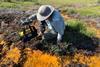
NewsNew study uncovers why the Arctic’s rivers are rusting
Scientists have identified the two biggest reasons that once-pristine rivers across the Arctic are growing cloudy with toxic orange iron particles that smother insects and suffocate fish. As the climate warms, a layer of Arctic soil that had been frozen for millennia has begun to thaw.