
Researchers at Queen Mary University of London have discovered that tiny photosynthetic bacteria band together into protective “herds” when attacked by predators – a survival strategy that could also influence how carbon is stored in the world’s waters.
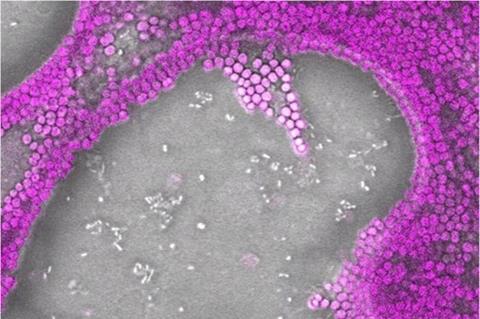
Published in The ISME Journal, the study reveals for the first time that cyanobacteria – microscopic organisms responsible for producing a significant proportion of the Earth’s oxygen – rapidly cluster into dense groups when they detect the presence of foreign bacteria. These defensive clumps, known as flocs, shield inner cells from attack, much like a herd of wildebeest protects its most vulnerable members from predators.
The research helps explain a long-standing biological mystery: why cyanobacteria invest energy in forming flocs despite the apparent cost to their growth. The findings suggest the behaviour is an evolved defense mechanism that could have implications extending from microbial ecology to the global carbon cycle.
Microbe interactions
The research team studied interactions between the cyanobacterium Synechocystis and Pseudomonas aeruginosa, a bacterium commonly found in soil and freshwater. They found that the predator uses microscopic molecular “weapons” to puncture and kill individual cyanobacterial cells, consuming the nutrients they release. In response, the cyanobacteria rapidly aggregate into dense flocs surrounded by a protective layer of extracellular slime, making it much harder for predators to reach the cells inside.
MICROBIOLOGY NEWS: Register with The Microbiologist for more free articles
“It was very exciting to see this project leading to a new explanation for why cyanobacteria form flocs. We saw that these tiny cells quickly come together into protective clumps when predators are present, showing that this is a coordinated survival strategy, not just a passive response. This work gives a new way to think about how this can affect the biological carbon pump in nature. In simple terms, it is like how many living organisms stay in groups for protection, cyanobacteria also cluster together to reduce the risk of being attacked,” says Dr Shylaja Mohandass, first author of the study.
Mutant cyanobacteria
The team found that predators grew more successfully when attacking mutant cyanobacteria that could not form these protective clumps, providing strong evidence that flocculation is an effective defense against bacterial predation. The researchers also discovered that the response is triggered simply by contact with foreign bacteria, suggesting cyanobacteria can distinguish between “self” and “non-self” at the microscopic level.
Beyond revealing an unseen microbial battle, the findings may also help scientists better understand one of the planet’s most important natural climate processes.
When cyanobacteria form dense flocs, they are more likely to sink, carrying carbon absorbed through photosynthesis into deeper waters where it can remain stored for long periods. This process, known as the “biological carbon pump”, plays a crucial role in regulating atmospheric carbon dioxide.
Predator-prey relationship
Professor Conrad Mullineaux from Queen Mary University of London, said: “It was fascinating to look in the microscope and see a complex predator-prey relationship unfolding on such a tiny scale. It reminds me of lions and wildebeest on the Serengeti - you can see P. aeruginosa catching and lysing those cyanobacteria that were a bit too slow to get into the herd.”
The discovery also raises an intriguing possibility: bacteria previously thought to reduce carbon storage by consuming organic matter may, under some circumstances, actually help increase carbon burial by triggering floc formation in photosynthetic microbes.
MICROBIOLOGY ON TAP: Get full access to all The Microbiologist articles from just £2.17 a month
“It’s so interesting to see that bacterial predation may actually be a crucial factor in the control of environmental carbon levels, and is an exciting new avenue for the field to explore,” added Dr Alice Collins, from Imperial College London, who contributed her Pseudomonas expertise to the study.
Cyanobacteria transformed the biosphere about 2.5 billion years ago, and today they remain hugely abundant in lakes and oceans, producing over 20% of the world’s oxygen. This study is indispensable as it reveals that microscopic bacteria work together to defend themselves from predators—and that this behaviour could have unexpected consequences for how our planet stores carbon.
Topics
- Algae
- Alice Collins
- Bacteria
- Clean Water
- Climate Action
- Conrad Mullineaux
- cyanobacteria
- Ecology
- flocs
- Imperial College London
- Marine Science
- Ocean Sustainability
- predation
- predator-prey relationships
- Pseudomonas aeruginosa
- Queen Mary University of London
- Research News
- Shylaja Mohandass
- Synechocystis
- UK & Rest of Europe






No comments yet