
Even among plastics labelled “biodegradable,” some break down readily while others persist for long periods. In experiments using landfill leachate, a collaborative research team led by the Korea Advanced Institute of Science and Technology (KAIST) demonstrated these differences and identified candidate microorganisms and enzymes potentially involved in plastic degradation.
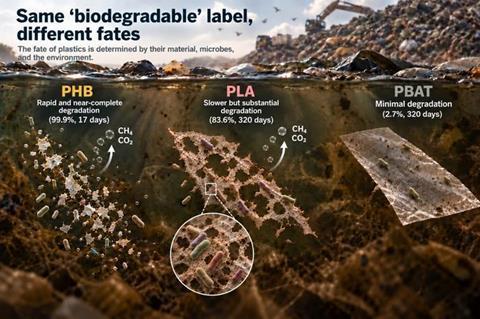
The findings are expected to provide a scientific basis for selecting materials suited to their disposal environments and for developing plastic-degradation technologies.
On November 10, KAIST (President Choongsik Bae) announced that a research team led by Professor Jaewook Myung of the Department of Civil and Environmental Engineering, in collaboration with a team led by Professor Changsoo Lee at Ulsan National Institute of Science and Technology (UNIST), had investigated the extent of biodegradable plastic degradation and the activities of associated microorganisms under anaerobic conditions using landfill leachate.
Why biodegradability depends on environment
Biodegradable plastics that microorganisms can break down have attracted attention as a promising strategy to reduce plastic waste. However, the rate and extent of degradation vary with the type of material, temperature, oxygen availability, and surrounding microbial communities. A plastic that degrades readily in a high-temperature composting facility, for example, may persist for much longer in a landfill.
When separate collection and treatment systems are insufficient, biodegradable plastics may be disposed of alongside general municipal waste. Yet how extensively they break down under the oxygen-limited conditions associated with landfills and which microorganisms may be involved remains poorly understood.
The research team investigated three biodegradable plastics—polyhydroxybutyrate (PHB), poly(lactic acid) (PLA), and poly(butylene adipate-co-terephthalate) (PBAT)—by incubating them in landfill leachate under anaerobic conditions at 35 °C for up to 320 days. Landfill leachate is water that has passed through waste and contains a mixture of dissolved substances and microorganisms. Conventional low-density polyethylene (LDPE) was included for comparison.
The researchers assessed biodegradation using the extent of mineralization, defined here as the percentage of plastic-derived carbon converted into gases such as methane and carbon dioxide. This measure distinguishes microbial conversion of the polymer carbon from changes in appearance or fragmentation into smaller pieces.
Very different degradation rates
The results showed that PHB reached 99.9% mineralization within just 17 days. PLA showed an initial lag of approximately 20 days before degrading gradually, ultimately reaching 83.6% mineralization after 320 days. In contrast, PBAT reached only 2.7% after 320 days, while conventional LDPE reached 0.4%. Thus, the plastics exhibited markedly distinct degradation outcomes under the same experimental conditions.
The PLA result was particularly notable. Although PLA is generally known to degrade more readily under high-temperature composting conditions, it underwent substantial mineralization over an extended period at just 35 °C. Electron microscopy also revealed biofilms—thin communities of microorganisms attached to surfaces—associated with cracks and damaged areas on the PLA films.
The team further examined gene activity in microorganisms associated with the plastics. By combining metagenomic analysis of microbial DNA with metatranscriptomic analysis of RNA, the researchers compared the genes present in microbial communities with those being transcribed. Among 238 reconstructed microbial genomes, 118 contained candidate genes encoding enzymes potentially involved in PHB or PLA depolymerization. However, only 49 of these genomes showed evidence of transcription of the candidate genes. In other words, the presence of a degradation-related gene did not necessarily mean that it was being expressed.
Many of the transcription-supported candidates belonged to poorly characterized microbial lineages beyond those represented by experimentally validated plastic degraders in reference databases. These findings highlight previously underexplored microbial lineages as promising targets for identifying and experimentally validating new plastic-degrading microorganisms and enzymes.
Transcription of these degradation-related genes was also more pronounced in biofilms on plastic surfaces than in the surrounding leachate. This suggests that understanding plastic degradation requires investigating not only which microorganisms are present, but also what the microorganisms attached to the plastic are doing.
Importantly, transcription of a candidate gene does not, by itself, establish that the corresponding microorganism or enzyme actually degrades the plastic. These candidate functions require validation in follow-up experiments. The measured degradation outcomes were also obtained in laboratory incubations at 35 °C and should not be interpreted as predictions of identical degradation rates or extents in actual landfills.
Towards more realistic biodegradability tests
The findings demonstrate the importance of considering the conditions that biodegradable plastics will encounter after disposal, rather than evaluating them solely on the basis of their material properties or biodegradability labels. They may help inform the selection of suitable materials and treatment methods, the development of environment-specific biodegradability assessment criteria, and future searches for microorganisms and enzymes that can degrade plastics.
“Our findings show that biodegradability is not simply an inherent property of a plastic material, but also depends on the environmental conditions and microbial communities it encounters after disposal,” said Professor Jaewook Myung. “The substantial degradation of PLA under mesophilic anaerobic conditions was particularly surprising, highlighting the importance of understanding which microorganisms are active and what functions they perform. We hope this research will help establish more environmentally relevant biodegradability assessments and guide the discovery of new plastic-degrading microorganisms and enzymes.”
MICROBIOLOGY NEWS: Register with The Microbiologist for more free articles
Dr. Shinhyeong Choe, who earned a Ph.D. from KAIST and is currently a postdoctoral researcher at Eawag, the Swiss Federal Institute of Aquatic Science and Technology, and Dr. Hyungmin Choi, who earned a Ph.D. from UNIST and is currently a postdoctoral researcher at Hokkaido University, contributed equally as co-first authors. Professor Changsoo Lee of UNIST and Professor Jaewook Myung of KAIST served as co-corresponding authors. The findings were published in Nature Communications on October 20, 2026.
Topics
- Asia & Oceania
- biodegradable plastics
- Bioengineering
- biomaterial
- civil engineering
- Environmental Microbiology
- Environmental sciences
- Healthy Land
- Korea Institute of Civil Engineering and Building Technology
- low-density polyethylene (LDPE)
- mesophilic anaerobic conditions
- Microbes of the Earth
- One Health
- poly(butylene adipate-co-terephthalate) (PBAT)
- poly(lactic acid) (PLA)
- polyhydroxybutyrate (PHB)
- Research News
- Ulsan National Institute of Science and Technology


No comments yet