
A Portland State University professor has received one of the National Science Foundation’s top honors for early-career scientists. Anne Thompson, an associate professor of biology, won a nearly $1.2 million NSF CAREER Award to answer a basic question about the ocean that science has largely left open: who eats the most abundant photosynthetic life form on Earth?
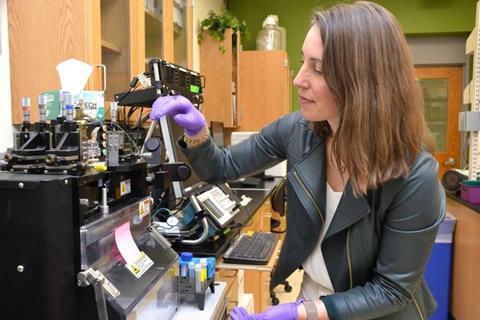
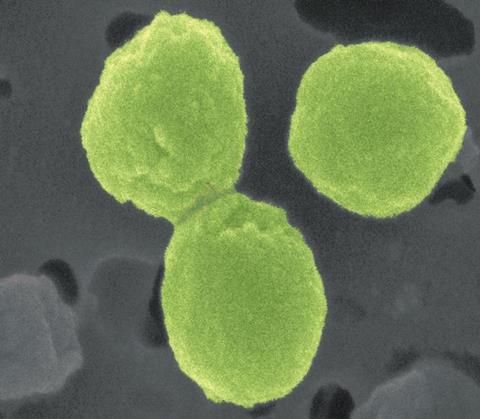
That life form is Prochlorococcus, a microbe so small it cannot be seen well with a microscope, but is so common it is the most numerous light-harvesting cell on the planet. Scientists know a great deal about what helps it grow. They know far less about what kills it.
Thompson’s project, funded over five years, will study how single-celled ocean predators hunt Prochlorococcus and what that predator-prey relationship means for the ocean’s food web, its carbon, and the way the sea supports life on Earth. The award also reflects Portland State’s push, as a federally designated Emerging Research Institution, to compete for and win the country’s most competitive research grants.
MICROBIOLOGY NEWS: Register with The Microbiologist for more free articles
“Prochlorococcus makes up a huge share of life in the open ocean, and we still cannot say very much about what other cells eat it, or why some cells get eaten while others escape,” Thompson said. “This award gives my students and me five years to chase that question. We get to ask who the ocean’s smallest predators pick on, and what that choice means for the whole system.”
Predator and prey
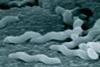
Thompson studies the question with a pair of microbes she can grow and watch in the lab. The predator is a choanoflagellate, a single-celled hunter that lives throughout the ocean and is often studied for clues about how animal life first evolved.
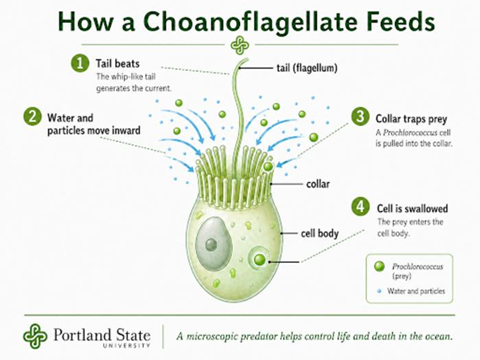
It feeds by beating a whip-like tail to draw a current of water toward its body, pulling prey into a collar of tiny finger-like structures, then swallowing the cell whole.
Her lab has developed methods to precisely measure which Prochlorococcus cells get caught and which slip away. Over the course of the project, her team will test about 40 types of Prochlorococcus to see whether the predator prefers some over others, whether a cell’s size or health affects its odds, and whether the prey can sense a predator and respond.
Student experiments
The award supports more than research. Thompson will build the experiments into two microbiology lab courses at Portland State, where roughly 200 undergraduates — many of them headed for nursing, pharmacy, and other health fields — will run real predation experiments and help produce the project’s data. Standout students can join her lab for paid summer research and continue into graduate study.
She is also writing a popular-science book about Prochlorococcus and how scientific discovery works, in development with Princeton University Press, to bring ocean and microbe literacy to readers outside the university. The project reflects Portland State’s focus on public impact research — work tied directly to real questions facing society — and its goal of giving students hands-on research experience early.
“Winning a CAREER Award at Portland State says something I care about,” Thompson said. “It says frontier science belongs here, and that our students can help do it. That is exactly who I want in the lab with me.”
MICROBIOLOGY ON TAP: Get full access to all The Microbiologist articles from just £2.17 a month
The award comes from the National Science Foundation’s Faculty Early Career Development (CAREER) Program (NSF Award No. OCE-2543440) for $1,165,130 over five years. Thompson will obtain many of the Prochlorococcus strains from Sallie “Penny” Chisholm’s lab at the Massachusetts Institute of Technology. The book is in development with Princeton University Press. The project builds on equipment from a prior NSF award to Portland State, including a high-throughput flow cytometer that lets researchers study cells one at a time.
No comments yet