
The yeast fungus Candida albicans is a common and usually harmless inhabitant of the mucous membranes in many people. Under certain conditions, however, it can trigger infections. One such example is vulvovaginal candidiasis, an infection of the vagina and the external genital area (vulva), commonly referred to as a vaginal yeast infection.
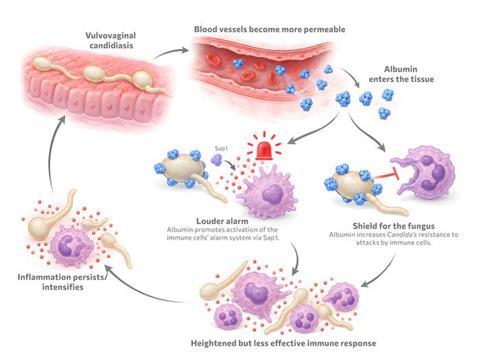
The associated symptoms are largely caused by the immune response to the fungus: the body’s defense cells migrate into the affected mucous membrane, where they can initiate an inflammatory reaction. This process increases the permeability of blood vessels, allowing not only immune components but also albumin—the most abundant protein in human blood—to enter the surrounding tissue.
In an earlier study, the research group led by Dr. Mark Gresnigt at the Leibniz-HKI demonstrated that albumin can enhance the pathogenic properties of Candida albicans. It has now been revealed that this protein can also trigger an excessive inflammatory response.
Inflammatory marker turns out to be a driver of inflammation
In vaginal samples from patients with recurrent yeast infections, researchers found higher concentrations of albumin than in healthy women. The greater the amount of albumin present, the higher the concentrations of various inflammatory mediators tended to be. This correlation was also observed in a second, larger group of patients, as well as in a mouse model.
“We wanted to determine whether albumin is merely a consequence—and thus a marker—of inflammation, or if it is actually part of the problem itself,” explains lead author Dr. Sophie Austermeier, who initiated the foundational work for the study during her doctoral research at the Leibniz-HKI. “Our findings suggest that the protein actively interferes with the interplay between the fungus and the immune response, helping to fuel the inflammatory reaction.”
The research team succeeded in identifying two mechanisms through which albumin amplifies the inflammatory response.
Activation of the molecular alarm system by a fungal protein
For one, albumin stimulates the fungal invader to produce certain factors. One of these is the enzyme Sap1, which is released by Candida albicans. In macrophages—key sentinels of the immune defense that respond to invading pathogens—this enzyme has a specific effect: it essentially presses the button for a molecular alarm system known as the NLRP3 inflammasome.
Its activation triggers the release of interleukin-1β, a highly pro-inflammatory signaling molecule. This, in turn, can attract additional immune cells to the site, where they are then activated. The inflammation intensifies further. However, the immune cells that have been summoned are unable to deploy their full defensive power.
Candida’s protective shield against the immune defense
At the same time, albumin shields the fungus from a key weapon used by immune cells: reactive oxygen species. Macrophages and neutrophil granulocytes—another important group of phagocytes—employ these aggressive molecules to kill pathogens. Albumin can partially scavenge these oxygen compounds and, furthermore, helps the fungus bolster its resistance against this assault.
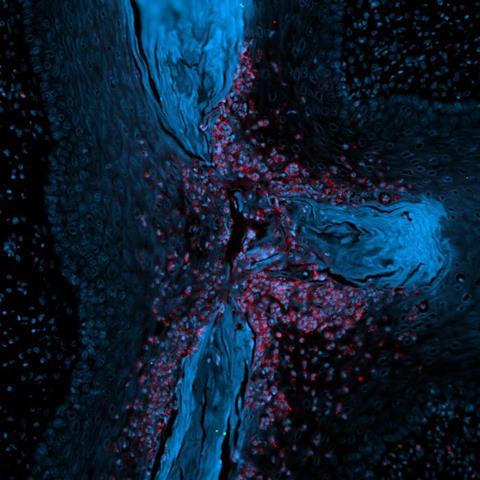
The researchers observed the consequences of this protective mechanism in cell culture experiments: in the presence of albumin, significantly more fungal cells survived within the attacking macrophages. Although neutrophil granulocytes were also more strongly activated, the albumin diminished their ability to curb fungal growth.
“This is the fascinating yet paradoxical aspect of our findings: while albumin prompts immune cells to sound a stronger alarm, it simultaneously weakens the effectiveness of one of their primary weapons,” explains Dr. Axel Dietschmann, who continued the work initiated by Austermeier, alongside doctoral candidate Kar On Cheng. “In this context, a vigorous immune response does not automatically translate into more effective combat against the fungus.”
Vicious cycle of inflammation
The study thus outlines a potential vicious cycle: a vaginal yeast infection triggers inflammation. Blood vessels become more permeable, allowing increased amounts of albumin to enter the tissue. Once there, the albumin protects Candida albicans from the immune response while simultaneously prompting the fungus—via the protein Sap1—to trigger further alarm signals. This draws in additional immune cells which are unable to effectively eliminate the fungus; instead, they contribute to further inflammation and discomfort.
“The development and progression of vulvovaginal candidiasis cannot be attributed to a single factor,” emphasizes Austermeier. “However, our study adds an important piece to the puzzle: understanding the role of albumin could help explain why inflammation becomes so severe in some patients, yet fails to result in the effective eradication of the fungus.”
Albumin itself is not inherently harmful. Its effect depends heavily on the specific environment and the nature of the infection. While it may support the immune response or protect tissue from damage elsewhere in the body, in this context, it appears to work in the fungus’s favor.
How this fateful interplay between the pathogen and the immune response might be influenced therapeutically in the future remains an open question. One challenge lies in curbing the harmful, excessive inflammation without simultaneously weakening the necessary immune defense against the fungus.
Funding
A total of 27 researchers from Germany, Belgium, the Netherlands, and Italy contributed to this extensive study. The research was led and coordinated by Mark Gresnigt from the Leibniz-HKI. The work—which yielded groundbreaking insights for improving women’s health—was supported by numerous funding agencies, including the European Union, the German Research Foundation (DFG), the Boehringer Ingelheim Foundation, the Free State of Thuringia, and the Research Foundation – Flanders (FWO).
MICROBIOLOGY NEWS: Register with The Microbiologist for more free articles
Austermeier S, Cheng KO, Dietschmann A, Vascelli G, Montaño DE, Hitzler SUJ, Skurk KS, Fernández-Fernández C, Saloni S, Westermann S, Jaeger M, Jablonowski N, Wisgott S, Elshafee O, Brachelente C, de Graaf DM, Próchnicki T, Latz E, Wirtz S, Becker C, Renga G, Oikonomou V, Hube B, Donders GGG, Pekmezovic M, Zelante T, Gresnigt MS (2026) Local albumin excess exacerbates Candida albicans-induced inflammasome activation linked with hyperinflammation during vulvovaginal candidiasis. Nat Commun. https://doi.org/10.1038/s41467-026-78761-w
Topics
- albumin
- Axel Dietschmann
- Candida albicans
- Fungi
- Immunology
- Infection Biology - Hans Knöll Institute (Leibniz-HKI)
- Infection Prevention & Control
- Infectious Disease
- interleukin-1β
- Kar On Cheng
- Mark Gresnigt
- One Health
- Reproductive &Urinary Tract Microbiome
- Research News
- Sophie Austermeier
- UK & Rest of Europe
- vulvovaginal candidiasis



No comments yet