By tracking ARG movement from soil into soybeans, a new study shows that black carbon not only counteracts the ARG-amplifying effects of plastic residues but also limits the transfer of resistance genes into plant tissues and seeds.

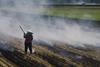
Farmer_burning_straw_stubble_in_Chishang_on_26_June_2014

Source: Mark 高維隆

Farmer burning straw stubble in Chishang on 26 June 2014.

Antibiotic resistance is a growing global health threat, with soils recognized as major environmental reservoirs of resistance genes. In modern agriculture, this risk is intensified by widespread use of plastic mulch films, which fragment into microplastics and alter soil microbial communities. These plastics can act as vectors that promote ARG persistence and horizontal gene transfer.

At the same time, large quantities of crop straw are generated annually, particularly in major grain-producing countries. Although open straw burning is officially restricted, it still occurs in many regions, leaving behind black carbon-rich ash that accumulates in surface soils. Despite the frequent coexistence of plastic mulch residues and black carbon in farmland, their combined influence on antibiotic resistance dynamics has remained poorly understood.

study (DOI:10.48130/newcontam-0025-0013) published in New Contaminants on 18 November 2025 by Fei Wang’s team, Beijing Normal University, highlights a potential, soil-based strategy to mitigate antimicrobial resistance risks in intensive farming systems where plastic mulching and straw residues commonly coexist.

Plastic mulch film

Researchers established a combined soil-incubation and soil–soybean pot experiment using two plastic mulch film (PMF) types—conventional polyethylene (PE) and biodegradable plastic (BP)—together with two black carbon (BC) scenarios, namely exogenous BC addition and in-situ straw burning.

READ MORE: Can biodegradable mulch films harm soil health?

READ MORE: Black carbon from wheat straw burning shown to curb antibiotic resistance spread in farmlands with plastic mulch residues

Over a three-month period spanning key soybean growth stages, they systematically quantified PMF aging characteristics, soil physicochemical properties, enzyme activities, microbial community structure, and the abundance, mobility, and microbial hosting of ARGs and mobile genetic elements (MGEs) across bulk soil, rhizosphere soil, rhizoplane, phyllosphere, and seeds.

The results revealed pronounced contrasts between PMFs and BC. Soil burial roughened both PE and BP surfaces through abrasion, while straw burning caused immediate thermal deformation and intensified perforation; BP showed stronger surface roughening under BC addition due to preferential biodegradation, whereas thinner PE was more vulnerable to heat damage.

Impacts on soil

Spectral analyses confirmed PE oxidation and aging alongside BP surface degradation, with straw burning exerting stronger effects than BC alone. Correspondingly, PMFs and BC reshaped soil chemistry and enzyme activities: PE generally lowered soil pH and increased nitrate and available phosphorus, BP elevated pH but reduced these nutrients, and BC modified both patterns while supplying phosphorus and potassium.

Enzyme responses reflected altered nutrient cycling, with alkaline phosphatase, urease, peroxidase, and catalase responding differently depending on PMF type and BC treatment. Gene profiling showed that PMFs alone elevated soil ARG abundance—more strongly under PE—whereas BC consistently reduced ARG levels, in some cases by nearly half, and sharply inhibited ARG transfer from soil to plants. During the reproductive stage, straw burning reduced ARG abundance in leaves by over 75% and in seeds by up to 80%.

Network and multivariate analyses further demonstrated that ARGs and MGEs were tightly associated with dominant bacterial hosts, particularly ProteobacteriaFirmicutesBacteroidota, and Actinobacteriota, and that habitat was the primary driver of ARG/MGE patterns. Although straw burning temporarily disturbed microbial diversity, soil communities recovered within three months, indicating that BC mitigated ARG dissemination without causing lasting damage to soil health or nutrient cycling.

The findings suggest that black carbon can act as a mitigating agent against antibiotic resistance risks in plastic-mulched agroecosystems. By reducing ARG abundance in soils and blocking their transfer into edible plant parts, black carbon may help lower the likelihood of resistance genes entering the food chain.