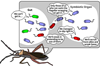
Researchers at National Institute of Advanced Industrial Science and Technology (AIST), in collaboration with researchers from The University of Electro-Communications (UEC) and Akita Prefectural University, have discovered a new insect pathogen that invades the gut symbiotic organ of stink bugs by mimicking their symbiotic microorganism, and this pathogen ultimately kills the host bugs.

Low-Res_★概要図_183_08_E

Source: National Institute of Advanced Industrial Science and Technology (AIST)

Scientists have discovered a pathogenic microorganism that behaves like a symbiotic microorganism, invading symbiotic organs and killing its host pest

Many pests harbor symbiotic microorganisms within their bodies and rely on them for functions essential to their survival, such as obtaining essential nutrients that cannot be obtained from food alone. Stink bugs are a well-known example of maintaining a symbiotic relationship like this. They do this by housing symbiotic microorganisms, which they acquire from the environment, in a well-developed, sac-like symbiotic organ located within the posterior region of their gut.

Symbiote mimic

In this study, researchers discovered a new pathogenic microorganism that mimics the symbiotic microorganisms of stink bugs to invade their bodies. This pathogen enters the gut from the soil and uses the same “wrapping motility” mode employed by symbiotic microorganisms to reach the symbiotic organ.

Researchers revealed that this pathogen proliferates abnormally after establishing itself in the symbiotic organ. It then breaches the organ and spreads into the host’s hemolymph, causing sepsis and killing the host stink bug with nearly 100% certainty within 10 days. This is the first reported case of an insect pathogen killing its host by colonizing the symbiotic organ while masquerading as a symbiotic microorganism. These findings are expected to lead to the development of new, eco-friendly pest control technologies.

Details of this technology were published online in the “Proceedings of the National Academy of Sciences of the United States of America (PNAS)” on April 28, 2026.

Study background

The natural environment is home to a wide variety of insects, including agricultural pests that damage crops. There are also stored-product pests that infest homes and food. And there are public health and nuisance pests that transmit pathogens. These pests adversely affect health and sanitation. Chemical pesticides are widely used to control these pests; however, concerns have arisen regarding their impact on biodiversity and the development of pesticide resistance in pest populations.

MICROBIOLOGY ON TAP: Get full access to all The Microbiologist articles from just £2.17 a month

Consequently, biological pesticides are gaining attention as they utilize insect-pathogenic microorganisms and natural enemies with high species-specificity against pests. Biological pesticides target pests more specifically and have a lower environmental impact than chemical pesticides. This makes them an important option for sustainable agriculture. Among agricultural pests, stink bugs are known to be difficult to control, and they damage many crops by sucking sap. Until now, chemical pesticides were the only effective control method.

Symbiotic organs

Many pests harbor symbiotic microorganisms within their bodies and rely on them for important nutritional metabolic functions, such as compensating for insufficient nutrients obtained from food and breaking down indigestible food. These symbiotic microorganisms are essential for the pests’ survival, growth, and reproduction.

Among insects that harbor symbiotic microorganisms, there are species known to have evolved specialized organs called “symbiotic organs” to maintain these microorganisms stably. Stink bugs have a sac-like symbiotic organ developed within a portion of their gut. This organ stores symbiotic microorganisms that they absorb from the soil and utilizes them for nutrient supplementation.

Key points

  • The search for microorganisms, pathogenic to stink bugs, led to the discovery of an insect-pathogenic microorganism that exhibits the same infection route and behavior as symbiotic microorganisms.
  • It was revealed that the discovered pathogenic microorganisms are taken up from the soil into the gut, invade the symbiotic organ using the same “wrapping motility” mode as symbiotic microorganisms, proliferate abnormally, and cause nearly 100% mortality in the host stink bugs within 10 days.
  • Their application could be a new biological pesticide with high specificity and low environmental impact.