
Residual antibiotics accelerate the dissemination of antibiotic resistance genes (ARGs) and resistant bacteria, severely compromising the efficacy of clinical treatments for bacterial infection worldwide. Beyond antibiotic-driven selection, growing evidence underscores the role of non-antibiotic factors in promoting ARG transmission.
In an earlier study (Journal of Environmental Management, 2025, 376: 1234488 ), a team of researchers in China highlighted the ecological safety risks posed by phthalates (PAEs), specifically dibutyl phthalate (DBP), in aquatic environments. PAEs are widely used as plasticizers in food packaging, biomedical devices, and polyvinyl chloride synthesis.
However, owing to their inability to form covalent bonds with polymer matrices, PAEs readily leach into surrounding environments, such as soil, water, air, and living organisms, and eventually accumulate in organisms. Furthermore, PAEs significant ecological and human health threats, exhibiting potent endocrine-disrupting effects at low concentrations and inducing toxic impacts on organisms, including liver and kidney damage, at higher concentrations.
Diisobutyl phthalate (DIBP), a branched-chain isomer of DBP, is increasingly used as an alternative plasticizer. Compared to linear DBP, DIBP exhibits enhanced environmental mobility, characterized by accelerated leaching rates and greater volatility, potentially compromising the flexibility and durability of various consumer products. Consequently, systematically evaluating its ecological and human health impacts is essential. Current research on the interaction between DIBP release and microorganisms, particularly the potential mechanisms facilitating ARG transmission, remains limited.
ARG transfer
To address this gap, the same research team conducted a new study to investigate the specificity of PAEs in promoting ARG transfer, extending the focus from linear to branched isomers.
“Aiming to elucidate the functional logic and synergistic mechanisms driving ARG propagation under DIBP exposure, we established both intrageneric and intergeneric systems to enhance the robustness of the assessment framework,” says corresponding author of the study, Xuejun Pan.
READ MORE: Microbially synthesized bioplastic may solve marine plastic pollution problem
READ MORE: The new ‘forever’ contaminant? Study raises alarm on marine fiberglass pollution
The team found that DIBP at environmentally relevant concentrations (0–100 μg/L) significantly increased conjugative transfer frequency in both intragenus (E. coli DH5α to E. coli HB101) and intergenus (E. coli DH5α to B. subtilis WB100N) systems. Mechanically, DIBP-induced oxidative stress serves as the primary upstream trigger, activating relevant stress-response signaling pathways (such as SOS response) that upregulate conjugation-associated gene while concurrently causing cellular damage.
Energy metabolism reprogramming
“Simultaneously, DIBP-altered cell membrane permeability triggers energy metabolism reprogramming, redirecting cellular resources from membrane repair towards conjugation processes,” adds Pan. “This synergistic effect coupled with enhanced energy supply further provides sustained momentum for plasmid transfer.”
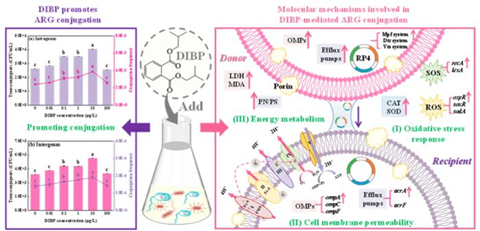
By shifting focus from straight-chain to branched-chain PAE isomers, this new study published in Environmental Chemistry and Ecotoxicology transcends phenomenological observation to establish a mechanistic framework for PAE-specific ARG conjugation.
Notably, the proposed “oxidative stress-membrane permeability-energy metabolism” coupling model elucidates how non-antibiotic contaminants like PAEs amplify ARG dissemination, providing a theoretical foundation for their ecological risk assessment.






No comments yet