
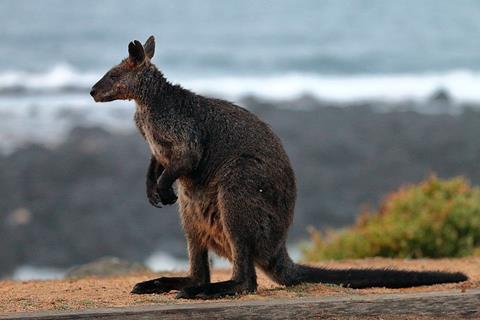
Marsupials are a group of mammals that encompass many of Australia’s most iconic animals, unique because of their geographically isolated evolution. Despite their household names, their microbiomes remain under-researched.
“Understanding marsupial gut microbiomes advances our knowledge of host-microbiome evolution, helps explain adaptations to challenging diets like eucalyptus, and supports conservation efforts for threatened species through improved health management,” says Kate Bowerman, a microbiologist at the University of Queensland (UQ) and co-author of the study.
This is what prompted UQ researchers to work towards deepening our understanding of the makeup of bacteria and viruses that live inside their guts.
READ MORE: Emerging human and canine leptospirosis in New South Wales shows separate transmission pathways
READ MORE: Koala stress linked to virus infection risk
In collaboration with scientists from Denmark and the US, the team collected and analysed faecal samples from 82 captive marsupials living in wildlife sanctuaries, and 16 wild marsupials in forested areas around Queensland.
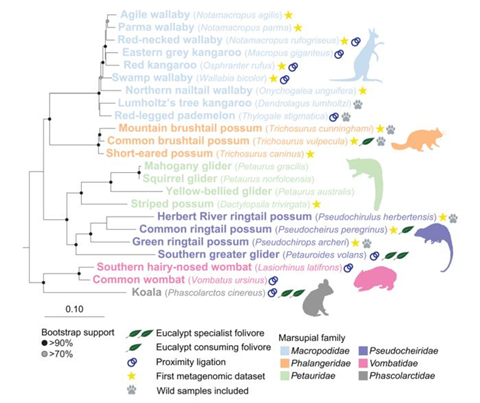
This research provided the first metagenomic data for 13 of the 23 marsupial species studied, including the red kangaroo and the common brushtail possum. They revealed that host family, animal location, and diet all contributed towards variance between different microbiomes.
Shared adaptation
One possible shared adaptation the researchers looked for was between animals that feed on eucalyptus, either exclusively (koalas and southern greater gliders) or generally (common and golden brushtail and common ringtail possums). Predictably, these two groups showed significant differences in the abundance of certain microbes.
However, even between the two specialist eucalypt feeders, koalas and greater gliders, each species showed distinct adaptation to this challenging diet with microbiomes that reflected the digestion of the different eucalypt type each prefers to eat.
More concerningly, researchers identified an increased prevalence of antimicrobial resistance genes in the microbiome of some captive marsupials compared to their wild counterparts. This is likely driven by human intervention via antibiotic treatments to infections at wildlife sanctuaries.
Wild v. captive
These comparative insights between wild and captive animals “will help veterinarians select more effective treatments and develop better antibiotic stewardship protocols for captive marsupial management,” says Bowerman.
She continues that work is still needed to further understand of what role these microbes play in the hosts’ ecosystems. The next steps will be to isolate and characterise the key species found in marsupial microbiomes in order to study their functional roles, for example, in how they contribute to eucalyptus digestion or host health.






.jpg)
No comments yet