
Every year, about a billion people worldwide contract influenza, leading to as many as 650,000 deaths. Outbreaks are often seasonal, and their pattern varies by climatic zone. In temperate regions, flu season is in the winter, while in the tropics, constant low-intensity activity is typically punctuated by two annual peaks—or a surge during the rainy season.

Aleksandra Stamper, Rachel Baker, and colleagues investigated whether specific humidity—the mass of water vapor per unit mass of air—could explain these differing patterns. Reduced specific humidity enhances viral viability and transmission in cold temperate winters, but less is known about transmission dynamics in the tropics.
The authors built a model of influenza epidemics using surveillance data at the national and subnational scale for 81 sites in North and South America, along with locally resolved climate data.
According to the model, the combined, non-linear effect of specific humidity and temperature can explain the timing of influenza outbreaks in both temperate and tropical climates.
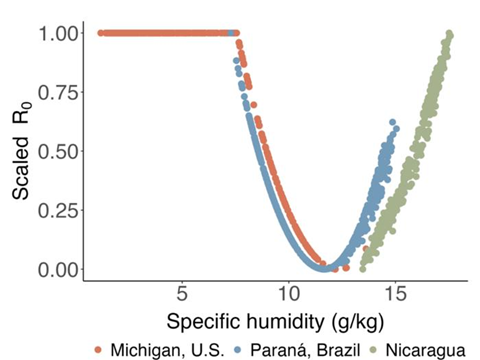
The model reveals a U-shaped relationship between specific humidity and transmission, with both high and low specific humidity associated with elevated transmission risk.
The model, published in PNAS Nexus, further predicts that as the climate warms, temperate areas may experience a decline in peak outbreak size as dry winters warm, while tropical areas may see increases in outbreak severity as humidity increases.






No comments yet