
Tiny underwater algae sway gently in the current. All of a sudden, a light shines on them and they form robotic-like arms that start to pick up small rocks and put them in floating baskets. Sounds like science-fiction, but researchers from Delft University of Technology (The Netherlands) have created a small soft robot arm covered with minuscule algae that can grasp and lift objects. And it’s powered by light. This exciting next step in biotechnology has just now been published in Nature Communications.
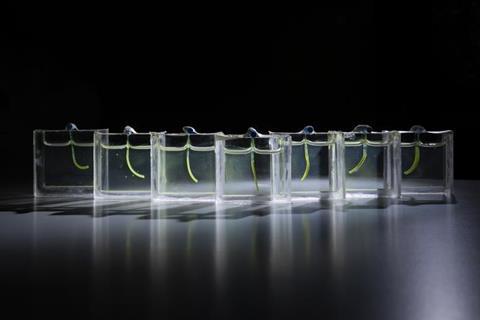
The tiny robot arm can perform large, reversible bending movements controlled by light. “Our proof-of-concept actuator is a green and soft strip made of two different hydrogel layers, with microalgae growing on its surface,” lead researcher Marie-Eve Aubin-Tam explains. “It is about 2 cm long and 1 mm thick. When exposed to changing light conditions, the strip can bend back and forth. The shape of the actuator can be easily changed to allow for different movement and function.”
Grasping and lifting
The robot’s movement can be used for simple tasks such as grasping and manipulating small objects, particularly in underwater environments where soft and gentle handling can be useful. As demonstrations, first author Fan Jiang and fellow researchers used the actuator to hook and lift a rubber ring and to grasp a small metal ball.
Beyond grasping, the robot can also reproduce movements found in nature. Its light-controlled bending could, for example, be incorporated into blinds or agricultural devices that change their shape or orientation in response to light. These demonstrations show how the basic bending motion could be developed into both soft robotic and biomimetic functions. But scientists are often driven by innate curiosity, Aubin-Tam admits: “We didn’t start with a specific application. Our goal has always been to bring the research of living materials to new levels. We wanted to explore what becomes possible when living cells are integrated into functional materials.”
How do they do it?
The microalgae drive the actuator through their metabolism, which depends on light. During illumination, the algae use light energy and CO2 to create their cellular “fuel” in form of sugars through photosynthesis, while they also use nitrogen to build cell components.
MICROBIOLOGY NEWS: Register with The Microbiologist for more free articles
These processes together increase the pH in the hydrogel. Jiang: “Since the two hydrogel layers respond differently to pH changes, they swell to different degrees, causing the strip to bend. When the light is switched off, the cellular fuel is “burned” releasing CO2, that shifts the pH back down. Within 10 seconds the actuator already starts bending in the opposite direction.”
Autonomous and environmentally responsive
According to Aubin-Tam, their new technology could contribute to soft robotic systems that are more autonomous and environmentally responsive in the longer term: “Microalgae are plantlike organisms that are largely self-sustaining. They use light as their energy source through photosynthesis, which gives the actuator potential for long-term operation with minimal external input. In theory, it wouldn’t require a lot of energy to run a system based on this technology. It is also just exciting to directly visualise the metabolic activity in microorganisms to be honest. To see synthetic materials actually translate the algae’s biological responses into mechanical motion.”





No comments yet