
Microbial electrobiotechnology pairs electrical circuits with living cells. Researchers are exploring how this combination could use renewable electricity to help microbes convert carbon dioxide into useful products or recover resources from waste streams. To work reliably, a reactor must meet the needs of both the microbes and the electrical system.
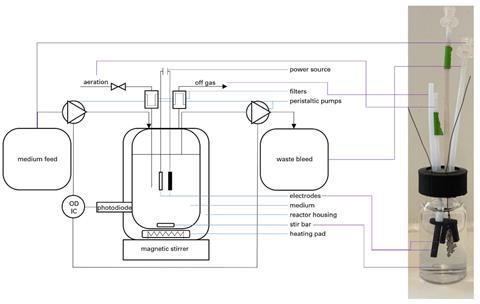
Cells need a steady supply of nutrients and gases, while the electrodes need controlled electrical conditions. The simple glass cells often used for early experiments can have high electrical resistance and uneven mixing, making it difficult to judge whether results will carry over to larger reactors.
A study published in Engineering in Life Sciences on 14 September 2026 by Dirk Holtmann’s team, Karlsruhe Institute of Technology, reports that a modified commercial mini-bioreactor supported two bioelectrochemical processes and yielded a bacterial variant that grew better than its parent under salt stress.
Adapting a mini-bioreactor for electrobiology
The researchers modified a commercial Pioreactor, which already included stirring, heating, pumps and an optical sensor for tracking cell density. In the first configuration, they placed two electrodes in a single chamber and used electricity to split water and generate hydrogen inside the vessel. The bacteria used that hydrogen for energy and carbon dioxide as a carbon source. In an initial test, optical density, a measure of how cloudy the culture becomes as cells accumulate, rose from 0.2 to about 9 by day six. The team then used the pumps to maintain a roughly constant cell density. Each addition of fresh medium also delivered sodium sulfate, so the salt concentration rose as the culture continued to grow.
After about 10 days, the researchers isolated a variant and compared it with its parent in microplates containing different salt concentrations. At 300 millimolar sodium sulfate, the adapted cells began growing sooner and finished with a higher optical density, although their maximum growth rate did not differ significantly from that of the parent in the microplate tests.
Neither strain grew appreciably at 400 or 500 millimolar. When tested at 300 millimolar in a separate 110-milliliter electrified reactor, the adapted strain began growing after about one day, compared with two days for its parent, and reached a final optical density of about 2.7.
Testing electron transfer to an electrode
In the second configuration, the researchers added a chamber and used three electrodes to test whether the bacteria could pass electrons to an anode. They added ferricyanide to shuttle electrons between the cells and the electrode. The inoculated reactor sustained a measurable current for several days, while cell density remained near its starting level for much of the test. The current eventually fell to the level of a control without bacteria.
MICROBIOLOGY NEWS: Register with The Microbiologist for more free articles
The study shows how a single benchtop platform can support experiments on electricity-driven growth, electron transfer and microbial adaptation. The salt-tolerance result carried over to a larger laboratory reactor, suggesting that small vessels could help identify promising strains for further testing. Measurements of mixing, gas transfer and electrical resistance would help establish how well the design can inform work at larger scales.


No comments yet