
D-lactate is a chiral organic acid used in food additives and as a monomer for stereocomplex polylactic acid (SC-PLA), a biodegradable plastic. Its optical purity is critical because stereochemistry controls PLA’s thermal and mechanical performance.
Lignocellulosic biomass contains glucose and xylose, but engineered microbes often consume these sugars sequentially because of carbon catabolite repression (CCR).
Single strains also produce succinate, acetate, ethanol, and formate, lowering yield and purity. Although some engineered E. coli strains use glucose or xylose alone, efficient co-utilization of mixed sugars remains difficult. Given these challenges, in-depth research is needed to develop engineered microbial consortia that co-utilize glucose and xylose and produce high-purity D-lactate from lignocellulosic feedstocks.
Splitting sugar metabolism between strains
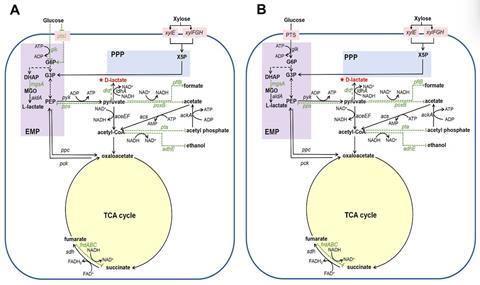
Researchers at the School of Life Science, Hubei University, Wuhan, China, published the study online on 3 February 2026 in BioDesign Research. They used CRISPR/Cas9 (clustered regularly interspaced short palindromic repeats/CRISPR-associated protein 9) genome editing to build two specialized E. coli strains: GL10 for glucose and XL12 for xylose. Both strains were designed to block byproduct pathways, while XL12 also relieved CCR and improved xylose uptake. When co-cultured, the strains divided metabolic labor, consumed glucose and xylose together, and produced D-lactate with 100% optical purity. DOI: 10.1016/j.bidere.2026.100072.
The study constructed XL12 by deleting glk, ptsI, pps, poxB, pflB, pta, frdABC, adhE, dld, and mgsA. GL10 lacked pps, poxB, pflB, pta, frdABC, adhE, dld, and mgsA. These edits blocked succinate, formate, ethanol, and acetate formation and redirected carbon toward D-lactate. Quantitative real-time PCR (qRT-PCR) showed downregulation of pgi, ppc, and ackA in XL12, supporting flux redirection. In single-sugar tests, XL12 produced 2.66 g/L D-lactate from xylose with a 53.2% conversion rate, while GL10 produced 3.15 g/L from glucose with a 63% conversion rate.
Higher D-lactate from mixed sugars
In mixed sugars, the 1:1 consortium fully consumed glucose and used 53.21% of xylose, reaching 3.76 g/L D-lactate after 36 hours—5.96-fold higher than wild-type (WT)—with 100% optical purity. Shaking speed from 50 to 250 rpm improved xylose use, though D-lactate yield plateaued at 250 rpm. An inoculation ratio of 1:5 further improved D-lactate production to 6.55-fold above WT. In corn straw hydrolysate, the consortium produced 5.15 g/L D-lactate, 41.87% more than WT. These results show that metabolic division of labor can overcome CCR and byproduct formation in mixed-sugar fermentation.
The authors said that assigning glucose and xylose metabolism to separate strains turned a single-cell bottleneck into a community-level advantage. By blocking competing byproduct pathways and relieving carbon catabolite repression, the consortium used mixed sugars more completely while keeping D-lactate optically pure. They added that the same strategy worked in corn straw hydrolysate, producing more D-lactate than the wild-type strain. According to the authors, this division-of-labor approach offers a scalable foundation for converting non-food lignocellulosic sugars into high-value D-lactate for bioplastics.
Towards bioplastic production from biomass
The consortium could support industrial production of D-lactate for SC-PLA, a recyclable bioplastic used in food packaging, fibers, nonwovens, and films. Because it uses glucose and xylose from corn straw hydrolysate, the process can rely on non-food biomass and reduce competition with food supplies. High optical purity is essential for PLA’s heat resistance and mechanical strength, and the 100% purity reported here addresses a major bottleneck.
MICROBIOLOGY NEWS: Register with The Microbiologist for more free articles
Future work should optimize oxygen levels, pH control, inoculation ratios, and scale-up fermentation to manage acid stress and improve productivity. If these challenges are met, engineered E. coli consortia may help replace petroleum-based plastics such as polyethylene (PE), polypropylene (PP), and polystyrene (PS) with bio-based alternatives.


No comments yet