
Waterborne pathogens remain a leading cause of infectious disease globally, responsible for 24% of all deaths and over 10 million fatalities each year.
Despite decades of progress in water treatment, conventional approaches have struggled to keep pace with the evolving threat—pathogens are becoming more resistant, more mobile, and harder to predict in the face of climate change, urbanization, and chemical pollution.
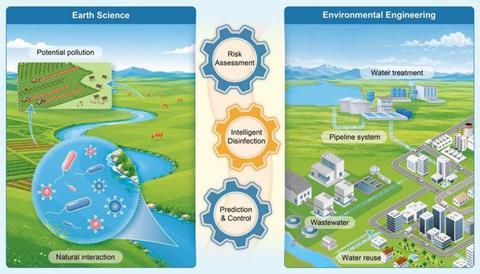
In a new perspective published in Water & Ecology, a China-UK research team led by Zheng-Yang Huo from Renmin University of China proposes a multidisciplinary research framework that integrates earth science and environmental engineering to mitigate the escalating risks of waterborne pathogens.
“The main issue is that we have been fighting this battle from two separate fronts,” says Huo. “Earth scientists understand how pathogens evolve and spread in natural environments, while engineers develop technologies to kill them in treatment plants. But neither perspective alone can solve the full problem.”
Critical gaps
The researchers identified critical gaps in current research. “Earth science provides powerful tools to characterize geochemical processes and pathogen transmission networks across watersheds, yet lacks effective microbial control technologies,” explains Huo. “Environmental engineering delivers efficient disinfection methods for municipal facilities, but fails to account for coordinated microbial responses to environmental perturbations, leaving emerging risks unpredicted.”
MICROBIOLOGY NEWS: Register with The Microbiologist for more free articles
To bridge this divide, the authors proposed a unified research framework spanning the entire pathogen life cycle. From the earth science perspective, the framework emphasizes real-time detection, numerical simulation, and multi-omics approaches, including metagenome-assembled genomes and environmental DNA metabarcoding, to track pathogens, harmful genes, and virulence factors across air, water, and solid media.
From the engineering perspective, it prioritizes cost-effective, reliable, and safe disinfection technologies tailored to diverse scenarios, from decentralized rural systems to centralized urban treatment plants, while strictly controlling secondary risks such as disinfection by-products and viable-but-non-culturable states.
“The key is vertical integration,” says Huo. “Geochemical insights inform where and how pathogens evolve, while engineering solutions determine how to interrupt that evolution before it reaches human populations.”
Why it matters
The authors highlighted how integrating epidemic information, environmental parameters, and local health data can enable accurate, location-specific risk assessment models. They stated that in treatment facilities, understanding ecological processes that drive pathogenicity changes can improve disinfection design, while in natural environments, identifying pathogen transmission hotspots allows targeted deployment of in situ control methods.
“These cases show that cross-disciplinary intelligence can reveal hidden mechanisms and provide actionable strategies,” says Huo. “It redefines pathogen control from reactive treatment to predictive, full-chain governance.”
MICROBIOLOGY ON TAP: Get full access to all The Microbiologist articles from just £2.17 a month
Nonetheless, the authors acknowledged implementation challenges, including data integration complexity, high technical costs, and the need for standardized monitoring networks. “Phased implementation starting with priority watersheds and high-risk facilities, coupled with expanded interdisciplinary collaboration, offers the most realistic pathway forward,” says Huo.






No comments yet