
A new hypothesis reveals how different receptor-binding proteins may make distinct contributions when a bacteriophage recognizes a bacterial cell.
The stochastic-cooperative hypothesis does not assume that every RBP has an equivalent function and instead proposes that some may help a phage remain near the cell surface while others establish the stable receptor interaction needed for infection to proceed.
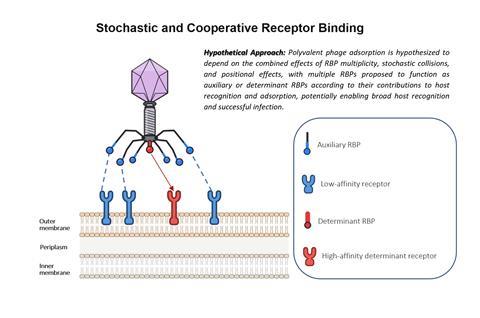
The hypothesis proposed by Dr. Song Zhang and Prof. Juhee Ahn at the Innovation Center of Yangtze River Delta, Zhejiang University in China and Kangwon National University in the Republic of Korea does not assume that every RBP has an equivalent function and instead proposes that some may help a phage remain near the cell surface while others establish the stable receptor interaction needed for infection to proceed.
The hypothesis is introduced in a perspective, ‘Rethinking host range in polyvalent bacteriophages through a stochastic-cooperative hypothesis of receptor recognition’, which has been accepted for the Journal of Applied Microbiology, an Applied Microbiology International publication.
“This Perspective examines a continuing question in phage biology concerning how broad host recognition should be interpreted when a phage contains several RBPs or can interact with multiple bacterial surface receptors,” said corresponding author Prof. Ahn.
“Current evidence from phage adsorption studies was reassessed to develop a testable explanation for how different RBPs may contribute to host recognition.”
The work was developed through research at Innovation Center of Yangtze River Delta-Zhejiang University in China.
Antibacterial agents
“Bacteriophages are being investigated as highly specific antibacterial agents, including for treatment and biocontrol. A practical difficulty is deciding which bacteria a phage can truly infect,” said Prof. Ahn.
“A plaque on a bacterial lawn is the final result of several steps. The phage must first encounter and attach to the cell, deliver its genome and overcome bacterial defense systems before producing new phage particles. This means that host range cannot always be understood from receptor recognition alone.
“The Perspective examines whether phages with multiple RBPs may divide the early stages of bacterial recognition among functionally different binding components and considers how this possibility can be tested experimentally.”
Mechanistic models
The analysis examined structural, genetic and single-particle studies of phage adsorption and compared different mechanistic models for broad host recognition. These include separate RBPs acting independently on different hosts, enzymatic removal of a surface barrier before access to another receptor and a single RBP recognizing related receptors in different bacteria. This comparison led to the stochastic-cooperative hypothesis.
The model separates two possible functional contributions. An auxiliary RBP may increase the chance that a phage contacts or remains near the bacterial surface. A determinant RBP may then establish the stable interaction needed for genome delivery. Direct binding by the determinant RBP is also possible, so the auxiliary interaction is not proposed as an obligatory first step.
The important point is that this is a testable hypothesis and does not imply that all polyvalent phages use the same mechanism. The model predicts different experimental effects when auxiliary or determinant interactions are disrupted, which allows it to be distinguished from independent or strictly sequential receptor-recognition mechanisms.
Structure and reality
“One striking point was the gap between knowing the structure of a phage adsorption apparatus and knowing what actually happens over time when a single phage particle meets a bacterial cell. Detailed structures can identify receptor-binding components and conformational changes, but a static structure cannot show which receptor contact occurs first or how long each interaction lasts,” said Prof. Ahn.
“Another important observation was that broad host range does not necessarily indicate the involvement of several RBPs. A single RBP can sometimes recognize related receptor structures in different bacterial hosts. This makes it important to separate the observed host-range phenotype from the molecular mechanism that produces it.”
A more precise description of phage adsorption could improve the way phages are selected and eventually engineered for antibacterial use. If different RBPs make different contributions, host recognition may depend not only on receptor identity but also on receptor abundance, accessibility and spatial distribution on the bacterial surface.
Host compatibility
The work also emphasizes that successful attachment is only one part of host compatibility. A bacterium may permit phage adsorption but block genome replication through intracellular defense systems. Therefore, practical phage selection requires separate consideration of adsorption and post-entry compatibility.
The next step is direct experimental testing. Individual RBPs and their bacterial receptors should be altered while early surface contact, stable attachment, genome entry and productive infection are measured separately. Single-particle microscopy could measure how frequently phages contact cells and how long individual contacts last.
Surface plasmon resonance or biolayer interferometry could measure receptor-binding kinetics. Receptor deletion and complementation experiments could test how receptor abundance changes adsorption and infection.
MICROBIOLOGY NEWS: Register with The Microbiologist for more free articles
“These experiments could determine whether different RBPs act independently, sequentially or cooperatively. The hypothesis is intended to be experimentally evaluated. Further experimental evaluation will help determine how auxiliary and determinant RBPs contribute to phage adsorption and define the conditions under which their cooperative interactions influence host recognition,” Prof. Ahn said.
The Perspective was developed by Dr. Song Zhang and Prof. Juhee Ahn. Song Zhang was closely involved in analyzing the scientific evidence and preparing the manuscript and figures. Juhee Ahn initiated and led the study and guided the development of the stochastic-cooperative hypothesis and the interpretation of current evidence. The work was funded by the Innovation Center of Yangtze River Delta – Zhejiang University, China, under grant RCBX-202504140019.New hypothesis drills down into the contributions of phage receptor-binding proteins in recognising a bacterial cell
Topics
- Applied Microbiology International
- Asia & Oceania
- Bacteria
- Bacteriophages
- Community
- host recognition
- Innovation Center of Yangtze River Delta, Zhejiang University
- Juhee Ahn
- Kangwon National University
- One Health
- Proteomics & Enzymology
- receptor-binding proteins
- Research News
- Song Zhang
- stochastic-cooperative hypothesis




No comments yet