
For years, beneficial Bacillus bacteria have been used to promote plant growth and protect crops, yet most studies treat these microbes as functionally interchangeable. The assumption has been that closely related strains deliver roughly the same benefits.
But whether plants can actually tell these beneficial partners apart — and whether the amount of bacteria matters — has remained largely unexplored. Based on these challenges, there is a need for in-depth research into how plants discriminate among closely related mutualistic microbes and integrate dose-dependent signals.
Now, an international team led by researchers at the Universidad de Málaga and the Spanish National Research Council (Consejo Superior de Investigaciones Científicas, CSIC) reports that melon plants perceive and respond differently to two phylogenetically similar Bacillus strains.
Published (DOI: 10.1093/hr/uhag053) on February 23, 2026, in Horticulture Research, the study combined transcriptomic, metabolomic, and physiological analyses to track plant responses from seed to adulthood. The findings show that Bacillus subtilis NCIB3610 and B. velezensis FZB42 — despite colonizing roots with similar efficiency — trigger fundamentally different host programs.
Differing effects
The researchers found that B. subtilis promoted root elongation, starch storage in chloroplasts, and drought tolerance regardless of how much bacteria was applied.
In contrast, B. velezensis produced a clear dose-dependent effect: a low dose (10⁷ colony-forming units per mL) allowed normal root growth, but a high dose (10⁸ CFU/mL) temporarily suppressed it. This suppression, the team discovered, depends on the combined action of surfactin — produced by both strains — and bacillomycin D, an iturin-type lipopeptide unique to B. velezensis.
MICROBIOLOGY NEWS: Register with The Microbiologist for more free articles
At the molecular level, high-dose B. velezensis triggered widespread transcriptional activation, including upregulation of retrotransposon-related genes and downregulation of allene oxide synthase (AOS), a key enzyme in jasmonic acid (JA) biosynthesis.
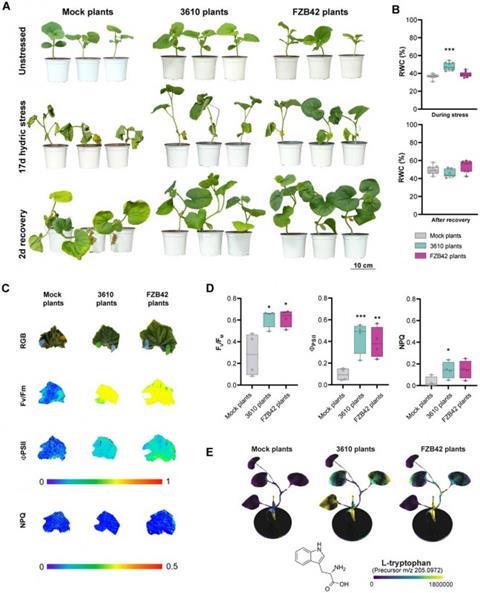
Although the early growth trajectories diverged, both priming strategies converged on enhanced aboveground stress resilience — but through different routes. B. subtilis-primed plants accumulated caffeic acid and rosmarinic acid to fend off the fungal pathogen Botrytis cinerea, while B. velezensis-primed plants modulated the JA pathway to curb reproduction of JA-sensitive Tetranychus urticae mites.
Different signals
“What surprised us most was that even though these two Bacillus strains are closely related and colonize the plant in similar ways, the melon plant reads them as completely different signals,” the authors said. “The plant doesn’t just sense that a beneficial bacterium is present — it actually distinguishes who is there and how many of them there are, and then decides how to respond. It’s like the plant has a sophisticated surveillance system that allows it to tailor its developmental and defense programs to the specific microbial partner it encounters.”
MICROBIOLOGY ON TAP: Get full access to all The Microbiologist articles from just £2.17 a month
The findings challenge the long-standing assumption that beneficial microbes are functionally redundant and open the door to precision seed treatments in horticulture. By identifying the specific lipopeptide fingerprints, sentinel metabolites, and defense transcripts associated with each strain’s effects, the study provides a mechanistic framework for selecting or engineering microbial strains with desired traits.
For farmers, this could mean moving beyond one-size-fits-all bio-inoculants toward strain-specific seed coatings tailored to particular crops, soils, or expected stress pressures. The work also raises intriguing questions about whether plants can “remember” early microbial encounters — and whether such memory could be harnessed to build more resilient cropping systems from the very start of a plant’s life.







No comments yet