
A research team has found that core bacteria and rare bacteria play roles in shaping soil microbial communities across China’s Loess Plateau. Core bacteria were most strongly associated with the complexity of bacterial networks, while rare bacteria were particularly important for their stability.

The groups also responded differently to environmental conditions: climate was the main influence on core and abundant bacteria, whereas soil properties mattered more for rare bacteria. These findings could help guide soil biodiversity monitoring and ecological restoration by identifying microbial groups associated with community organization and resilience.
Soil bacteria support nutrient cycling, organic matter decomposition, and other processes. Researchers distinguish between abundant, rare, and widely distributed core microorganisms to understand how these communities respond to environmental change. Studies have revealed different distribution patterns among these groups, but their assembly mechanisms and contributions to community complexity and stability remain uncertain. China’s Loess Plateau, where rainfall declines from southeast to northwest and vegetation spans forests, shrublands, and grasslands, provides an opportunity to investigate how bacterial communities form across contrasting environments.
A study (DOI: 10.48130/aee-0026-0020) published in Agricultural Ecology and Environment on 28 August 2026 by Xing Wang’s & Xinhui Han’s team, Northwest A&F University, reports that core bacterial assembly was dominated by deterministic processes, while stochastic processes predominated among abundant and rare bacteria, with distinct associations linking these groups to network complexity and stability.
Surface soil samples
The researchers collected 117 surface soil samples across four regions of the Loess Plateau in July 2016, covering ecosystems from primary forests to planted grasslands. Each sample combined ten soil cores from the upper ten centimeters.
They measured vegetation characteristics and soil properties, including moisture, pH, texture, and nutrient concentrations, alongside climatic information. Sequencing the bacterial 16S ribosomal RNA gene enabled the team to identify bacterial sequence variants and classify them by abundance.
Rare variants had relative abundances below 0.001%, while abundant variants exceeded 0.1%. Core variants, defined independently, occurred in at least 80% of samples and could overlap with abundance categories.
Evolutionary relationships
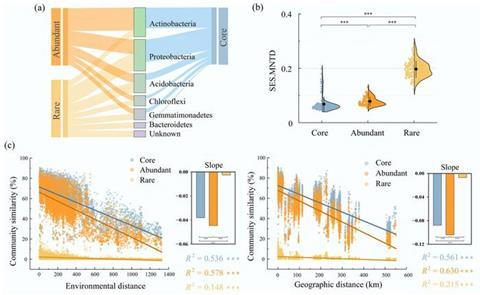
The team then compared evolutionary relationships, used null models to assess community assembly, and constructed networks of bacterial co-occurrence. Path modeling and boosted regression trees examined links between environmental conditions, bacterial groups, and network properties. Rare bacteria accounted for 50.02% of sequence variants but only 4.24% of total abundance. Abundant bacteria represented fewer than 1% of variants yet contributed 31.48% of abundance. Core bacteria comprised just 0.34% of variants and accounted for 21.19% of average abundance.
Core and abundant groups were more closely related evolutionarily than rare groups. Assembly analyses indicated stronger environmental selection among core bacteria, whereas chance processes predominated in abundant and rare groups. The network contained 9,990 bacterial variants connected by 194,063 associations. Core and abundant bacteria had more connections and occupied more central positions than rare bacteria.
MICROBIOLOGY NEWS: Register with The Microbiologist for more free articles
Modeling identified the strongest relationship between core bacteria and network complexity, while rare bacteria were particularly associated with stability. Greater network complexity was positively associated with estimated stability. Climate primarily explained variation in core and abundant groups; soil characteristics were more influential for rare groups. Analyses supported these relationships after accounting for spatial environmental patterns, ecosystem type, and vegetation type.
Overlooked microbial groups
The study highlights why counting the most abundant bacteria alone may overlook microbial groups associated with soil community stability. It provides evidence that widespread core bacteria and diverse rare bacteria contribute complementary information about microbial network organization.
Because the findings rely on co-occurrence patterns from surface soils sampled during one growing season, they do not establish direct bacterial interactions or long-term resilience. Sampling deeper soils and tracking seasonal changes could test whether these relationships persist and strengthen their usefulness for ecosystem assessment.






No comments yet