
Scientists at the University of Maryland have created Smart Underwear, the first wearable device designed to measure human flatulence. By tracking hydrogen in flatus, the device helps scientists revisit long-standing assumptions about how often people actually fart. It also opens a new window into measuring gut microbial metabolism in everyday life.

For decades, physicians have struggled to help patients with intestinal gas complaints. As gastroenterologist Michael Levitt, known in the field as the “King of Farts,” wrote in 2000: “It is virtually impossible for the physician to objectively document the existence of excessive gas using currently available tests.”
To address this challenge, researchers led by Brantley Hall, an assistant professor in the Department of Cell Biology and Molecular Genetics at UMD, developed Smart Underwear—a tiny wearable device that snaps discreetly onto any underwear and uses electrochemical sensors to track intestinal gas production around the clock.
In a study published in Biosensors and Bioelectronics: X, a team led by UMD assistant research scientist Santiago Botasini found that healthy adults produced flatus an average of 32 times per day, roughly double the 14 (±6) daily events often reported in medical literature. Individual variation was extreme, with daily totals ranging from as few as four flatus events to as many as 59.
Lower estimates
So why were older estimates so much lower? Previous research relied on invasive techniques in small studies or self-reporting, which suffers from missed events, imperfect memory and the impossibility of logging gas while asleep. Visceral sensitivity also varies widely: two people can produce similar amounts of flatus yet experience it very differently.
“Objective measurement gives us an opportunity to increase scientific rigor in an area that’s been difficult to study,” said Hall, the study’s senior author.

In most people, flatus consists mainly of hydrogen, carbon dioxide and nitrogen. Some individuals’ flatus also contain methane. Because hydrogen is produced exclusively by gut microbes, continuously tracking hydrogen in flatus provides a direct readout of when and how actively the gut microbiome is fermenting dietary substrates.
“Think of it like a continuous glucose monitor, but for intestinal gas,” Hall said, noting the device successfully detected increased hydrogen production following consumption of inulin, a prebiotic fiber, with 94.7% sensitivity.
Human Flatus Atlas
Normal ranges exist for blood glucose, cholesterol and countless other physiological measures. But for flatulence, no such baseline exists.
“We don’t actually know what normal flatus production looks like,” Hall said. “Without that baseline, it’s hard to know when someone’s gas production is truly excessive.”
To fill this gap, the Hall Lab is launching the Human Flatus Atlas. The project will use Smart Underwear to objectively measure flatulence patterns, day and night, across hundreds of participants and correlate those patterns with diet and microbiome composition. Devices are shipped directly to participants, allowing anyone in the United States to join remotely. The results of the Human Flatus Atlas will help to establish the normal range of flatus for people in the United States over the age of 18.
Zen digesters and hydrogen hyperproducers
To capture the full range of variation, Hall’s team is recruiting participants across several categories that emerged from their early studies:
- Zen Digesters: People who consume high-fiber diets (25-38 grams of fiber daily) yet experience minimal flatus. These individuals may hold clues to understanding microbiome adaptation to high-fiber diets.
- Hydrogen Hyperproducers: Simply put, people who fart a lot. Studying these individuals could reveal what drives excessive gas production.
- Normal People: People who fall between the two categories above.
To investigate the microbial drivers of gas production at both extremes, the team will collect stool samples from Zen Digesters and Hydrogen Hyperproducers for microbiome analysis.
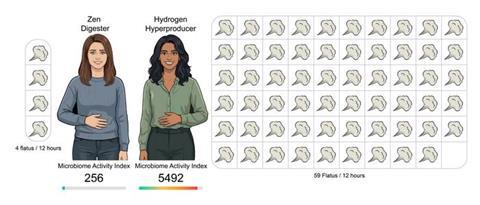
“We’ve learned a tremendous amount about which microbes live in the gut, but less about what they’re actually doing at any given moment,” Hall said. “The Human Flatus Atlas will establish objective baselines for gut microbial fermentation, which is essential groundwork for evaluating how dietary, probiotic or prebiotic interventions change microbiome activity.”
Find out more
To enroll in the Human Flatus Atlas, please visit flatus.info for more information. Enrollment is open to adults ages 18 years or older in the U.S. Participants will receive a Smart Underwear device to wear day and night for the study period. Enrollment is limited.
READ MORE: The fart factor: researchers get wind of hydrogen’s role in the gut
READ MORE: Termite hydrogen: a wildcard in the fight against climate change
Patent applications related to this technology have been filed, with Brantley Hall and Santiago Botasini as inventors. Both are co-founders of Ventoscity LLC, which has licensed the technology.
This research was supported by the University of Maryland, the Maryland Innovation Initiative Phase I and the UM Ventures Medical Device Development Fund.






No comments yet