
Wastewater is no longer just a stream to clean and discharge. It can also contain recoverable water, fertilizer nutrients, and usable energy—if treatment systems can recover them without increasing external power demand.
A new study reports a self-powered platform that links electrically assisted forward osmosis (eFO) with a microbial desalination cell (MDC), allowing electricity produced by wastewater-fed microbes to drive nutrient and water recovery.
In tests with synthetic livestock wastewater, the closed-loop system used internally generated bioelectricity to drive magnesium ions migration, promote struvite formation, increase water transport, and improve desalination. The work offers a path toward compact wastewater refineries that recover resources while reducing reliance on external electricity.
Towards resource recovery
Conventional wastewater treatment has largely focused on pollutant removal, but growing water scarcity, energy constraints, and fertilizer demand are pushing the field toward resource recovery.
Forward osmosis (FO) can draw water across a membrane with low hydraulic pressure, while bioelectrochemical systems such as microbial desalination cells can convert organic matter into electricity and help move salts. Yet these tools are often run separately: FO systems still face concentration polarization and reverse salt flux, and electrically assisted FO usually needs continuous external power supply.
Based on these challenges, in-depth research is needed on integrated treatment designs that can recover water, nutrients, and energy in one stable, low-energy process.
Innovative approach
Researchers from Temple University and New Jersey Institute of Technology published (DOI: 10.1016/j.ese.2026.100730) the study in Environmental Science and Ecotechnology in 2026; the manuscript was accepted on July 4, 2026. The article presents an integrated electrically assisted forward osmosis (eFO)–microbial desalination cell (MDC) system that uses bioelectricity generated during organic matter oxidation to drive ion migration, recover struvite fertilizer, improve water flux, and enhance desalination from synthetic livestock wastewater.
The system turns one treatment challenge into the power source for another. In the eFO module, an osmotic gradient pulls water from the wastewater side toward a magnesium sulfate draw solution. When a mild electric field is applied, magnesium ions migrate back toward the wastewater side, where they react with ammonium and phosphate and precipitate as struvite, magnesium ammonium phosphate hexahydrate, a slow-release fertilizer.
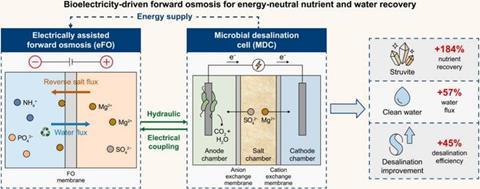
In the MDC, electroactive microorganisms oxidize organic matter, generate electrons, and support desalination. The researchers harvested this microbial electricity, stored it in a 400-farad supercapacitor, regulated the voltage, and fed it back to the eFO unit. At bench scale, the MDC generated more than 7.0 milliwatts, while the eFO module consumed less than 1.0 milliwatt.
Compared with the control, water flux rose by 57%, struvite recovery increased from 0.25 to 0.71 grams at 1.8 volts, and total desalination efficiency improved by 45%. At higher voltage, struvite recovery reached 1.03 grams at 3.8 volts. To guide operation, the team also developed a hybrid model that combined mechanistic transport equations with a support vector machine (SVM), enabling prediction of struvite recovery, chemical oxygen demand (COD), conductivity, and power output across different operating conditions.
Redesigning wastewater treatment
The authors said the study shows how wastewater treatment can be redesigned as a connected resource-recovery loop rather than a set of separate unit operations. They said the important step lay not only in coupling a membrane process with a bioelectrochemical process, but also in allowing the electricity generated by microorganisms to directly control ion movement and fertilizer formation. In their view, this internal feedback makes the approach more practical for nutrient-rich streams such as livestock wastewater, where water recovery, salinity control, and phosphorus recovery can all create value.
MICROBIOLOGY NEWS: Register with The Microbiologist for more free articles
The results point to applications in decentralized wastewater treatment, agricultural waste management, and future resource-recovery facilities. The paper also makes clear that scale-up will require engineering work: the MDC produced enough power for the eFO module, but hydraulic retention times, module sizing, struvite harvesting, membrane scaling, and electrode durability still need optimization. A techno-economic assessment (TEA) estimated a bench-scale net treatment cost of 10.2 United States dollars per cubic meter, falling to 3.3 United States dollars per cubic meter in an engineering scale-up scenario.






No comments yet