
Cadmium (Cd) pollution, driven by industrial emissions and agricultural runoff, has become a major concern worldwide due to its toxicity, persistence, and ability to enter the food chain. Exposure to even trace amounts of Cd can cause severe health issues such as kidney failure, osteoporosis, and cancer.

While remediation efforts continue, many remain costly and ineffective in the long term. Some bacteria offer a natural alternative by binding metals to their surfaces or converting them into less harmful forms. However, little is known about how bacteria remodel their structures to survive heavy metal stress. Due to these challenges, there is an urgent need to investigate the cellular mechanisms that underpin microbial Cd tolerance.
In a new study (DOI: 10.1016/j.pedsph.2025.06.015) published in Pedosphere in September 2025, scientists from Zhejiang University and international collaborators revealed a powerful bacterial defense strategy against Cd toxicity. The team found that Stenotrophomonas sp. H225 sheds Cd-laden cell wall fragments and rebuilds new protective layers through a process involving the mtgA gene. Using advanced imaging and genetic tools, the researchers mapped this exfoliation-regeneration cycle, identifying a key mechanism for microbial survival in toxic environments.
Exfoliating portions of cell wall
Through a combination of microscopy, spectroscopy, and transcriptomic analysis, the researchers observed that under increasing Cd concentrations, Stenotrophomonas sp. H225 progressively exfoliates portions of its peptidoglycan (PG)-rich cell wall. Transmission electron microscopy and elemental mapping confirmed that these exfoliated fragments were rich in Cd, functioning as extracellular detoxifying barriers. Concurrently, spectroscopic analysis showed a marked reduction in structural amide content, while ELISA detected a steady increase in exfoliated PG—from 148 ng/mL in control to 240 ng/mL at 200 mg/L Cd.
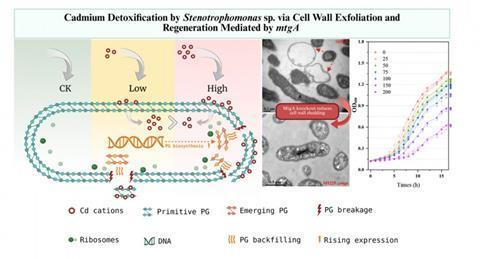
At the same time, the bacterium activates genes linked to PG biosynthesis. Notably, genes like murB, uppS, and mrcA exhibited significant upregulation under Cd stress, indicating an active rebuilding of the cell wall. Among them, mtgA, which encodes a transglycosylase, was particularly important. When mtgA was knocked out, the modified strain showed reduced cell wall damage and better growth under Cd stress, outperforming both the wild-type and pbpC-deficient strains. This suggests that mtgA plays a central role in balancing exfoliation with regeneration, enabling structural recovery without excessive damage.
Bacterial defense system
“Our research uncovers a fascinating and dynamic bacterial defense system,” said Dr. Jianming Xu, the study’s lead author. “By shedding Cd-saturated cell walls and immediately triggering regeneration, Stenotrophomonas sp. H225 demonstrates a sophisticated form of self-protection. The identification of mtgA as a key genetic switch opens new possibilities for designing microbial strains that can survive and even thrive in Cd-contaminated environments.”
This study provides a compelling model of how bacteria can dynamically defend themselves against heavy metals through coordinated exfoliation and renewal. Targeting genes like mtgA offers a novel bioengineering route to enhance microbial resilience in polluted soils.
Such genetically optimized strains could be deployed for bioremediation in industrial waste sites, agricultural land, or mine-impacted regions. Beyond Cd, this mechanism may also apply to other metals, broadening its environmental relevance. By harnessing nature’s detoxifiers, we may be one step closer to sustainable, low-cost strategies for cleaning up contaminated ecosystems.





No comments yet