
More than 99% of bacterial species in natural environments remain uncultured, a phenomenon often referred to as “microbial dark matter”. Traditional solid-culture (TSC) methods routinely recover only fast-growing, copiotrophic “weed” species, which rapidly outcompete slow-growing and rare lineages—leaving the vast majority of microbial diversity inaccessible for study.

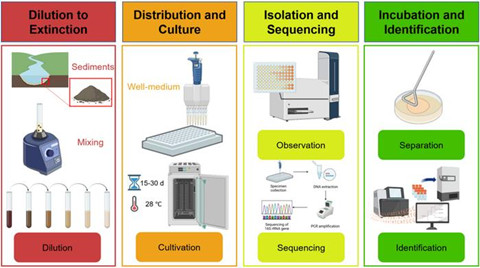
In a research article published in Journal of Systematics and Evolution (JSE), an international team led by Prof. Wen-Jun Li (Sun Yat-sen University), Dr. Zi-Wen Yang (South China Normal University), and Dr. Osama Abdalla Abdelshafy Mohamad (Arish University, Egypt) developed a simple liquid-medium-dilution (LMD) method that physically isolates single cells in liquid microcultures using limiting dilution, without requiring specialized equipment.
Comparative analysis of 787 bacterial strains isolated from estuarine sediments of the Qiantang River, China, showed that LMD recovered 72 putative novel species (19.2%), a significantly higher proportion than the TSC method (47 strains, 11.4%; P < 0.01). Importantly, LMD uniquely accessed rare and slow-growing lineages, including members of the phylum Verrucomicrobiota and, most notably, two novel species—Poseidonivirga lenticrescens gen. nov., sp. nov. and Poseidonivirga cretacea sp. nov.—which show low 16S rRNA gene sequence similarities (90.37% and 90.51%) to known taxa and represent a novel order, Poseidonivirgales ord. nov., within the class Alphaproteobacteria.
The “fair start” principle
The success of the LMD method stems from a simple yet powerful principle: by performing high dilutions and distributing single cells into individual wells before exponential growth begins, the method grants each founding cell a private, resource-replete niche. This “fair start” is crucial for slow growers, providing them with uninterrupted time to adapt to laboratory conditions without facing immediate competitive pressure from fast-growing taxa.
Marked differences in taxonomic profiles: TSC was heavily biased toward Bacillota (e.g., Bacillus), a common artifact of solid-plate cultivation, while LMD enriched for diverse Pseudomonadota, a pattern more congruent with the in situ community structure.
Phylogenomic analysis confirmed that strains SYSU 1G8T and SYSU 3D8T form an independent branch sister to orders including Sphingomonadales and Emcibacterales. Relative Evolutionary Divergence (RED) analysis provided rank-normalized support (RED=0.46), aligning perfectly with established orders within the same tree.
Metagenomic read mapping revealed extremely low in situ abundance for the novel strains (0.03% and 0.13% of total clean reads), explaining why they were not captured by metagenome-assembled genome (MAG) approaches and highlighting a critical limitation of sequencing-only methods for detecting ultra-rare taxa.
A complementary tool for mcrobial discovery
While LMD may not capture bacteria requiring obligate syntrophic interactions, it significantly democratizes access to microbial dark matter. By replacing the specialized equipment required for microfluidic, diffusion chamber, or cell-sorting methods with standard media and simple OD600 monitoring, LMD provides a conceptual workflow optimization for average laboratories. The authors recommend conducting a preliminary gradient test for novel sample types to achieve the optimal 30–35% positive-well rate required by the Poisson distribution.
The LMD method serves as a powerful first-pass strategy to rapidly expand culture collections and identify lineages of interest, which can subsequently be subjected to more targeted, equipment-intensive methods for deeper study.
MICROBIOLOGY NEWS: Register with The Microbiologist for more free articles
Beyond environmental microbiology, the challenges of competitive exclusion are pervasive across plant and animal microbiome research, where fast-growing “weed” species frequently hinder the isolation of critical host-associated symbionts. The LMD method thus holds significant application potential for biologists seeking to isolate elusive microbes from diverse systems, contributing to a more comprehensive understanding of global biodiversity and evolution.
Topics
- Alphaproteobacteria
- Arish University
- Asia & Oceania
- Bacteria
- Ecology & Evolution
- Healthy Land
- Innovation News
- liquid-medium-dilution
- Microbiological Methods
- Middle East & Africa
- Osama Abdalla Abdelshafy Mohamad
- Poseidonivirga cretacea
- Poseidonivirga lenticrescens
- Poseidonivirgales
- South China Normal University
- Sun Yat-sen University
- Taxonomy, Phylogeny, Function
- Verrucomicrobiota
- Wen-Jun Li
- Zi-Wen Yang






No comments yet