
The Middle East and North Africa (MENA) region stands at the intersection of climate vulnerability and escalating disease risk. Ticks and the pathogens they transmit—collectively known as tick-borne diseases (TBDs)—pose increasingly severe threats to human health, animal productivity, and economic stability across the region.
Rising temperatures and shifting environmental conditions are expanding tick habitats and lengthening transmission seasons, intensifying what was already a significant public health challenge.
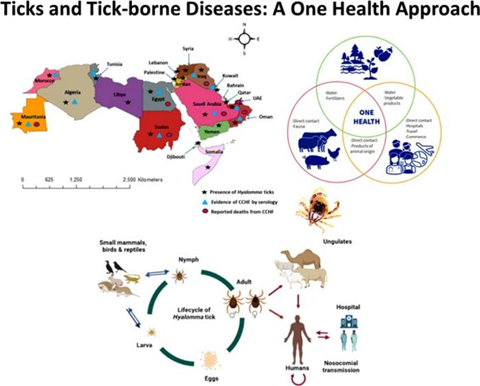
A new study published in Science in One Health examines the multifaceted dimensions of tick-borne disease management in the MENA region through the lens of the One Health approach. The research synthesizes insights from a symposium hosted by the United Arab Emirates University that brought together experts in epidemiology, veterinary science, entomology, environmental science, and policy to assess current threats and identify pathways forward.
Where knowledge meets critical gaps
The research documents several critical findings that underscore the urgency of coordinated action. Tick-borne diseases in the region include some of the most consequential human pathogens—particularly Crimean-Congo hemorrhagic fever (CCHF), which carries a mortality rate exceeding 30%. The MENA region has reported significant CCHF cases, with Iraq alone documenting over 100 cases annually in recent years, highlighting the region’s disproportionate burden.
However, the study reveals substantial research gaps that hamper effective control strategies. These include limited understanding of acaricide (tick pesticide) resistance patterns, insufficient development of vaccines for many TBDs, incomplete epidemiological surveillance systems, and fragmented pathogen detection capabilities across national borders. Additionally, the economic impact of tick infestations on livestock productivity remains poorly quantified, obscuring the true cost of inaction.
The One Health imperative
The research emphasizes that addressing TBDs in the MENA region requires moving beyond traditional siloed approaches. The One Health framework—which integrates human medicine, veterinary medicine, and environmental science—emerges as essential for several reasons:
Interconnected Challenges: Ticks thrive in multiple ecological niches and affect both human and animal populations. Climate change amplifies these interconnections by altering habitats, migration patterns, and the geographic distribution of tick species and their pathogens. No single discipline possesses the full toolkit needed to address these complex dynamics.
Surveillance and Detection: Effective disease control depends on early detection and rapid response. A coordinated One Health surveillance system—combining human case reporting, animal health monitoring, and environmental tick surveillance—can identify emerging threats more quickly than fragmented national systems.
Integrated Management: The research advocates for strategies that simultaneously target ticks across human, animal, and environmental settings. This includes improved vector control, enhanced diagnostic capabilities, vaccine development, and climate-informed public health planning.
Pathways for regional cooperation
The study identifies several concrete recommendations for strengthening the region’s response:
- Enhanced cross-border collaboration: Establishing regional data-sharing networks and joint surveillance programs to track disease trends and emerging threats
- Capacity building: Investing in training, laboratory infrastructure, and diagnostic equipment to strengthen national and regional detection capabilities
- Research prioritization: Focusing resources on high-impact questions such as acaricide resistance monitoring and vaccine development
- Climate-informed planning: Integrating climate projections into disease surveillance and control strategies to anticipate future risk patterns
- Institutional partnerships: Fostering formal collaborations among universities, government agencies, and international organizations to sustain long-term coordinated efforts
Implications beyond the MENA region
While focused on the MENA region, the findings carry broader significance. Climate change and tick-borne disease emergence pose global challenges. The One Health approach developed and advocated here provides a replicable model for regions facing similar climate-driven increases in vector-borne disease risk, offering lessons applicable to other parts of the world grappling with comparable threats.
As the MENA region faces an accelerating climate crisis and mounting disease burdens, the integration of scientific disciplines and regional cooperation is not merely advantageous—it is essential. The research published in Science in One Health underscores that effective tick-borne disease management in this region depends on breaking down institutional barriers, strengthening research infrastructure, and embracing collaborative frameworks that recognize the fundamental interconnectedness of human, animal, and environmental health.





_Virus_(41541604722).jpg)
No comments yet