
A microscopic predator may offer a new way to protect some of the Caribbean’s most endangered corals, indicates a new study published in The ISME Journal.
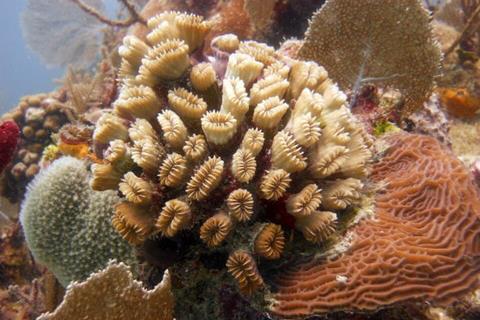
Georgia Tech researchers found that tiny predatory bacteria can halt the spread of a destructive coral disease by hunting and consuming pathogens responsible for the infection.
Coral disease
Caused by the Vibrio coralliilyticus pathogen, the infection is one of the most notorious causes of tissue loss and death in stony corals. In the study, all untreated corals bleached within 48 hours. But corals exposed to the predatory bacteria fared much better: more than half showed no signs of bleaching beyond the infection site — and disease progression was effectively halted.
“Disease is a major driver of death for these corals, and with sea surface temperatures continuing to rise globally, we anticipate that rates of disease will only increase. It’s part of a deadly synergy profoundly threatening Caribbean coral reefs,” says lead author Lauren Speare, assistant professor in the School of Biological Sciences. “Predatory bacteria function like a living probiotic, fighting coral disease without harsh side effects. This could be a targeted way to protect and treat our most vulnerable coral reefs.”
Natural Defenders
Speare became interested in the research while completing her postdoctoral training with Professor Rebecca Vega Thurber, director of the UCSB Marine Science Institute. “Dr. Thurber discovered that predatory bacteria are present in many coral microbiomes,” Speare recalls. “We theorized that they might be contributing to what keeps the ecosystem healthy, balancing it through predation.”
At the time, the theory was hard to test. Marine predatory bacteria are difficult to preserve long-term, making experiments challenging. The bacteria are also extremely scarce, with populations increasing during a coral infection and rapidly declining after. Catching them while their populations are high is a matter of timing, Speare says.
MICROBIOLOGY NEWS: Register with The Microbiologist for more free articles
“It’s a bit like trying to catch a mountain lion in the act of hunting a deer. If we aren’t looking at the right time, we might miss it entirely,” Speare says. “I knew that if I wanted to study these bacteria in more detail, I would need to carefully design my experiments and timing.”
Testing the Treatment
To test their theory, the team spent six weeks conducting experiments at the Mote’s Elizabeth Moore International Center for Coral Reef Research and Restoration (IC2R3) in Summerland Key, Florida, a facility that maintains lab-grown living corals in seawater aquariums.
“First, we had to make our corals sick,” Speare says. “But there wasn’t an established way to reliably create these infections in this species in a laboratory setting.”
After weeks of experimenting, Speare developed a “pathogen-sticker,” a small agar patch containing the disease-causing pathogens. When placed at the coral’s base, it mimics how infections spread in the wild.
MICROBIOLOGY ON TAP: Get full access to all The Microbiologist articles from just £2.17 a month
Then, at the first sign of infection, the team treated the coral with the Halobacteriovorax predatory bacteria. “Surprisingly, the most effective method was to pour the bacteria directly into the sick coral’s tank,” Speare says. “The bacteria are tiny, so we were able to create a concentrated liquid of them by using a filter small enough that only they can pass through.”
Halobacteriovorax are among the fastest-known predatory bacteria, and quickly navigate to their food source – presumably the pathogen causing the infection.
From Aquariums to Oceans
Because of the straightforward delivery method, Speare believes the team’s methods could be readily adapted for coral restoration efforts, offering a simple way to deliver treatment on natural reefs.
“There are several approaches to treating corals and mitigating stress, but these techniques don’t work for all situations and all species,” she explains. “Corals are complex, and there is no single cure-all, so we need as many tools as possible to help corals survive.”
For Speare, the next step will be to move from lab-based work to reef environments. She’s particularly curious as to why the predatory bacteria aren’t already moderating illness on natural reefs. “If this is such an effective way to control pathogens, why isn’t this system preventing disease outbreaks on reefs already?” she says. “We need to understand what’s limiting this natural defense system – and that’s what we’re digging into next.”
.jpeg)
No comments yet