
For decades, Vietnam’s dengue surveillance relied on a straightforward logic: when cases exceed the five-year average by a sufficient margin, sound the alarm. That logic is now breaking down.
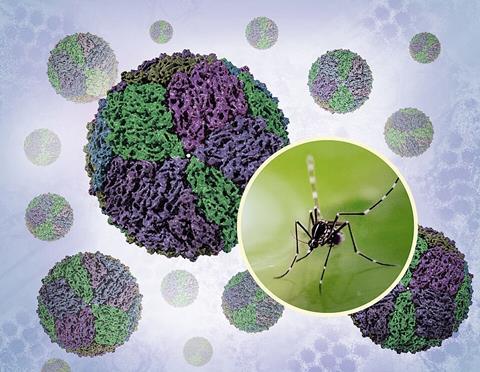
As climate change reshapes temperature patterns, intensifies drought cycles, and amplifies the influence of El Niño events, dengue transmission in Vietnam has shed its predictable seasonality and entered an era of climate-driven instability.
The North, once protected by cool winters that limited mosquito survival, is seeing sustained transmission creep into highland and subtropical regions. Outbreaks in 2019, 2022, and 2024 were early warnings of a structural shift — and the country’s surveillance infrastructure has not kept pace.
Early warning
In a perspective article published in Science in One Health, researchers from VinUniversity and the University of Pennsylvania argue that Vietnam urgently needs to replace its case-average-based early warning system with one anchored in biologically grounded climatic thresholds.
The authors synthesize existing evidence on how specific environmental signals — temperature exceeding 27°C, moderate weekly rainfall of 130–210 mm, severe drought as measured by the Palmer Drought Severity Index, widening diurnal temperature ranges, heatwaves, and El Niño anomalies — interact with Aedes mosquito biology and dengue virus replication to create outbreak conditions.
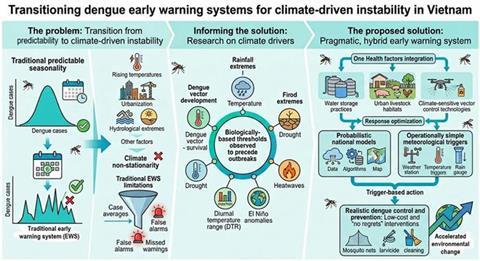
Crucially, these signals operate on different timescales: temperature and drought provide a strategic lead time of one to three months, rainfall signals demand rapid tactical responses within weeks, and El Niño–Southern oscillation (ENSO) phases offer a seasonal horizon suited to national planning. A tiered system that exploits these differential lead times could allow authorities to pre-position resources rather than scramble after cases appear.
Don’t ignore the gradient
The authors also caution against a one-size-fits-all approach. Vietnam spans 1,650 km of climatic diversity: in the warm South, hydrological signals and ENSO anomalies are the most informative triggers; in the North and Central region, thermal thresholds and diurnal temperature range retain strong predictive power for seasonal onset. Any national system that ignores this gradient risks misallocating resources or generating the very alert fatigue it seeks to prevent.
The proposed solution is a pragmatic hybrid: probabilistic superensemble models for national strategic forecasting, operationally simple meteorological triggers for district-level action, and — critically — a One Health framework that incorporates urban water storage practices, livestock habitats that sustain vector populations, and the impact of Wolbachia-based biological controls on transmission dynamics. By treating climatic signals as calls to readiness rather than passive predictions, Vietnam could transition from reactively managing outbreaks to proactively reducing their scale — a shift that accelerating environmental change makes not just desirable, but necessary.
Topics
- Aedes
- Asia & Oceania
- Climate Action
- dengue transmission
- diurnal temperature range
- early warning systems
- El Niño–Southern oscillation
- Emerging Threats & Epidemiology
- Environmental Microbiology
- hydrological signals
- Infection Prevention & Control
- Infectious Disease
- One Health
- outbreak conditions
- Palmer Drought Severity Index
- predictive microbiology
- Public Health
- Research News
- surveillance
- thermal thresholds
- University of Pennsylvania
- USA & Canada
- Veterinary Medicine & Zoonoses
- VinUniversity
- Wolbachia






No comments yet