
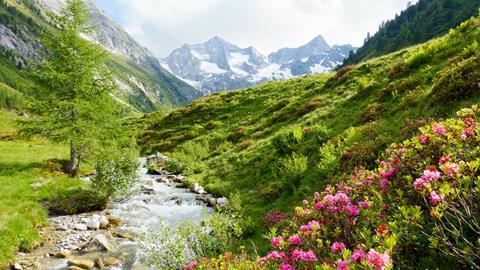
In the subalpine region of Carinthia, in northern Slovenia, cider is produced on remote family farms at altitudes of 500 to 860 metres - above the range in which the country’s vineyards operate. Here, cider-making is not a specialty product but a long-standing regional practice, historically shaped by a climate unsuited to winegrowing.
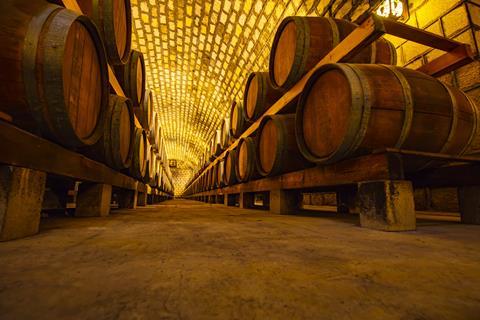
Each autumn, farms press a mixture of heritage apple varieties – Ananas Reinette, Bohnapfel, Graue Herbstrenette, Kronprinz Rudolf, Peinischer Krummstiel, Reinette du Canada and Steirischer Maschanzker, together with unnamed wild apples – and allow the juice to ferment spontaneously, without commercial starter cultures or temperature-controlled equipment. Fermentation takes place in old wooden barrels, in unheated cellars, relying entirely on the microorganisms already present. Spontaneous fermentation is generally assumed to be difficult to control and prone to inconsistency between batches. When we characterised the microbiota driving these cider fermentations across multiple farms, however, we found the opposite: a stable and reproducible microbial community, performing largely the same functions from cellar to cellar and from year to year. This article summarises what that community consists of, how it appears to sustain itself without external inoculation, and why it may be relevant beyond the specific case of Slovenian cider.
Deliberate food fermentation is not a recent development – the practice is more than 12,000 years old and predates any understanding of its microbial basis. Louis Pasteur established fermentation as a microbiological process in 1856, and Elie Metchnikoff proposed the first link between fermented milk consumption and health and longevity in 1910. What has changed since then is not the practice itself, which in places like Carinthia has remained largely unchanged, but the tools available to study it: from microscopy and phenotypic characterisation of isolates, to present-day culturomics and genome sequencing, which allow the fermentation process to be examined as a microbial ecosystem, strain by strain.
Cider production varies considerably by region. French cider is typically light, sparkling, and bottled in a style resembling Champagne. Spanish cider is often characterised by complex aromatics – green apple, honey, plum, vanilla. British cider tends to be darker and higher in alcohol, frequently made from concentrate. Slovenian cider does not follow any of these models; it is produced specifically in parts of the country where climatic conditions do not support wine grape cultivation, using apples rather than grapes as the primary raw material. The farms included in this study are distributed across the Carinthian highlands, at coordinates ranging from approximately 46°38’ N to 46°26’ N, at elevations between 500 and 860 metres. Each farm maintains its own orchard, its own combination of heritage apple varieties, and its own cellar. As the results below show, each also carries a distinct microbial signature, superimposed on a shared regional core.
The apple varieties themselves are relevant to the fermentation outcome. Heritage cultivars such as Bohnapfel and Steirischer Maschanzker were not selected for uniformity or shelf life. They are characterised by high total acidity, substantial phenolic and tannin content, and variable nitrogen availability – a more heterogeneous and demanding substrate than the standardised juice typically used in industrial cider production, and one that exerts specific selective pressure on the microorganisms able to ferment it efficiently. Sampling covered multiple farms across this altitudinal range of finished cider and cellar surface samples from each site. This design was intended specifically to distinguish patterns that are consistent across farms, from patterns specific to a single cellar – an important distinction when the underlying claim is that spontaneous fermentation in this system is reproducible rather than idiosyncratic.
Core microbiota of the fermentation
Using a culturomics approach – isolating and identifying the organisms actually present, rather than inferring community composition from sequencing data alone – we tracked the microbial populations responsible for these fermentations, from fresh juice through to finished cider.
Pellicle-forming yeasts
Kregervanrija fluxuum, a species infrequently reported in the cider literature, was a dominant taxon on many farms, at times representing 25–99% of relative yeast abundance. Together with Pichia membranifaciens, it is likely to make a substantial contribution to the ester-driven aroma profile characteristic of these ciders.
The Saccharomyces species complex
Cellar temperatures of 8–12°C through the winter favour cryotolerant strains. Saccharomyces uvarum is the dominant species in this niche, alongside S. cerevisiae and natural interspecies hybrids such as S. cerevisiae × S. kudriavzevii. These strains drive efficient alcoholic fermentation despite low cellar temperatures. In addition to the fermentative species, we identified S. paradoxus, a wild yeast species that is abundant in natural habitats but is seldom associated with fermentation environments.
Spoilage-associated yeasts
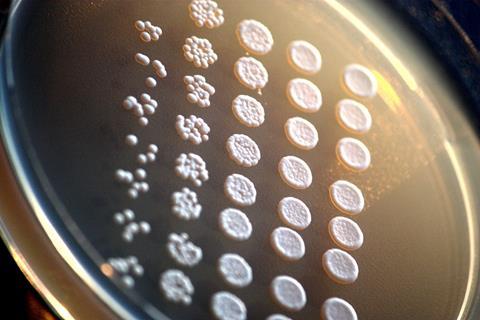
Brettanomyces species (B. bruxellensis and B. anomala) were detected in most of the ciders sampled. At low levels, they appear to contribute to regional sensory typicity; at higher concentrations, they generate volatile phenols such as 4-ethylphenol and 4-ethylguaiacol, which shift the sensory profile towards notes typically described as barnyard-like or medicinal.
Lactic and acetic acid bacteria
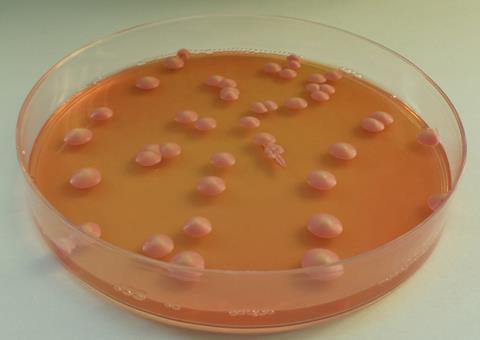
Oenococcus oeni was present on every farm sampled, at 36–100% relative bacterial abundance, and drives malolactic fermentation, reducing the malic acid content typical of high-altitude apples. Acetic acid bacteria, including Gluconobacter oxydans and several Acetobacter species, were also consistently recovered.
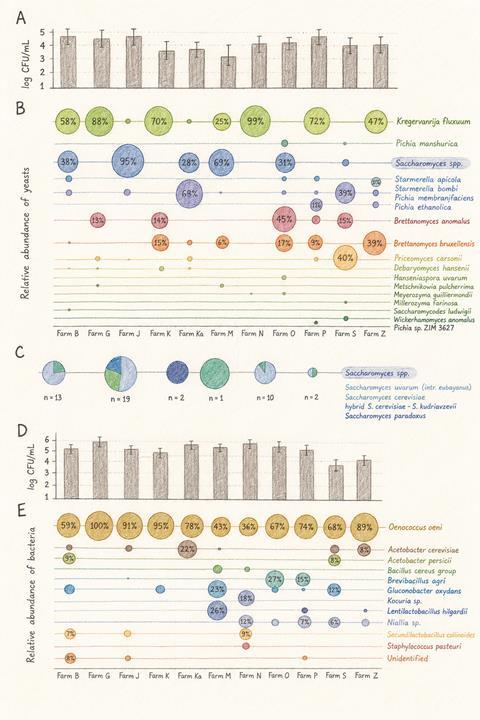
Overall, these fermentations are not driven by a single dominant strain, but by a multispecies microbial network that appears to be specifically adapted to cold, high-elevation cellar conditions.
Wooden barrels as a source of resident microbiota
To understand how these farms achieve consistent fermentation outcomes each year without commercial inoculants, we sampled the interior surfaces, taps, staves and bung holes of the wooden barrels used in each cellar. The same organisms recovered from finished cider – O. oeni, K. fluxuum and Brettanomyces species – were also readily isolated directly from the wood surfaces.
This indicates that the barrels serve as more than storage vessels: they act as facility-specific microbial reservoirs, seeding each new vintage from residual populations retained in the wood, and maintaining a farm-specific microbial profile across years, independent of variation in the surrounding orchard environment.
Interactions between species and their sensory consequences
Identifying which species are present accounts for only part of the fermentation outcome. To examine how these organisms interact, we conducted controlled co-fermentation trials using strains isolated from the region.
Saccharomyces uvarum consistently produced clean, dry fermentations at low temperature and outcompeted less cold-tolerant organisms. Oenococcus oeni showed increased growth in mixed culture with Brettanomyces bruxellensis relative to monoculture, a pattern consistent with cross-feeding, in which metabolic by-products of one organism – amino acids, vitamins, cofactors – support the growth of another in nutrient-limited apple must.
These interactions have measurable sensory consequences. Quantitative descriptive analysis by a trained panel found that ciders fermented with S. uvarum alone were consistently rated as clean, bright and floral, while increasing proportions of B. bruxellensis were associated with higher perceived bitterness, oxidative character and barnyard aromas linked to volatile phenol production. Total phenolic content and organic acid balance also shifted accordingly. This illustrates how a comparatively narrow change in species balance can determine whether fermentation is perceived as displaying desirable regional complexity or as sensorially faulty, depending on the concentrations reached and the expectations of the taster.
The early dominance established by S. uvarum also had a measurable effect on competing organisms: in several trials, its rapid establishment visibly limited the growth of less desirable species, including spoilage-associated bacteria, before they could become established. This form of competitive exclusion is functionally similar to what commercial fermentations deliberately attempt to achieve, by inoculating a large population of a single selected strain early in the process. In these cellars, a comparable effect appears to occur without intervention, as a consequence of the low cellar temperature combined with a well-adapted native strain reaching dominance first.
Traditional practice and its microbiological basis
Farmers have managed these fermentations for generations without reference to species names, relying instead on sensory judgement, timing, and family-maintained equipment. The microbiological and sensory data presented here do not alter that practice; they provide a mechanistic explanation for it, showing in molecular and chemical terms why empirically developed methods consistently produced a stable, reproducible fermentation outcome.
Relevance beyond this case
Global demand for cider has grown steadily in recent years: the market was estimated at approximately USD 5.48 billion in 2025, with an expected annual growth rate of around 5%. Commercial starter cultures used across the fermented food and beverage industry are drawn from a comparatively narrow genetic base. A limited number of well-characterised Saccharomyces lineages, selected decades ago for reliability, are reused across largely unrelated products. The native strains recovered from these cellars are different: they represent genetic and metabolic diversity that industrial fermentation has mostly lost, with a demonstrated ability to produce more complex, or at least distinctly different, aromatic profiles.
This has two practical implications. One is the potential to develop region-specific starter cultures from these native strains, giving small producers more predictable, food-safe fermentation without forcing them to use the same generic commercial S. cerevisiae employed throughout the industry, and without flattening the sensory character specific to their product. The other is treating these cellars as a reference collection: a source of strains and strain combinations that could be screened for traits useful well beyond cider ‑ cold tolerance, competitive exclusion of spoilage organisms, particular aromatic capabilities ‑ in other cold-fermented foods and drinks facing similar constraints.
There is also an agricultural dimension. The heritage apple varieties used here persist largely because the cider tradition that depends on them still exists; if the tradition stops, the orchards are unlikely to last much longer. Preserving a wooden cellar’s microbial ecosystem and preserving a marginal, high-elevation orchard turn out to be the same project. Growing market demand pushes towards standardisation, but it also creates space for products defined by regional and microbial distinctiveness rather than uniformity.
These findings do not indicate that spontaneous fermentation is inherently preferable to controlled, inoculated production; the sensory data show clearly that outcomes can shift towards undesirable characteristics without careful management, and not every farm’s balance of Brettanomyces will match consumer expectations. What they do indicate is that these cellars function as active reservoirs of microbial diversity, shaped by geography, apple genetics, and generations of accumulated practice, and that this diversity is at risk, as the small, marginal farms maintaining it decline in number.
That is why this kind of characterisation work matters beyond documenting a regional beverage. When a wooden cellar goes out of use, its resident microbial community does not relocate to a stainless-steel tank down the valley ‑ it is simply lost, along with whatever native starter cultures, cross-feeding relationships, or aromatic potential it held. Documenting these systems while the farms and their equipment are still active is likely to be the only realistic way to keep that diversity from disappearing along with them.
Further work is needed to establish the extent to which these findings generalise to other traditional cider-producing regions, and to determine whether the competitive and cross-feeding relationships observed here can be reproduced reliably enough to underpin a defined starter culture. Genomic characterisation of the recovered K. fluxuum and S. uvarum isolates is currently in progress, with the aim of identifying the specific metabolic pathways responsible for the aromatic and competitive traits described.



No comments yet