
Wastewater treatment plants (WWTPs) are upgraded to improve the quality of river water downstream, but the effects of such upgrades on aquatic microbial and viral communities remain poorly understood.
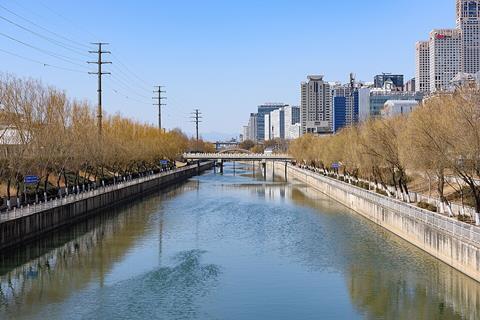
In a new study published in Water & Ecology, a research team led by Yaohui Bai from Research Center for Eco-Environmental Sciences, Chinese Academy of Sciences, investigated how the upgrade of a WWTP influenced nitrogen-cycling microorganisms and DNA viruses in its receiving river.
Conducted in Beijing’s Tonghui River (WWTP upgraded in 2017) and Qing River (WWTP upgraded in 2013) from 2015 to 2024, the research compared the river whose WWTP was upgraded during the study period against the river whose upgrade occurred prior to the study.
“We wanted to provide field-based evidence on whether improvements in effluent quality translate into ecological changes in aquatic microbial and viral communities,” says Bai.
Changes in water quality
The team found that substantial changes in water quality following the WWTP upgrade. “Total nitrogen (TN) concentrations in Tonghui River decreased markedly from 20~30 mg·L⁻¹ to approximately 10 mg·L⁻¹. This reduction was mainly attributed to the removal of organic nitrogen by the newly incorporated treatment processes,” shares Bai.
Regarding microbial communities, the team uncovered significant shifts in nitrogen-cycling bacteria despite stable overall diversity. The α-diversity measured by the Shannon index remained steady after the WWTP upgrade, indicating that species richness and evenness were not drastically affected by the environmental changes. However, β-diversity analysis revealed significant shifts in community structure after the upgrade. The partitioning of β-diversity demonstrated that species nestedness dominated community variation in Tonghui River.
“Its contribution increased substantially from 68% before the upgrade to 86% after, indicating that community differences were mainly driven by the loss or gain of some taxa while a stable core microbiome was retained, rather than by complete species turnover,” adds Bai.
Shift in nitrogen cycling
Functionally, the upgrade triggered a pronounced shift in nitrogen cycling processes. The median nitrifier-to-denitrifier abundance ratio decreased by 70% following the upgrade, indicating a shift in nitrogen cycling toward enhanced denitrification. Gene abundance profiles confirmed this reconfiguration, with denitrification-related genes becoming markedly more abundant than those associated with other nitrogen-transforming pathways.
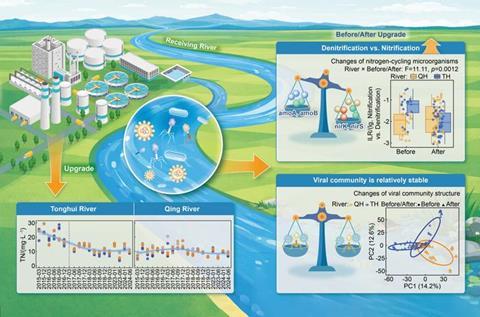
The viral communities presented a contrasting pattern. Unlike the bacterial communities, viral assemblages remained largely stable in structure over time, with PERMANOVA showing limited explained variance for upgrade effects. β-diversity partitioning indicated that differences between rivers were driven primarily by species turnover rather than nestedness, suggesting continuous inputs of novel viruses via WWTP effluent promoted compositional replacement. However, functional gene analysis revealed significant reprogramming.
Viral strategies
“After the upgrade, the abundance of viral replication and structural genes in the river water increased by approximately 15%~30%, the abundance of host metabolic auxiliary genes decreased by about 20%~40%,” says Bai. “We take this as evidence that improved effluent quality prompted viruses to shift from assisting host metabolism to prioritizing active self-replication, a strategy adjustment likely driven by reduced environmental stress on hosts.”
READ MORE: Dynamics of biofilm in backwashed sand filters
READ MORE: What are we swimming in? The growing need for Microbial Source Tracking
Taken together, the study provides rare long-term field evidence that WWTP upgrades can trigger ecological ripple effects beyond simple water quality improvements. While bacterial communities reorganize their composition and nitrogen-cycling functions, viral communities adjust their functional strategies even as their taxonomic structure remains stable. “These biological responses underscore the need to incorporate microbial and viral markers into post-upgrade water quality assessments and river management frameworks,” Bai adds.



.jpg)
No comments yet