
The yeast Candida albicans and the bacterium Enterococcus faecalis are usually harmless inhabitants of our mucous membranes. However, if the immune system is weakened or the microbial balance is disturbed—for example, after antibiotic therapy—they can cause infections.
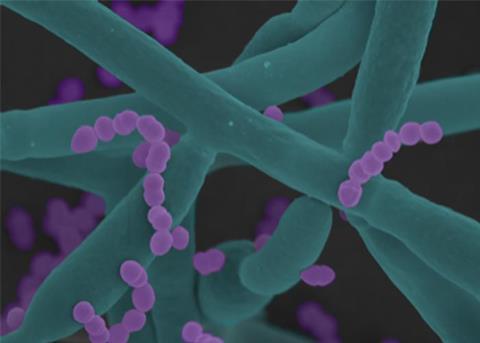
The severity of an infection also depends on how the two microbes interact with each other.
“Most studies examine how bacteria and fungi inhibit each other,” says Ilse Jacobsen, head of the Department Microbial Immunology at Leibniz-HKI. “We wanted to know why they cooperate under certain conditions, thereby causing significantly more damage, and what factors influence this.”
Cytolysin as a key factor
To understand this cooperation better, the team tested numerous E. faecalis strains in cell culture models. They found that only some of them significantly increased cell damage when infected simultaneously with Candida albicans. These strains shared a striking characteristic: they produced cytolysin, a toxin that perforates cell membranes and thus kills the cells.
If the corresponding gene was missing in the bacterium, the additional damage did not occur. When it was added, the effect reappeared. The findings from the cell cultures were also confirmed in the mouse model. Cytolysin-producing bacterial strains increased the damage to the mucous membrane caused by Candida albicans, while variants without the toxin even had a mitigating effect.
“Not all enterococci are the same,” emphasizes Jacobsen. “Here, the cytolysin-producing variants have proven to be the dangerous ones. This explains why more severe disease progressons are sometimes observed, even though the same microorganisms are involved in the clinical samples.”
How the collaboration works
In addition to the central role of cytolysin, the research team identified two main mechanisms that explain the dangerous alliance between the two microbes:
- Direct contact: The bacteria attach themselves to the fungal cells and thus come into close contact with the host cells. This allows the bacterial toxin cytolysin to act exactly where it causes most of the damage.
- Nutrient depletion: Candida albicans consumes sugar (glucose) particularly quickly. The resulting energy deficiency weakens the host cells and makes them more susceptible to the bacterial toxin.
In this way, the fungi and bacteria together create an environment in which they can fully unleash their destructive effects and cause massive cell damage – an impressive example of how complex microbiological interactions shape the course of an infection.
Encounters and tools
“The results of our study show that the danger of an infection depends not only on a single species, but on which microbes encounter each other and which tools they use,” says Jacobsen. “This helps us to better understand why some infections are so severe and could, in the long term, help to develop more targeted therapies against combined infections.”
The research project was funded by the German Federal Ministry of Research, Technology and Space (BMFTR) through the Center for Sepsis and Sepsis Control (CSCC), by the Leibniz Center for Photonics in Infection Research (LPI) and by the German Research Foundation (DFG) as part of the Cluster of Excellence “Balance of the Microverse”.
The article is published in Proceedings of the National Academy of Sciences.

No comments yet