
A new study provides the first comprehensive analysis of African swine fever outbreaks in Nepal, revealing a disease that has quietly dismantled livelihoods, disrupted food security, and exposed deep gaps in the country’s animal health system — with no vaccine in sight.
Since its first detection in March 2022, African swine fever (ASF) has swept through Nepal’s pig farming sector with alarming speed and lethality. A new study published in Science in One Health offers the most thorough epidemiological account of the outbreak to date, documenting 48 confirmed outbreaks, 17,005 officially reported pig deaths — and warning that the true toll is likely far worse.
ASF is caused by a highly resilient virus for which there is currently no commercially available vaccine or cure. In Nepal, the case fatality rate has reached 92.91% — meaning that when ASF enters a farm, virtually no pig survives. Official figures record 17,005 confirmed pig deaths through June 2025, but the research team estimates the actual number may be closer to 70,000, as widespread underreporting — driven by fears of stigma and the absence of compensation schemes for affected farmers — has masked the true scale of the crisis.
Stark reversal
The consequences have rippled through Nepal’s entire pig sector. Between fiscal years 2021/22 and 2022/23, the national pig population fell by 14.5% (a loss of approximately 231,000 animals), while pork production dropped 9.8%, erasing years of steady growth. For a sector that had been expanding at roughly 10% per year and was increasingly central to Nepal’s meat economy, the reversal has been stark.
The human cost is inseparable from the numbers. Pig farming in Nepal is not merely an agricultural activity — for ethnic communities such as the Rai, Limbu, Tharu, and Magar, it is deeply woven into cultural identity, ritual practice, and daily nutrition. Pigs feature in religious ceremonies, communal festivals, and ancestral rites. When ASF strikes, it does not simply reduce income; it severs a thread connecting communities to their heritage.
Food security
At the market level, disrupted supply chains have pushed up pork prices, threatening food security for rural households that depend on pork as an affordable source of protein. Nepal’s credibility in international trade has also taken a hit: the United States imposed a ban on Nepali pork products in response to ongoing outbreaks, underlining the global reach of what might otherwise appear to be a local problem.
The estimated direct economic loss stands at USD 20 million — and that figure accounts only for the market value of pigs lost. Indirect costs, including the loss of breeding stock, reduced restocking due to persistent fear of reinfection, and the burden placed on an already overstretched veterinary system, are expected to push the real figure considerably higher.
Why is ASF spreading so fast?
The study identifies a web of interconnected risk factors that together create ideal conditions for the virus to persist and spread. Swill feeding — the common practice of feeding pigs kitchen scraps and food waste from hotels and restaurants — is one of the most significant entry points: improperly treated waste containing ASF-contaminated pork products can transmit the virus directly. Informal cross-border trade with India and China, where ASF is also present, provides a near-constant route for reintroduction. Poor on-farm biosecurity — inadequate fencing, uncontrolled animal movement, and substandard slaughter practices — allows the virus to spread once it arrives.
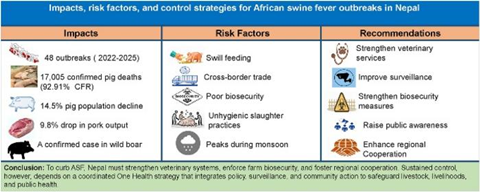
Timing also matters. Outbreaks peak during the monsoon season, when flooding, higher humidity, and the movement of pigs for cultural festivals converge to accelerate transmission. The disease is disproportionately concentrated in high-density pig farming regions, particularly in Koshi Province, which holds over half of Nepal’s domestic pig population.
Perhaps most concerning, the study documents ASF’s confirmed spread to wild boar — a development with long-term implications. Wild boar can act as a reservoir, sustaining the virus in the environment and making eradication far more complex.
A system under strain
The outbreak has exposed structural vulnerabilities that predate ASF itself. Nepal’s veterinary infrastructure is thinly spread and under-resourced, already managing simultaneous outbreaks of Lumpy Skin Disease, Glanders, avian influenza, and Classical Swine Fever. Diagnostic capacity is concentrated in central laboratories, slowing outbreak confirmation in rural areas. Legislation governing biosecurity and slaughter hygiene exists on paper but is inconsistently enforced. And at the community level, many smallholder farmers simply lack the knowledge or resources to implement basic protective measures.
Together, these gaps mean that ASF control in Nepal has been reactive rather than preventive — and reactive is rarely sufficient against a virus this lethal.
A roadmap for resilience
The study does not stop at diagnosis. It proposes a concrete, multi-layered response strategy built around eight priority areas: strengthening surveillance and early detection, expanding veterinary and diagnostic infrastructure, enforcing farm-level biosecurity, tightening cross-border movement controls, raising public awareness, developing a dedicated legal framework for ASF, monitoring wild boar–domestic pig interactions, and deepening community and stakeholder engagement.
Crucially, the authors frame these recommendations within a One Health approach — recognizing that ASF cannot be effectively controlled by the animal health sector alone. The virus sits at the intersection of animal health, human livelihoods, food security, and ecosystem dynamics. Sustainable control requires coordinated action across government ministries, local communities, regional neighbors, and international organizations such as FAO and WOAH.
Lessons for a region at risk
Nepal’s experience is a cautionary tale for other resource-limited countries navigating transboundary animal diseases. As the authors note, the country’s challenges are not unique — limited veterinary capacity, porous borders, smallholder-dominated farming systems, and low biosecurity awareness are common across South and Southeast Asia.
What Nepal offers, through this study, is a documented record of what happens when a highly lethal, vaccine-preventable-in-principle disease enters such a system — and a practical framework for building resilience before the next outbreak strikes.






No comments yet