
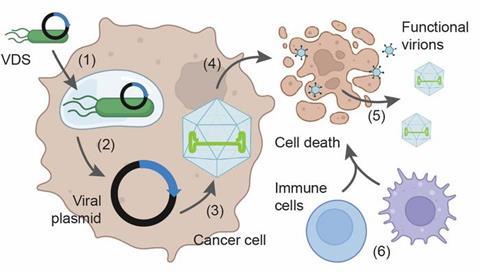
Researchers at the University of Massachusetts Amherst have designed non-toxic Salmonella bacteria to deliver viruses that are safe to humans but potent against liver and pancreatic cancer tumors — two cancers with an extremely poor prognosis. The researchers found that animal models treated with this combination of bacteria and viruses saw almost all their tumors eliminated and lived significantly longer.
“There’s so much more research to be done before this treatment could be available to humans, but the potential of giving years to a liver or pancreatic cancer patient is exciting,” says Neil Forbes, corresponding author and professor in the Riccio College of Engineering at UMass Amherst.
“Our goal is to build therapies that don’t just shrink tumors, but give patients real, lasting time,” says Shradha Khanduja, first author on the paper and UMass chemical engineering Ph.D. candidate. “Seeing these results in two of the deadliest cancers tells us we’re on the right path and that biology still has tools we haven’t fully tapped.”
Power of oncolytic viruses
This new research harnesses the power of oncolytic viruses. While these viruses don’t make humans sick, they are known to kill cancer cells. However, oncolytic viruses have only proved effective for surface cancers, like melanoma. Within the body, the immune system eradicates the viruses before they can ever reach the tumor.
Here, Forbes and his team saw a solution. The Forbes Lab at UMass Amherst specializes in designing a strain of Salmonella to function as a drug transport directly to tumors. “I was already being a little bit crazy asking, ‘How can I use a live organism to help treat disease?’” says Forbes. “Now, the question is: ‘how can I use two organisms to treat a disease, but I’m going to have one organism control the other organism that’s now going to treat the cancer.”
The researchers developed a new, engineered Salmonella bacterium that can carry the virus and deposit it directly into the tumor. When they measured how much bacteria was present in the mice models, they found that the tumor had 50 million times more bacteria than the liver or spleen, the organs responsible for filtering bacteria out of the body.
Impact on tumors
As a result, the mice treated with the virus-carrying Salmonella had tumors that were a quarter of the size of those in the control mice, and 27% the size of tumors in mice treated with a standard liver cancer drug (named Sorafenib). They also lived up to 65 days longer than those who did not receive the treatment.
It is also worth noting that, these effects were just as strong when the virus-carrying Salmonella were administered through an IV as they were if they were injected directly into the tumor.
“Injecting treatments directly into internal tumors is incredibly difficult and often dangerously invasive for cancer patients, says Khanduja. “This therapy completely bypasses that hurdle by utilizing a simple, standard intravenous (IV) line, allowing the engineered bacteria to safely navigate through the bloodstream and hunt down deep-seated tumors on their own.”
Undetectable microtumors
This therapeutic approach also resolves challenges with eliminating undetectable microtumors that lead to metastasis and also could induce immune responses that help counter tumors’ ability to hide from the immune system.
“Those immune responses are really important, because they’re the ones that tumors shut off so that your immune system doesn’t clear the tumor itself,” says Forbes. “Tumors have to evolve with time in order to shut those systems off, so we’re turning them back on by putting pathogens into the tumor.”
These immune responses not only contributed to smaller tumors, but they also trained the immune system to fight future tumors, suggesting that this therapy may help prevent recurrence or metastasis.
The researchers also confirmed the therapy’s safety, as measured by satisfactory changes in weight and inflammatory markers.
Next steps
For this initial testing, the researchers investigated liver cancer as well as pancreatic cancer, which have low five-year survival rates of 21% and 13%, respectively. Next, they intend to investigate other cancers and use different viruses. They also want to determine how to make the treatment more effective so that tumors won’t just shrink but disappear altogether.
This research is published in Cell Reports Medicine and was supported by the National Cancer Institute of the National Institutes of Health, the U.S. National Science Foundation and the Department of Defense.



No comments yet