
Periodontitis is a chronic inflammatory disease driven by pathogenic microbial communities and an unbalanced host immune response, leading to progressive destruction of periodontal soft and hard tissues. Porphyromonas gingivalis (P. gingivalis) is a key pathogen that can degrade gingival collagen and evade host defenses.
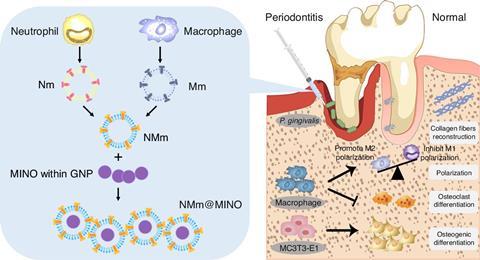
Conventional scaling and root planing (SRP) primarily targets subgingival biofilm and calculus, while additional therapeutic strategies may be needed to address persistent inflammation and promote periodontal tissue regeneration. Local nanoparticle delivery can improve drug retention, yet rapid immune clearance, limited penetration into periodontal pockets, and insufficient active targeting remain barriers. Given these challenges, in-depth research is needed on integrated local nanoplatforms that can simultaneously control infection, restore immune homeostasis, and promote periodontal regeneration.
Targeting infection and inflammation
The study, published on 26 October 2026 in International Journal of Oral Science, involved researchers at Chongqing Medical University and collaborators; animal experiments were approved by the Animal Ethics Committee at Chongqing Medical University. The team developed neutrophil–macrophage hybrid membrane-coated minocycline-loaded gelatin nanoparticles (NMm@MINO) and evaluated its physicochemical properties, biosafety, antibacterial and immunomodulatory effects in vitro, and therapeutic efficacy in a rat ligature-induced periodontitis model at early, intermediate, and advanced disease stages. The work combined materials characterization with macrophage, osteoblast, osteoclast, and fibroblast assays before in vivo testing.
NMm@MINO formed a stable core–shell structure, with a hybrid membrane shell surrounding a minocycline-loaded gelatin core. The gelatin core was designed to release minocycline in response to elevated gelatinase activity in inflamed periodontal tissue. In vitro, the platform showed strong bactericidal activity against P. gingivalis and Staphylococcus aureus (S. aureus). In macrophages, NMm@MINO downregulated M1-associated transcripts (Nos2, Tnf, Il1b, and Cd86) and upregulated M2-associated markers (Mrc1, Arg1, and Tgfβ1), consistent with decreased inducible nitric oxide synthase (iNOS) and increased cluster of differentiation 206 (CD206) immunofluorescence.
Promoting bone and tissue repair
It enhanced osteogenic markers (Alpl, Spp1, and Runx2), suppressed receptor activator of nuclear factor-κB ligand (RANKL)-induced osteoclastogenesis, reduced tartrate-resistant acid phosphatase (TRAP) staining, and lowered osteoclast-related genes (Acp5, Tnfsf11, Ctsk, Fos, and Mmp9). It also promoted fibroblast migration and collagen I expression. In vivo, local NMm@MINO reduced interleukin-6 (IL-6) and C-reactive protein (CRP), improved collagen remodeling, and mitigated alveolar bone loss while modulating TRAP and the RANKL/osteoprotegerin (OPG) axis. The authors highlighted the combination of gelatinase-responsive minocycline release, cytokine-neutralizing activity of the hybrid membrane observed in vitro, and beneficial effects on bone and soft-tissue cells as the platform’s distinguishing features.
The authors said the design was intended to move beyond bacterial killing alone. The hybrid membrane was designed to facilitate interactions with inflamed periodontal tissues, while the gelatin core enables gelatinase-responsive minocycline release. NMm@MINO integrates local minocycline delivery, membrane-associated immunomodulatory activity, and pro-regenerative effects. Across the evaluated experimental models, the combined formulation generally showed greater therapeutic benefits than free minocycline or hybrid membrane vesicles alone. They said future work should investigate periodontal pocket retention, biodistribution, potential effects on the oral microbiome, and manufacturing scalability.
Towards clinical translation
The findings support further investigation of NMm@MINO as a local adjunct to scaling and root planing (SRP) or local drug delivery (LDD) approaches for periodontitis, particularly for addressing the interconnected processes of infection, inflammation, and tissue destruction. A local injectable system may improve drug retention at periodontal sites while potentially reducing the need for systemic antibiotic administration.
MICROBIOLOGY NEWS: Register with The Microbiologist for more free articles
Questions remain, including antibiotic-resistance risk, effects on the oral microbiome, manufacturing consistency for cell membrane-based materials, storage stability, and further quantitative evaluation of periodontal pocket retention and active targeting. Head-to-head studies with established clinical LDD products and tracking/biodistribution studies will be needed before clinical translation. If validated, the platform could inform next-generation biomimetic therapies for other inflammatory diseases.




No comments yet