
Adoptive cell therapy has produced remarkable responses in some blood cancers, but solid tumors remain a much harder target. Transferred T cells often have difficulty reaching tumors, staying active once they arrive, and overcoming the strongly immunosuppressive environment surrounding cancer cells.
A research team led by scientists at Nanjing Drum Tower Hospital has developed a new approach that combines therapeutic T cells with engineered probiotics. Rather than simply administering the two treatments together, the researchers physically attached the bacteria to the surface of T cells, creating a hybrid system called T-FOLactis.
The study, published in Science Bulletin, suggests that this cell-surface engineering strategy may provide a new way to improve adoptive cell therapy in solid tumors.
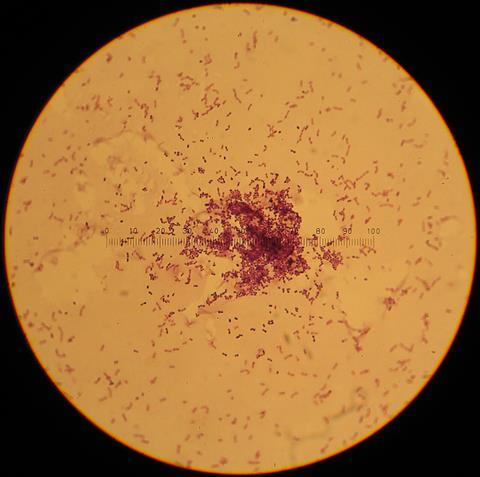
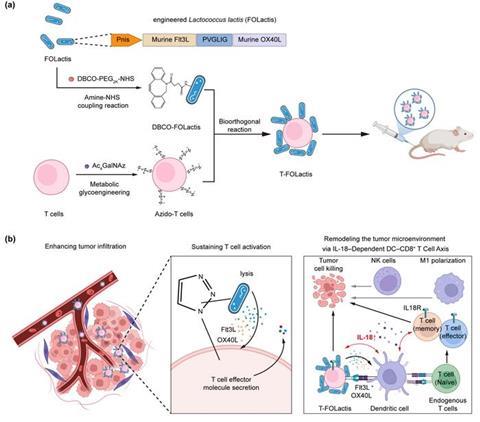
The researchers used an engineered strain of Lactococcus lactis called FOLactis. The bacteria produce a fusion protein containing Flt3L and OX40L, two immune-regulatory signals designed to support dendritic-cell activation and T-cell responses.
Click chemistry
To connect the bacteria to T cells, the team used a type of bio-orthogonal “click chemistry.” The method allows specially modified molecules on the bacterial and T-cell surfaces to react selectively under physiological conditions. This created a stable probiotic–T cell chimera in which FOLactis remained attached to the T-cell surface rather than simply being mixed with the cells.
The physical connection between the two components was important. T-FOLactis showed improved localization within tumors compared with conventional T cells or T cells administered together with unattached FOLactis. The engineered bacteria were also recovered mainly from tumor-associated tissues, with only minimal detection in major organs or blood.
In mouse colorectal cancer models, T-FOLactis produced substantially stronger tumor control. Tumor burden was reduced by 78.1% compared with saline-treated controls and by 65.0% compared with conventional adoptive T-cell therapy. Median survival increased from 22 days to 46 days, and the treatment did not cause overt systemic toxicity under the tested conditions.
Only connect
The researchers then asked why physically linking the bacteria and T cells worked better than simply giving them together.
Their results showed that T-FOLactis changed the local organization of the immune response inside tumors. Dendritic cells, which help coordinate T-cell activation, became more activated and were found in closer proximity to CD8-positive T cells. This created a local environment in which immune signals, co-stimulation and T-cell activity could be more effectively coordinated.
One of the signals involved was interleukin-18, or IL-18. Blocking IL-18 reduced several important CD8-positive T-cell functions and weakened the antitumor effect of T-FOLactis. However, the researchers also found that IL-18 alone could not explain the therapeutic benefit. Free FOLactis could induce substantial IL-18 production but did not reproduce the stronger antitumor activity of the physically linked T-FOLactis system.
This finding suggests that where immune signals are delivered may be as important as how much of them is produced.
Next steps
Single-cell sequencing further supported this model. T-FOLactis strengthened communication between dendritic cells and CD8-positive T cells, including molecular interactions involved in antigen presentation, cell adhesion and co-stimulation. These effects were partially reduced when IL-18 was blocked.
The researchers also tested the approach using primary human T cells. Human T-FOLactis showed stronger activation-associated features, increased interferon-gamma production and improved killing of human cancer cells in vitro, suggesting that key functional properties of the platform could also be reproduced in human cellular systems.
MICROBIOLOGY NEWS: Register with The Microbiologist for more free articles
The work remains preclinical. Most of the current evidence comes from mouse colorectal cancer models, and additional studies in humanized systems, patient-derived models and more clinically representative tumor models will be needed. Future clinical development would also require standardized manufacturing and quality-control procedures for bacterial loading, stability, sterility, and biological potency.
The study nevertheless introduces a broader strategy for cell therapy. Instead of modifying T cells only from within, therapeutic cells can also be equipped with functional biological components on their surface. By combining T-cell therapy, engineered probiotics and bio-orthogonal chemistry, T-FOLactis provides a platform for organizing immune stimulation directly around therapeutic cells inside tumors.





No comments yet