
Dark septate endophytes (DSE) are a group of endophytic fungi that colonize plant roots, offering unique advantages in promoting plant growth and inducing systemic resistance, with broad application prospects in green agriculture. The Plant Disease and Biocontrol Research Team at the Institute of Plant Protection, Guangxi Academy of Agricultural Sciences, has long been dedicated to the development and utilization of DSE resources.
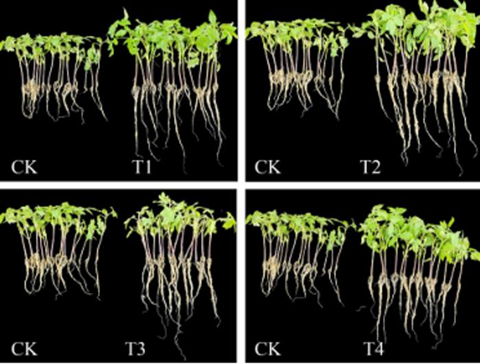
Previous studies identified the novel DSE species Cladophialophora guangxiense HX2 as exhibiting excellent control efficacy against tomato bacterial wilt. Its chlamydospores, serving as the core functional carriers, possess strong stress resistance, stable colonization ability, and extended shelf life.
However, the industrial production of chlamydospores has long been constrained by low yields, prolonged formation cycles, and significant susceptibility to environmental factors, severely limiting the industrialization of DSE-based biocontrol agents. To address these challenges, the research team systematically optimized the liquid fermentation process using chlamydospore yield of strain HX2 as the key response indicator.
Through single-factor experiments, the team first identified molasses, corn flour, and soy flour as the optimal carbon and nitrogen source combination, while inorganic salt ions were found to have no significant promoting effect. Subsequently, the Plackett-Burman design was employed to screen three key medium components—molasses, corn flour, and soy flour—from six factors. Further optimization via the steepest ascent experiment and Box-Behnken response surface methodology (BBD) determined the optimal formulation: molasses 84 g/L, corn flour 25 g/L, and soy flour 26 g/L.
Fermentation conditions
For fermentation condition optimization, the team established the optimal parameters through single-factor experiments and BBD design: rotation speed at 170 r/min, temperature at 28 °C, inoculum ratio at 3.6%, liquid volume at 115 mL per 250 mL flask, and initial pH at 5.12. Under these optimal conditions, the actual chlamydospore yield of strain HX2 reached 2.71×10⁸ spores/mL, exceeding the predicted value of 2.29×10⁸ spores/mL by 18.3%.
Molasses, a byproduct of the sugar industry, is widely available, low-cost, and rich in monosaccharides, sucrose, vitamins, and minerals. It serves dual functions of carbon source supply while avoiding the antagonistic risks associated with traditional multi-salt systems. This formulation design not only significantly reduces production costs but also offers a novel approach for the development of green and low-cost culture media.
Stability assays demonstrated that under sealed storage at room temperature, the germination rate of HX2 chlamydospores gradually decreased from 90.42% at 1 month to 59.42% at 8 months. This characteristic indicates that strain HX2 possesses considerable potential for developing long-shelf-life DSE-based biocontrol products, effectively overcoming the short shelf-life bottleneck of conventional biocontrol agents.
Increase in yield
This study systematically revealed the coupling relationship between strain specificity and medium compatibility. Through response surface methodology, the team innovatively constructed a composite system of “corn flour + molasses + soy flour,” achieving a 145.13% increase in chlamydospore yield compared to the single-molasses medium (8.73×10⁷ spores/mL). The findings provide critical process parameters and technical support for subsequent large-scale fermentation, formulation development, and field application studies of C. guangxiense HX2.
MICROBIOLOGY NEWS: Register with The Microbiologist for more free articles
Currently, the DSE-based green high-yield disease-resistant technology system developed by this team has been selected as a 2025 National Tropical Agricultural Science and Technology Innovation Achievement, with demonstration applications implemented in Guangxi, Yunnan, and other regions. The team will continue to advance research on formulation development, field application efficacy, and industrial-scale fermentation processes for chlamydospore-based biocontrol agents, providing a theoretical foundation for developing DSE formulations with high chlamydospore content.
The study is published in Acta Microbiologica Sinica.
Topics
- dark septate endophytes
- Agriculture
- Asia & Oceania
- Bacteria
- biocontrol
- chlamydospores
- Cladophialophora guangxiense HX2
- Food Security
- Fungi
- Guangxi Academy of Agricultural Sciences
- Healthy Land
- Microbial Biotechnology
- Microbial Fermentation
- Microbiological Methods
- Research News
- Soil & Plant Science
- tomato bacterial wilt






No comments yet