
Cedars-Sinai is partnering with Exobiosphere, a company that has developed scientific hardware to automate biomedical research in space and on Earth. Using this hardware, Cedars-Sinai investigators will send experiments to Haven-1, which is set to become the world’s first commercial space station, developed by Long Beach-based aerospace company Vast.
The investigators want to study how the weakened gravitational pull in space affects the growth of organoids—small collections of cells that emulate the form and function of human organs. Scientists use organoids to model diseases and test drugs, and the hope is that they will grow more quickly in space than on Earth.
READ MORE: Rocket test proves bacteria survive space launch and re-entry unharmed
READ MORE: Microbes and Space special issue
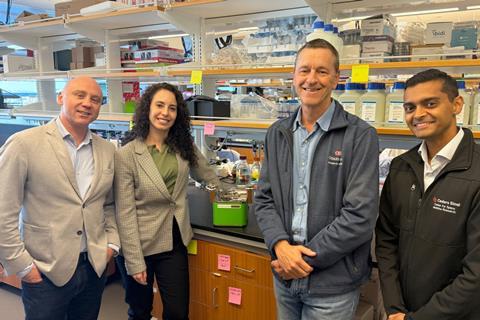
“Our ultimate goal is to accelerate the progress of biological research and discovery,” said Arun Sharma, PhD, director of the Center for Space Medicine Research and research scientist in the Board of Governors Regenerative Medicine Institute at Cedars-Sinai. “Our partnership with Exobiosphere furthers Cedars-Sinai’s mission to be at the forefront of space biomedicine while deepening our understanding of how organoids develop in microgravity.”
Speeding up discovery
Sharma and his colleagues hope to speed the discovery of therapies that treat medical issues astronauts experience, including bone and muscle loss and heart and immune system degradation. These discoveries could also be applied to terrestrial patients experiencing similar conditions, such as sarcopenia (muscle loss), osteoporosis (bone weakening) and cardiomyopathy (enlargement, stiffening or weakening of the heart muscle).
“Drugs that are used to treat astronauts can also benefit people on Earth, making a potential broader impact for millions of patients,” Sharma said.
Microgravity offers tremendous opportunities for scientific discovery but also creates challenges that investigators don’t face on Earth. For example, when astronauts open petri dishes in space, the fluid and cells inside drift out.
Surface tension
However, a Cedars-Sinai study co-authored by Sharma and led by Maedeh Mozneb, PhD, from the Sharma Lab, found that in 96-well plates—rows of tiny wells much smaller than petri dishes—surface tension is strong enough to hold the contents in place.
“It was the first time that anybody has ever showed that you can take this piece of affordable hardware that’s commonly used in labs on ground and bring it to space to do cell biology research,” said Sharma, a research professor in the Department of Biomedical Sciences and the Smidt Heart Institute. “In a way, it’s democratizing life sciences.”
Building on this discovery, Exobiosphere developed a research platform that automates organoid experimentation in microgravity. The hardware integrates precision liquid handling, environmental control, robotic manipulation and live imaging—capabilities that previously required intensive astronaut intervention.
“This system is designed to remove barriers for scientists,” said Kyle Acierno, CEO of Exobiosphere. “By streamlining the complexity of space-based research, we’re enabling our partners to focus on the science itself—delivering data faster, with greater consistency, and at a scale that’s never been possible in orbit.”
Lab productivity
The unit, about the size of a carry-on suitcase, accommodates six 96-well plates and includes a built-in incubator, microfluidic‑based liquid dispenser, plate reader and robotic arm. While optimized for microgravity, the platform can also enhance lab productivity on Earth.
Exobiosphere’s innovative work earned it a spot in the Cedars-Sinai Accelerator+ program, which invests in startups focused on improving healthcare to help bring their products to market. Cedars-Sinai Technology Ventures also recently made a $1.4 million investment in the company and will provide mentorship from researchers.
“As an academic medical center committed to innovation, we are thrilled to invest in a company conducting important biosciences research in space while collaborating with our colleagues at the Center for Space Medicine Research,” said Nirdesh K. Gupta, PhD, managing partner of Cedars-Sinai Intellectual Property Company. “Our work together exemplifies our dedication to advancing breakthrough technologies that transform healthcare in space and on Earth.”


No comments yet