
Researchers at AIST, in collaboration with researchers from the National Institute of Technology, Kagoshima College, have developed the Anaerobic Baffled Continuous Stirring (ABCS) reactor, a device capable of simultaneously treating solid waste and wastewater from biomanufacturing processes while recovering methane for energy self-sufficiency.
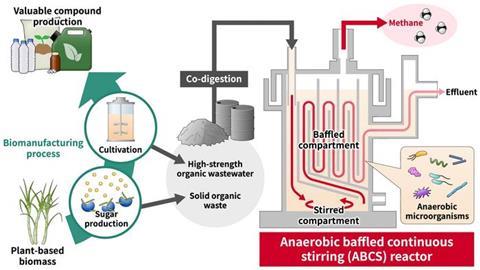
Solid organic waste and high-strength organic wastewater generated during biomanufacturing processes contain large amounts of organic matter that can be converted into energy resources through anaerobic digestion. However, it has been difficult to use conventional reactors for efficient methane production while maintaining a long-term stable microbial community and addressing challenges such as the accumulation of solids and the acidification of wastewater associated with solubilization.
In this study, the newly developed ABCS reactor integrates a stirred and a baffled compartment within a single unit. This design promotes the solubilization of solid organic waste and the production of methane, enabling the stable co-digestion of solid organic waste and high-strength organic wastewater.
The newly developed reactor suppresses the accumulation of solids, maintains stable performance over 100 days of continuous operation, and achieves a methane production rate 1.62-fold that of conventional reactors. This technology improves the operational efficiency of wastewater treatment facilities, reduces their facility size, and enables energy self-sufficiency, thereby contributing to the enhanced practicality and sustainability of microbial wastewater treatment technologies.
Details of this technology were published online in the Journal of Environmental Chemical Engineering on June 29, 2026.
Biomanufacturing background
Biomanufacturing is the production of chemicals and materials using biological systems such as microorganisms and enzymes. This industry is expected to continue growing due to its potential to reduce dependence on fossil resources and contribute to a decarbonized society. In biomanufacturing, sugars derived from plant-based biomass, such as wood and agricultural residues, are used as feedstock.
However, this process generates solid organic waste that was not converted to sugars. Furthermore, the process of cultivation of microorganisms to produce target compounds generates high-strength organic wastewater containing high concentrations of sugars and organic acids.
MICROBIOLOGY NEWS: Register with The Microbiologist for more free articles
Since the solid waste and wastewater generated by biomanufacturing processes may adversely affect the environment, they must be properly treated prior to disposal and discharge.
Promising alternative
Currently, the most common method for treating solid organic waste is incineration following dehydration and drying. However, this method is not considered sustainable due to its high energy consumption.
High-strength organic wastewater is treated using aerobic treatment processes such as the activated sludge process. However, the high concentration of organic matter requires large amounts of microbial biomass and aeration for treatment, necessitating large-scale facilities. Therefore, anaerobic digestion technology is a promising alternative because microorganisms degrade organic matter under anaerobic conditions and energy is recovered in the form of methane.
However, conventional anaerobic reactors have limitations in the organic loading rate because the microbial hydrolysis of solid organic waste is slow. As a result, hydrolysis often becomes the rate-limiting step due to the limited contact between microorganisms and solid organic matter. Consequently, it has been difficult to efficiently produce methane while maintaining stable operation of the multiple biological processes.
Topics
- Anaerobic Baffled Continuous Stirring reactor
- anaerobic digestion
- Asia & Oceania
- biomanufacturing
- Clean Water
- Climate Action
- Healthy Land
- Kagoshima College
- methane production
- National Institute of Advanced Industrial Science and Technology
- National Institute of Technology
- Research News
- Strategies for Sustainability
- Waste Management
- Wastewater & Sanitation






No comments yet