
The SARS-CoV-2 fitness landscape within individual clades is modulated by an epidemic phase which initially favors transmissibility but progressively shifts toward immune escape after the epidemic peak.
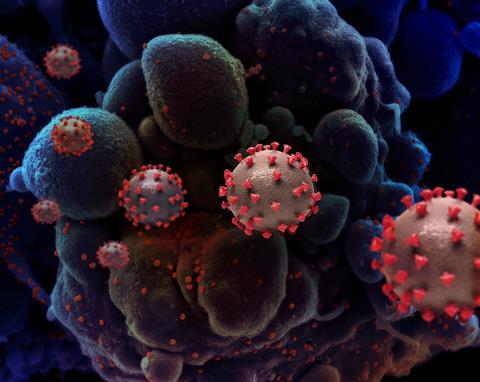
This reveals an evolutionary asynchrony between viral diversification and selection as the transmission surge generates the greatest viral diversity, yet selection during this phase differs from that encountered later. As a result, immune-evasive variants favored late may be suppressed earlier, creating a mismatch that constrains continuous within-clade adaptation.
Dynamic shifts in evolutionary selective pressures across an epidemic wave can constrain gradual adaptation within SARS-CoV-2 clades, helping explain why the virus evolves through sudden, punctuated lineage replacements, according to a new study published in Virologica Sinica. The findings bridge macroscopic epidemiology with microscopic viral evolution, challenging forecasting approaches that assume selective pressures remain static over time.
Viral fitness landscape
The research team tracked global infection dynamics, spike protein sequence diversity, and experimental functional traits including receptor binding, cell entry, and antibody escape—across eight major SARS-CoV-2 clades from 2020 to 2024. “We found that the viral fitness landscape within each clade is dynamically modulated by the epidemic phase,” shares Dr. Mingkun Li, corresponding author of the study. “Early in a wave, selection favors transmissibility and purges immune-evasive mutations that compromise receptor binding; however, once cumulative infections surpass roughly 70% of the wave, rising population immunity sharply redirects selection toward immune escape.”
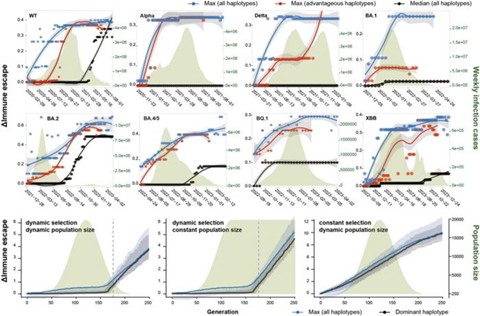
Notably, this shift creates a timing mismatch—termed “evolutionary asynchrony”—between when mutations are generated and when they are favored. “The transmission surge generates peak viral diversity, producing many immune-evasive variants early on, yet they lack a selective advantage at that stage and are quickly lost to genetic drift,” explains Dr. Wentai Ma, first author of the study. “By the time late-phase selection finally favors antibody escape, shrinking case numbers have contracted viral diversity, leaving limited raw material for continuous, stepwise adaptation.”
Evolutionary bottleneck
Forward-time evolutionary simulations confirmed that both fluctuating population size and shifting selection pressures are required to create this evolutionary bottleneck. This constraint on circulating lineages opens a window for highly divergent variants—such as those evolving during chronic infections—to sweep the population.
The team’s findings also improve how scientists forecast emerging variants. “Incorporating epidemic progression alongside functional metrics into machine learning models substantially improved our ability to predict the growth advantage of emerging haplotypes,” says Ma.
MICROBIOLOGY NEWS: Register with The Microbiologist for more free articles
Nonetheless, the researchers note that because total clade infection proportions are retrospective, future early-warning frameworks will need to integrate real-time genomic proxies, such as normalized haplotype diversity, to forecast viral evolution prospectively.
Funder: This study was funded by the National Key R&D Program of China (Grant No. 2024YFC2607900 to M.L., service.most.gov.cn), the National Natural Science Foundation of China (Grant No. 92569107 to M.L. and W.M., www.nsfc.gov.cn), the Strategic Priority Research Program of Chinese Academy of Sciences (Grant No. XDA0460404 to M.L., www.cas.cn), and the PhD Research Start-up Fund of Anhui Normal University (Grant No. 903/762530 to W.M., www.ahnu.edu.cn).
Topics
- adaptation
- Anhui Normal University
- Asia & Oceania
- COVID-19
- early-warning frameworks
- Ecology & Evolution
- Emerging Threats & Epidemiology
- epidemic phase
- evolutionary asynchrony
- evolutionary selective pressures
- fitness landscape
- immune escape
- Infectious Disease
- Mingkun Li
- One Health
- punctuated evolution
- Research News
- SARS-CoV-2
- selection
- transmissibility
- Viruses
- Wentai Ma







No comments yet