
The Ebola virus polymerase and replication machinery can now be studied under standard BSL-2 conditions. A new study published in Virologica Sinica reports that this machinery is associated with the cytoskeleton and that depolymerising microtubules increases viral replication.
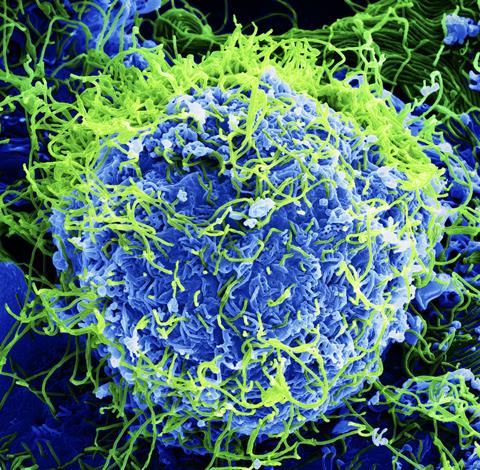
Live Ebola virus requires BSL-4 containment, and the L polymerase — the genome-copying enzyme — has been difficult to detect because reliable antibodies are lacking. Small epitope tags make L detectable but usually reduce its activity. Earlier minigenome and infectious virus-like particle (iVLP) systems relied largely on transient expression. The researchers therefore established stable cell lines carrying Strep-tagged L together with NP, VP35 and VP30, and selected a clone that efficiently supports sustained minigenome replication and iVLPs production, mimicking the viral life cycle. Because L is detected via the Strep tag, the system does not depend on anti-L antibodies.
The EBOV iVLPs were purified by biochemical approaches. The lipid envelope was removed with a detergent buffer. Both intact iVLPs and delipidated RNPs can be efficiently pelleted by low-speed centrifugation, which is unusual for a virus whose precipitation normally requires high-speed ultracentrifugation. This low-speed sedimentation step can be combined with density-gradient ultracentrifugation to purify iVLPs and RNP preparations.
Proteomics of intact iVLPs and delipidated RNPs identified tubulin isoforms clustered with core RNP proteins, a previously unrecognised association. Depolymerising microtubules with nocodazole increased viral RNA synthesis, the formation of inclusion bodies, and particle output. Three-dimensional confocal microscopy showed inclusion bodies localised to gaps in the microtubule network, suggesting that the network may physically constrain viral genome replication.
“The stable BSL-2 system removes the BSL-4 requirement for L and RNP research, simplifies antiviral screening and host-factor studies, and can be adapted to other ebolaviruses, including Bundibugyo virus, which is associated with current outbreaks.” said Prof. Zhong.






No comments yet