
A chromosome-level genome and population survey of the fungus-dependent orchid Gastrodia elata has revealed how hidden genetic differences may shape growth, tuber form, and carbohydrate allocation.
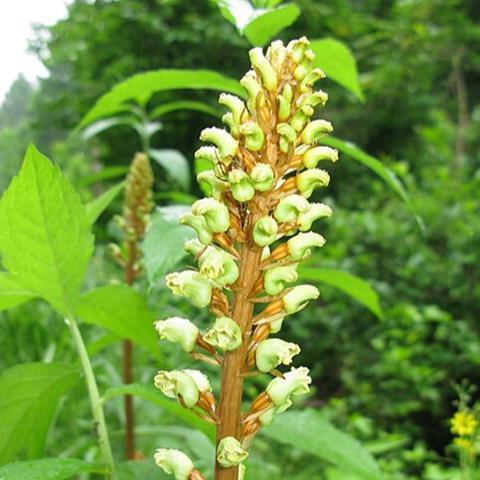
The study links large chromosomal rearrangements and variation in the strigolactone (SL) signaling system to distinct cultivated groups. In particular, a Clade G haplotype formed a more stable complex between the DWARF14 (GeD14) receptor and DWARF53 (GeD53) suppressor, which was associated with stronger SL signaling and altered expression of tuber-development genes.
By connecting genome structure, signaling dynamics, and visible traits, the work offers a mechanistic view of how a fully non-photosynthetic plant adapts while relying on fungal partners for carbon and nutrients.
Medicinal orchid
Unlike green plants, mycoheterotrophic species cannot produce their own carbohydrates through photosynthesis and instead depend on fungi for nourishment. Gastrodia elata, an important medicinal orchid cultivated in several forms, lives in close association with Armillaria fungi and displays marked differences in growth, tuber morphology, and chemical composition.
Previous genome studies described species-level adaptations, including gene loss and the retention of symbiosis-related pathways, but they did not clearly explain how genetic variation within the species contributes to different cultivation traits. Variety-specific reference genomes and integrated population data have also been limited.
Based on these challenges, there is a need to investigate how intraspecific genomic variation reshapes symbiotic signaling and growth adaptation in Gastrodia elata.
The research
Researchers from the China Academy of Chinese Medical Sciences, Jiangsu University, and the Ningxia Academy of Agriculture and Forestry Sciences reported (DOI: 10.1093/hr/uhag099) the findings in Horticulture Research on June 4, 2026.
The team assembled a chromosome-level reference genome for Gastrodia elata forma glauca and combined it with population genomics, transcriptomics, protein-interaction experiments, and structural simulations.
Their analysis resolved three genetic clades and identified clade-specific variants in the GeD14 and GeD53 genes, providing a molecular explanation for differences in tuber development and carbohydrate allocation among cultivated forms.
Orchid genetics
The researchers built a 1.05-gigabase genome anchored to 18 pseudochromosomes and compared it with two published Gastrodia elata assemblies. Around 26% of syntenic regions contained inversions, and transposable elements were enriched near inversion breakpoints, indicating that mobile genetic elements helped generate extensive within-species structural variation. Resequencing 150 individuals produced 14.3 million single-nucleotide polymorphisms and separated the samples into Clade E, Clade G, and an admixed Clade I.
MICROBIOLOGY NEWS: Register with The Microbiologist for more free articles
Transcript profiling then showed that 15 symbiosis-related genes differed between Clades E and G, including four genes in the SL pathway. Protein assays confirmed interaction between the GeD14 receptor and the GeD53 suppressor. Molecular dynamics simulations showed that the Clade G GeD14–GeD53 complex had substantially greater binding stability than the Clade E complex, while the receptor’s leucine-to-isoleucine substitution at position 88 had little effect on SL perception.
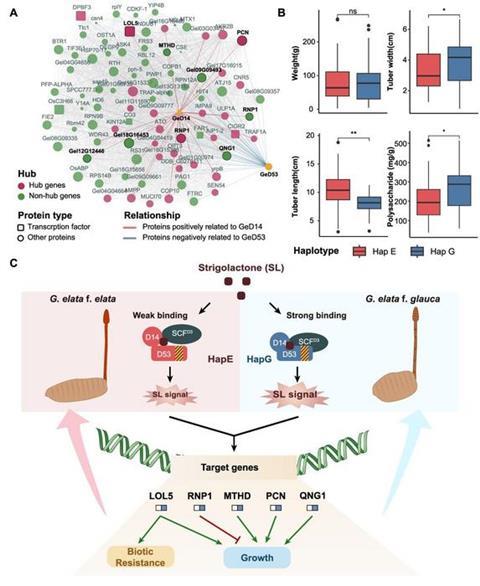
Variation in the M domain of GeD53 instead emerged as the main structural driver. A weighted gene co-expression network analysis identified the genes LOL5, RNP1, MTHD, PCN, and QNG1 as candidate downstream effectors associated with growth–defense allocation. Haplotype G plants developed shorter, wider tubers and accumulated more polysaccharides than Haplotype E plants, despite similar fresh weight, linking sequence variation to distinct developmental and metabolic outcomes.
Plant adaptation
The authors said the results show that adaptation in a fungus-fed plant can be shaped not only by losing or retaining genes, but also by subtle changes in how signaling proteins interact. They said the key difference was concentrated in the GeD53 suppressor rather than in the GeD14 receptor itself, allowing one haplotype to transmit the SL signal more efficiently.
This signaling shift was connected to downstream genes controlling growth, stress responses, and tuber development, offering a plausible explanation for why cultivated Gastrodia elata groups allocate resources differently while maintaining their dependence on Armillaria.
The new reference genome and population dataset can support cultivar identification, germplasm conservation, and the selection of lines with desirable tuber shape or polysaccharide content. The identified GeD14–GeD53 haplotypes also provide testable markers for studying how Gastrodia elata balances growth with fungal interaction and biotic defense. More broadly, the findings offer a framework for examining adaptation in other mycoheterotrophic plants, whose biology is difficult to investigate with conventional models.
The authors caution, however, that direct genetic transformation remains limited in Gastrodia elata. Future work should test whether the haplotypes alter fungal colonization and nutrient transfer, and should experimentally validate the proposed downstream targets before they are used in breeding.
Topics
- Armillaria
- Asia & Oceania
- China Academy of Chinese Medical Sciences
- Ecology & Evolution
- Fungi
- fungus-dependent orchids
- Gastrodia elata
- Healthy Land
- Jiangsu University
- Microbial Genetics
- mycoheterotrophic species
- Ningxia Academy of Agriculture and Forestry Sciences
- Pharmaceutical Microbiology
- Research News
- Soil & Plant Science
- symbiosis






No comments yet