
For a bacterium trying to cause an infection, the first challenge is simple: don’t get swept away.
Inside the human intestine, disease-causing E. coli must latch onto the cells lining the gut. If it cannot hold on, it is much less likely to establish an infection. But a new study shows that when some E. coli bacteria lose one of their main attachment tools, they can rapidly find another way to cling to human cells and make that new grip much stronger.
The research, led by Phd. Student Noam Yedidi, Prof. Ilan Rosenshine and Prof. Sigal Ben-Yehuda of the Institute for Medical Research Israel-Canada (IMRIC) at the Hebrew University of Jerusalem, was published in Gut Microbes.
The team studied enteropathogenic Escherichia coli, or EPEC, a type of E. coli that can cause severe diarrhea, especially in young children. Persistent infection can be particularly harmful to children, affecting both physical growth and development.
Many traditional EPEC strains use tiny hair-like structures to attach to cells in the intestine. Yet in recent years, “atypical” EPEC strains, bacteria that lack this important attachment system, have become increasingly common.
That raised an important question: if these bacteria have lost one of their main ways to hold onto the gut, how are they still causing infections?
Evolution in the lab
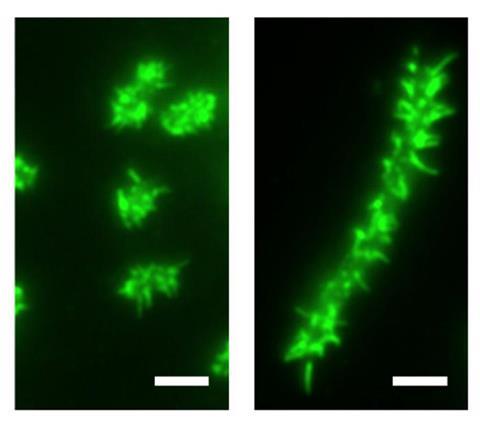
To find out, the researchers recreated this challenge in the laboratory. They started with bacteria that lacked their major attachment mechanisms, then repeatedly selected the few bacteria that still managed to stick to human cells (image 1).
The result was striking. After only four rounds of selection, the bacteria had evolved a far stronger ability to attach.
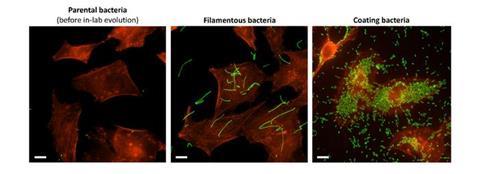
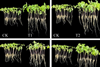
They did so in two ways (image 2). Some bacteria became unusually long, creating more surface area and allowing many small attachment structures to work together (image 3). Others developed small genetic changes in a protein called FimH, found at the tip of these structures. Those changes made the protein bind more tightly to molecules on human cells.
In some cases, the evolved bacteria attached to human cells more than 100 times better than the original strain.
“It is like losing a hook and quickly learning to use another one,” said Prof. Rosenshine. “The bacteria do not need to invent an entirely new system. They can take a tool they already have and improve it.”
Real world processes
The researchers then asked whether the same process might be happening outside the laboratory. They examined the genomes of 327 atypical EPEC strains isolated from patients and found changes in the fimH gene in about half of them. When the researchers recreated and tested many of these naturally occurring changes, they found that several made the bacteria attach to human cells 10 to 100 times more strongly.
The bacteria’s improved grip also appeared to make infection more effective. EPEC uses a needle-like molecular system to inject proteins into human cells and interfere with their normal functions. Bacteria with stronger attachment were better able to deliver these proteins.
MICROBIOLOGY NEWS: Register with The Microbiologist for more free articles
The findings do not yet offer a treatment, but they point to a possible future strategy. Rather than trying only to kill the bacteria, scientists may be able to interfere with their ability to attach to the intestine in the first place. Drugs that block FimH are already being studied for other E. coli infections, although more research is needed before this approach could be considered for atypical EPEC.
More broadly, the study offers a vivid example of evolution in action: when bacteria lose an important tool, they may not become weaker. Sometimes, they find another tool—and quickly learn to use it better.


No comments yet