
A new study reports that specially engineered biochar can significantly improve compost quality by reducing nitrogen loss and accelerating the formation of stable humic substances. The findings offer a promising strategy for transforming organic waste into more effective fertilizers while lowering environmental emissions.

Composting plays a critical role in recycling agricultural and food wastes into nutrient rich soil amendments. However, conventional composting systems often suffer from two major challenges. Large amounts of nitrogen can be lost as ammonia gas, and the formation of stable humic substances can be slow and inefficient. Both problems limit the fertilizer value and environmental benefits of compost.
Researchers addressed these challenges by designing two types of modified biochar. One was enriched with phosphorus, while the other contained both phosphorus and magnesium. These materials were added to pig manure compost to investigate whether they could simultaneously retain nitrogen and promote humification, the process that converts organic matter into stable soil carbon compounds.
The study, published in Biochar, found that both modified biochars significantly reduced ammonia emissions compared with conventional biochar. The phosphorus modified biochar reduced ammonia release by about 21 percent, while the phosphorus magnesium co modified biochar reduced emissions by nearly 28 percent. These improvements occurred because the modified surfaces of the biochar particles could capture ammonium and convert it into stable mineral forms during composting.
Stimulating microbial activity
At the same time, the modified biochars stimulated microbial activity that supports nitrogen transformation and organic matter stabilization. The research team tracked changes in microbial communities and nitrogen cycling genes throughout the composting process. They found that the modified biochars enriched beneficial microbial groups that help convert nitrogen into forms that support the formation of humic substances.
“We found that modified biochar can coordinate both biological and chemical processes in composting,” the study authors explained. “This synergy allows nitrogen to be retained in the system while also accelerating the formation of stable humic materials that improve soil fertility.”
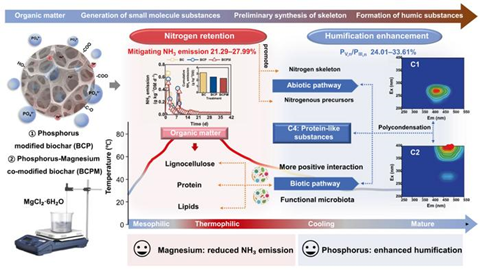
Measurements of compost chemistry confirmed these benefits. Compared with conventional biochar, the modified materials increased nitrogen retention and improved the accumulation of plant available nutrients such as phosphorus and potassium. Compost treated with the modified biochars also showed higher germination index values, indicating reduced phytotoxicity and better suitability for agricultural use.
Role of phosphorus
The study also revealed that phosphorus plays a particularly important role in promoting humification. Phosphorus enriched biochar enhanced microbial degradation of lignin and proteins, two key steps that generate precursors for humic acid formation. Magnesium provided an additional benefit by helping form mineral complexes that trap ammonium and prevent nitrogen loss as ammonia gas.
Advanced spectroscopic analysis showed that the modified biochars increased the proportion of humic like substances in the final compost. These stable organic compounds are essential for improving soil structure, nutrient retention, and long term carbon storage.
According to the researchers, the results demonstrate how engineered biochar additives can transform composting systems into more efficient nutrient recycling technologies.
Working with microbes
“By designing biochar that works together with microbial communities, we can redirect nitrogen and organic matter toward the formation of valuable soil amendments instead of losing them as emissions,” the authors said.
The findings provide new insights into how biological and chemical mechanisms interact during composting. They also highlight the potential of modified biochar as a sustainable tool for improving waste management and agricultural soil health.
As organic waste production continues to grow worldwide, technologies that enhance compost quality while reducing environmental impacts will become increasingly important. The researchers believe that biochar based additives could play a key role in developing next generation composting strategies that support circular agriculture and climate friendly soil management.




No comments yet