
Researchers have discovered that natural “sunscreen” compounds found in algae and cyanobacteria may also support skin and heart health.
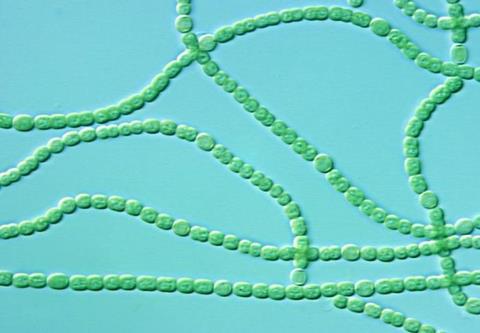
By comparing two mycosporine-like amino acids, the team showed for the first time that these molecules can block a key enzyme involved in blood pressure control in laboratory tests, while also offering antioxidant and anti-aging effects. The findings open new possibilities for cosmetics and functional foods based on nature-derived ingredients.
Natural compounds produced by seaweeds and microscopic organisms have long helped these species survive intense sunlight. Known as mycosporine-like amino acids (MAAs), these molecules act as natural sunscreens by absorbing harmful ultraviolet (UV) radiation and protecting cells from damage.
Because of this ability, MAAs have attracted growing interest from scientists and cosmetic companies seeking safer, nature-based alternatives to synthetic UV filters. However, researchers are now discovering that these compounds may do much more than a shield against the sun.
Skin health and blood pressure
The new study, published online on January 19, 2026, in Bioscience, Biotechnology, and Biochemistry, suggests that MAAs may also support skin health and help regulate processes linked to blood pressure. The study was led by Professor Hakuto Kageyama from the Graduate School of Environmental and Human Sciences, Meijo University, Japan. Prof. Kageyama says, “We discovered that MAAs can inhibit angiotensin-converting enzyme, suggesting a previously unrecognized potential for blood-pressure–related health benefits.”
READ MORE: Natural saclipins in cyanobacteria offer hope of combating skin aging
Angiotensin-converting enzyme (ACE) plays an important role in controlling blood pressure by regulating how blood vessels tighten and relax. Many commonly prescribed medicines for hypertension work by blocking this enzyme. Finding ACE-inhibiting activity in naturally occurring compounds is therefore of strong interest in nutrition and health research.
MAAs are produced by algae and cyanobacteria as part of their natural defense system against sunlight. While more than 70 types of MAAs have been identified, most commercial products rely on only a few well-known forms. Many chemically modified versions remain poorly understood, even though small structural changes can strongly affect how these molecules behave in the body.
Comparing MAAs
To explore this, the research team compared two MAAs with different chemical structures. One was porphyra-334, a typical MAA commonly found in edible seaweed. The other was GlcHMS326, an atypically modified MAA that contains additional chemical groups. These modifications slightly alter the molecule’s shape and properties.
The researchers first purified both compounds from natural sources. Porphyra-334 was extracted from dried seaweed, while GlcHMS326 was isolated from a cyanobacterium collected from a hot spring in Thailand. They then tested how the compounds responded to heat and light and evaluated their biological activities using established laboratory methods.
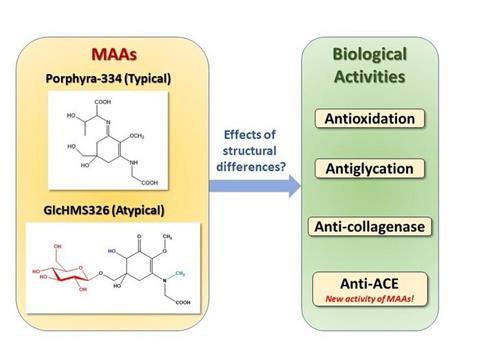
Several experiments focused on antioxidant activity, which reflects a compound’s ability to neutralize unstable molecules called free radicals. These molecules can damage cells and contribute to aging and disease. The team found that GlcHMS326 acted as a strong but slow-working antioxidant, suggesting sustained rather than immediate activity, while porphyra-334 showed weaker antioxidant effects.
Antiglycation activity
The researchers also examined antiglycation activity. Glycation is a process in which sugar molecules bind to proteins, reducing their flexibility and function. This process plays a role in skin aging and some chronic diseases. In these tests, porphyra-334 was more effective than GlcHMS326 at preventing protein damage.
In addition, both MAAs were tested for their ability to block collagenase, an enzyme that breaks down collagen and contributes to wrinkle formation. GlcHMS326 showed stronger collagenase inhibition, suggesting potential anti-aging benefits.
One of the most notable findings came from experiments on ACE inhibition. Both compounds reduced the activity of this enzyme in laboratory tests, marking the first report of such an effect for MAAs. Although the observed effects were moderate and measured outside the human body, the discovery opens a new direction for future research. “Our data further support their potential as multifunctional ‘natural sunscreen’ ingredients,” says Prof. Kageyama. “Chemical modifications can substantially shift their functional profiles.”
Controlled experiments
The researchers emphasize that their findings are based on controlled laboratory experiments. Further studies are needed to determine whether similar effects occur in living organisms and whether practical doses can be achieved through food or cosmetic products. Still, the results are encouraging.
Porphyra-334 is abundant in edible seaweed, which is already consumed widely in many countries. This raises the possibility that everyday foods may contain underappreciated bioactive compounds worthy of further health-related research.
Overall, the study provides new insight into how natural sun-protective molecules can serve multiple biological roles. By revealing how small chemical differences shape their activity, the research lays the groundwork for developing next-generation cosmetic products and functional foods inspired by nature.
Topics
- Algae
- angiotensin-converting enzyme
- antiglycation
- Asia & Oceania
- Bacteria
- blood pressure
- Cardiometabolic disease
- collagenase
- cyanobacteria
- Disease Treatment & Prevention
- GlcHMS326
- Hakuto Kageyama
- Japan
- Meijo University
- mycosporine-like amino acids
- One Health
- Personal Care Product & Cosmetics
- Pharmaceutical Microbiology
- Research News
- sunscreen





No comments yet