
Antimicrobial resistance poses a growing global health crisis, with few new antibiotics in development. Researchers at Sultan Qaboos University have identified three novel antimicrobial peptides (AMPs) from dromedary camels that effectively target multidrug-resistant bacteria, offering potential alternatives to conventional drugs.

Published in Frontiers in Immunology (Volume 17, 21 January 2026), the study combined bioinformatics predictions with experimental validation, including colony-forming assays, membrane permeability tests, and electron microscopy on strains like MRSA and MDR E. coli.
Peptides CdPG-3 and CdCATH demonstrated strong antibacterial activity across Gram-positive and Gram-negative bacteria, causing membrane damage and leakage without high toxicity to camel or human red blood cells at lower doses.
READ MORE: Llama nanobodies deliver breakthrough in building HIV immunity
Camels’ robust innate immunity, including these cathelicidin-like AMPs, may explain their resistance to infections common in other ruminants. “This lays the foundation for exploring camel AMPs as therapeutics against resistant pathogens,” note the authors.
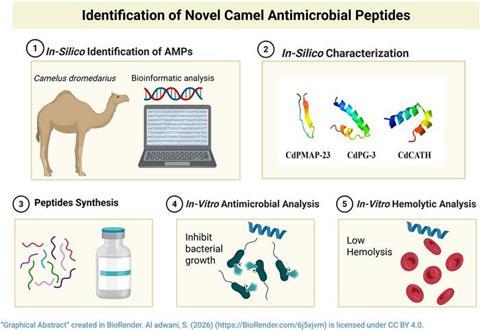
Unlike traditional antibiotics prone to resistance via target mutations, AMPs disrupt bacterial membranes broadly, reducing adaptation risks. The peptides showed low hemolytic activity in relevant species, supporting safety for further development.
Future research will optimise these AMPs for clinical use, leveraging Oman’s camel resources.




No comments yet