
Governments around the world conserve plants and animals in part by setting aside land. Whether as wilderness reserves or as resource management zones that allow industrial activities such as logging, 17.4 percent of the planet’s land offers some measure of protection. These protected areas overlap with one-fifth, on average, of the range of Earth’s terrestrial mammals.
But beneath these parched deserts, dark forests and rolling grasslands is an invisible world that keeps these aboveground places healthy. And we’re not protecting that world much at all.
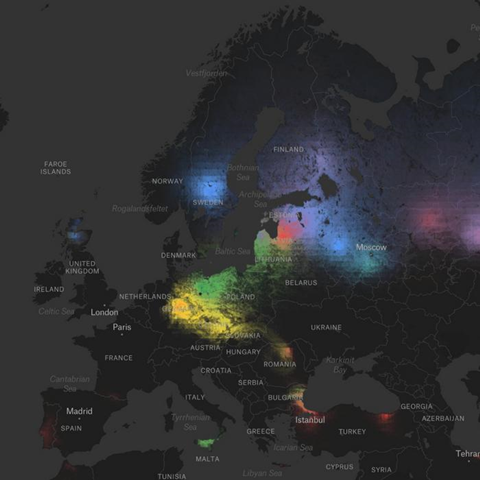
In a new study published in the journal Conservation Letters, scientists built the most comprehensive models ever of the ranges of 2,858 important fungal species and compared them with the world’s protected landscapes. Unlike elephants or kangaroos or elk or capybaras, researchers learned, more than half of these critical underground organisms are less protected than if conservation areas had been drawn at random. That matters because belowground fungal networks underpin the health of virtually every terrestrial ecosystem, feeding nutrients and water to 80 percent of plant species in exchange for carbon.
Conservation mismatch
The findings, in other words, highlight a mismatch: Conservation has been built around the life we see, without regard to the hidden organisms below our feet that help aboveground life thrive.
“Protected areas have historically focused on plants and animals rather than fungi, and it shows,” said the study’s lead author, data scientist Clara Qin, formerly with the Society for the Protection of Underground Networks (SPUN). “We found that the majority of mycorrhizal fungal species were underrepresented in protected areas, which suggests a lot of room for improvement.”
But this work offers a roadmap to begin charting a new course. With this biggest-of-its-kind global atlas of thousands of fungal species’ ranges “we can now pinpoint places on a map and say, ‘if you wanted to establish a new park, this is where you’d get the most bang for your buck and cover the most habitat for lots of different mycorrhizal fungal species,’” said the study’s senior author, Michael Van Nuland, an ecologist and lead data scientist at SPUN.
As climate change and growth and development disrupt natural systems, protecting these areas “is one way to ensure that we have a source pool of fungi able to partner with plants,” Qin said.
Dense networks
Mycorrhizal fungi form dense networks that help plants absorb phosphorous, nitrogen and water, which in turn helps the world’s vegetation battle stress, such as pests and disease. These fungi make ecosystems more resilient to drought and changing conditions and make it more likely that restoration projects produce robust, functioning landscapes. Mycorrhizal fungi also draw down and store billions of tons of carbon.
The two major types, arbuscular mycorrhizal (AM) fungi and ectomycorrhizal (EM) fungi, are buried in soil and often too tiny to be spotted in traditional wildlife surveys. So to determine their ranges, Qin, Van Nuland and other researchers drew upon 16.5 million observations of fungal species in soil samples collected by scientists from around the world. They “sequenced a small barcode of DNA of every single fungal species present in each environmental sample,” said co-author Adriana Corrales, field science lead for SPUN. Then they built complex models that projected where each species likely lives, even in places no one has yet looked.
Tantalizing insights
The resulting maps offer tantalizing insights. The 2,669 species of ectomycorrhizal fungi they examined dominate hardwood and conifer forests, the temperate biomes most likely to be protected. Yet of the few hundred species of EM fungi whose global health has been assessed by the International Union for Conservation of Nature (IUCN), roughly a quarter are already at risk of extinction.
While far fewer species of arbuscular mycorrhizal fungi exist, it is these types that partner overwhelmingly with the majority of Earth’s plant species. AM fungi are found predominantly on croplands, grasslands and savannas, places substantially less secure under existing protection measures. Yet not a single AM fungal species has been surveyed for the potential threat of extinction.
Individual species
The new research builds on a 2025 paper in the journal Nature that also explored that relationship between fungi and protected areas. In that study, “we found that less than 10 percent of mycorrhizal biodiversity hotspots are within the fence line, so to speak, of protected areas,” Van Nuland said. The vast majority of the most diverse mycorrhizal communities were not protected at all.
This new work is distinguished by its focus on individual species. Mapping thousands of species of mycorrhizal fungi makes it easier to identify precisely which ones aren’t protected—and where. With roughly 25,000 species of mycorrhizal fungi known to science—and perhaps five times as many more yet to be described—the novel approach taken in this research will continue to come in handy. “Once we have a method that works for mapping 2,800 species, then we can use it to map more and more species as we discover them,” Corrales said.
The research was sponsored by SPUN, a non-profit dedicated to mapping and protecting the planet’s mycorrhizal fungal networks. SPUN has issued grants to more than 140 “underground explorers,” who are sampling and mapping underground fungi in ecosystems around the world, especially in the Global South. The organization was co-founded by evolutionary biologist Toby Kiers, who this year was awarded the Tyler Prize, often called the Nobel Prize for the environment, for her groundbreaking work highlighting the importance of belowground fungi. Last fall she was named a MacArthur “Genius” Fellow.
Topics
- Adriana Corrales
- Applied Microbiology International
- Clara Qin
- Community
- Ecology
- ectomycorrhizal fungi
- Environmental Microbiology
- Fungi
- Healthy Land
- International Union for Conservation of Nature
- Michael Van Nuland
- mycorrhizal fungi
- Research News
- Society for the Protection of Underground Networks
- Soil & Plant Science
- Toby Kiers
- UK & Rest of Europe
- USA & Canada


No comments yet