
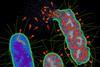
Researchers at the Francis Crick Institute and King’s College London have used phototherapy to inhibit a protein in E. coli bacteria that makes them resistant to antibiotics.

This new method, if proven safe and effective in living organisms, holds promise for rescuing the effectiveness of antibiotics that bacteria have become resistant to.
Antimicrobial resistance (AMR) is a growing global problem. 4.7 million deaths were associated with AMR in 2021, expected to rise to 8.2 million in 2050. Gram-negative bacteria, which include Escherichia coli (E. coli), Salmonella and Helicobacter pylori, have tough cell walls that block the entry of drugs, meaning fewer treatment options are available even before the bacteria develop resistance.
In research published in the Journal of the American Chemical Society, an interdisciplinary team of researchers adapted a method used for cancer drug discovery, where small molecules degrade specific proteins of interest, for its first use in antibiotic rescue.
They targeted an enzyme only found in drug-resistant bacteria, called NDM-1, which breaks down commonly used ‘beta-lactam’ antibiotics like penicillin.
Chemical tool
The researchers designed a new chemical tool, named ‘Ru1’. The tool is composed of a light-activated ruthenium metal complex attached to an organic molecule (known as a ‘ligand’) that binds to NDM-1. In a process known as phototherapy, when exposed to blue light, the metal complex produces molecules, called reactive oxygen species (ROS), that can cause damage to proteins like NDM-1.
Through a series of experiments, the team showed that Ru1 degrades NDM-1 by producing ROS that damage the enzyme’s active site, which prevents it from binding and destroying an antibiotic. As a result, Ru1 inhibits NDM-1 a hundred times better in the light. As soon as the light is switched off, Ru1 can no longer cause damage and can be recycled to be used again.
READ MORE: How reactive oxygen species target viruses differently: new clues for safer water disinfection
READ MORE: Dual wavelengths of light effective against antibiotic-resistant bacterium
To see if Ru1 works in live bacteria, the team incubated it with E. coli and tested its ability to inactivate NDM-1. They found that Ru1 partially inactivates NDM-1 in the dark, but is thirty times more effective in the light, showing that their targeted approach works.
Finally, they tested whether Ru1 can rescue the activity of a beta-lactam antibiotic, meropenem, in E. coli. At all concentrations tested, Ru1 boosted meropenem activity better than the organic ligand or the metal complex alone. At the maximum concentration tested, Ru1 increased the activity of meropenem against E. coli by 53 times. Furthermore, Ru1 didn’t show any toxicity to human cells.
Animal model
The next step for the research is to check if Ru1 works in an animal model of an infection with Gram-negative bacteria.
Jeannine Hess, Group Leader of the Biological Inorganic Chemistry Laboratory, Lecturer in the Department of Chemistry at King’s College London and senior author, said: “Many new antibiotics are not truly new at all. They are improved versions of previous drugs, attacking bacteria in a similar way. This means that bacteria can quickly become resistant, but making new antibiotics from scratch, which work by different mechanisms, is challenging and time-consuming.
“We’ve shown that rescuing the activity of existing antibiotics, by targeting vulnerabilities in the bacteria themselves, can provide a powerful alternative strategy. As blue light can’t penetrate deeply into tissue, this approach is likely best suited for surface-accessible infections such as skin infections, dental applications, wound care or for sterilising medical devices, rather than treating infections deep inside the body.”
Lars Stevens-Cullinane, Senior Laboratory Research Scientist in the Biological Inorganic Chemistry Laboratory and first author, “We’re just scratching the surface for how phototherapy and targeted damage could work to stop bacteria resisting treatment. We hope that, in the future, this becomes a versatile tool, where different ligands are swapped out to target other proteins of interest, in the antimicrobial resistance field or beyond.”



No comments yet