
A new review casts new light on what the ocean can tell us about the partnership between animals and microbes.
’‘Marine holobionts: a model arena for host–microbe biology, from ecosystem function to biotechnology’’ by scientists in Italy appears in Sustainable Microbiology, an Applied Microbiology International publication.
It is accompanied by ‘Reframing marine host-microbe symbioses: from taxonomic inventories to functional convergence’, a Perspective resulting from the Trends in Host-Microbe Symbioses Symposium.
The review asks what the ocean can tell us about the partnership between animals and microbes, says corresponding author Dr Maria Elena Martino.
“Almost every marine organism, from corals and sponges to squid, fish, deep-sea mussels and seagrasses, lives as a holobiont: a host together with the bacteria, archaea, microscopic eukaryotes and viruses it carries. Marine holobionts encompass an extraordinary diversity of life, spanning animal lineages and ecological settings that are rarely brought together in other environments.
Natural laboratory
“This makes the ocean a natural laboratory for understanding how hosts and microbes interact, how these relationships have evolved, and what general principles govern their functioning.
“In our review, we explore what marine host–microbe partnerships can tell us about the fundamental relationships between animals and their microbial partners, and how this knowledge could help us better understand and protect marine ecosystems.”
Marine ecosystems are changing rapidly under the pressure of climate change, coral bleaching, disease outbreaks and pollution - yet we are trying to protect and manage organisms whose biology we still only partly understand, in part because so much of it depends on an invisible microbial dimension.
Protecting marine microbiomes
A coral’s ability to tolerate heat, the growth and health of a farmed fish, or the nutrient balance of a seagrass meadow all depend on the microorganisms associated with it. Protecting marine ecosystems therefore means understanding and protecting their microbiomes too.
“This is particularly important because microbial communities can respond to environmental change on timescales that differ from those of their hosts. Some microbial populations can adapt or turn over rapidly, while others are remarkably stable,” said Dr Martino.
“Understanding when these communities are resilient, when they change, and how those changes affect their hosts is essential. The challenge is that we still know relatively little about which microbial functions matter most, in which hosts and under which environmental conditions.
“We also have limited ability to predict the consequences when key functions are disrupted. Without this knowledge, it is difficult to turn the growing interest in marine microbiomes into effective conservation and management strategies.”
Microbial diversity
Advances in DNA sequencing have transformed marine microbiology over the past decade. Researchers have been able to identify the microorganisms associated with different hosts at an unprecedented scale, generating extensive inventories of microbial diversity and revealing how communities vary across species and environments.
This work has been indispensable, but the resulting picture remains uneven. A relatively small number of model systems, particularly reef-building corals, sponges, bobtail squid and deep-sea mussels, account for a substantial proportion of the literature. Many other marine animal groups, including entire phyla, remain poorly studied or have received virtually no attention.
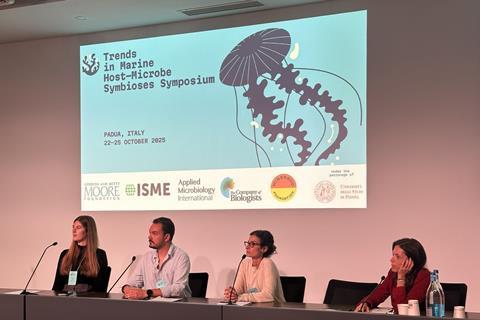
To discuss the current state of the art of the field, scientists organized the first edition of Trends in Marine Host–Microbe Symbioses, an international scientific symposium hosted in Padua, Italy in October 2025.
Vital opportunity
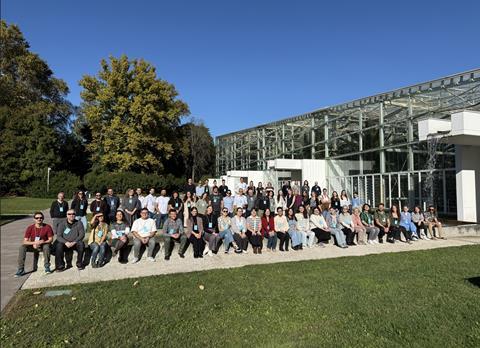
Bringing together around 100 participants from across the world, the meeting provided an opportunity to share emerging research in marine host-microbe symbioses, compare approaches across different host systems and discuss the future of the field. The strong participation of early-career researchers was particularly encouraging, highlighting a new generation of scientists working to understand marine host–microbe interactions across a wide range of organisms and ecosystems.
“Yet the contributions also illustrated how concentrated the research effort remains,” said Dr Martino.
“Of the 65 scientific contributions presented, approximately 87% focused on just six host groups, with corals and sponges particularly prominent. Similarly, seven out of ten presentations on microbiome-based interventions focused on corals.
“At the same time, the field is beginning to ask different questions. Rather than simply identifying which microorganisms are present, researchers increasingly want to understand what those microbes do, how they influence their hosts and whether their activities can be harnessed to support marine health. The next step is to move from describing microbial communities to understanding their functions and the mechanisms that underpin host–microbe partnerships.”
Key insights
Two important insights emerge from the review. The first is that very different marine hosts can rely on similar microbial functions. Processes such as nitrogen and carbon cycling, sulfide and methane metabolism, immune modulation and protection against environmental stress recur across distantly related organisms. In some cases, different microbial partners can perform similar ecological roles, suggesting that particular functions may be more widespread than the specific host–microbe associations in which they occur.
“Carbon fixation provides a striking example. Marine holobionts have evolved different ways of obtaining energy and organic carbon through microbial partnerships, including photosymbiosis in sunlit waters and chemosymbiosis in dark environments,” said Dr Martino.
“Despite their differences, both strategies rely on close associations between hosts and microorganisms that convert environmental energy into resources that sustain the partnership. These systems offer an opportunity to investigate how similar functional solutions have evolved in very different ecological settings.”
Beyond taxonomy
The second insight is that microbial identity alone tells us less than we might expect. The same microbial species can behave differently in different hosts or environmental conditions, while closely related bacteria may respond in different ways to changes in temperature or salinity.
Taxonomic classifications can therefore be misleading when used as proxies for microbial function. This does not mean that identifying microbial species is unimportant. Rather, it is only part of the picture.
To understand what a microorganism contributes to its host, we need to measure its activity and investigate how that activity changes with the host and its environment. A functional perspective can reveal shared mechanisms across apparently different associations that would be difficult to recognise from species lists alone.
Promising implications
The implications are promising, although applications are at different stages of development, said Dr Martino.
“One of the most visible examples is conservation. Microbiome-based interventions, including the use of beneficial microorganisms to improve coral resilience, are progressing from conceptual proposals towards controlled experiments and field-oriented research. These approaches aim to produce measurable benefits for hosts facing environmental stress. Their effectiveness, durability and ecological safety will need to be established before they can be applied more widely.
“Aquaculture is another important area. Understanding how microbial communities influence animal health, growth and disease susceptibility could inform better husbandry practices, support healthier farmed populations and potentially reduce reliance on antibiotics. However, successful applications will depend on identifying the mechanisms involved and demonstrating that interventions work reliably under real farming conditions.
“Marine holobionts also offer opportunities for blue biotechnology. Compounds and enzymes associated with marine animals may, in fact, be produced by their microbial partners. Exploring these partnerships could help uncover new bioactive molecules, potential drug candidates and enzymes with industrial applications.
Next steps
“All of this is promising, and the next step is as much cultural as technical. Microbes are still treated as a side chapter in animal and plant health, when they should belong in the main text alongside the genome for example, as they are as much a part of an organism’s biology as its own DNA.
“That change in thinking has to reach beyond microbiologists, to physiologists, ecologists and biologists generally, and from there to governments and policy-makers. Microbial communities respond to environmental change within days, where host populations need generations; if we want to act on the timescale at which the ocean is actually changing, the microbiome is one of the few levers that moves fast enough.”
Bringing together the literature reviewed in the paper and the latest research discussed at the Trends in Marine Host-Microbe Symbioses symposium yields five priorities for the field, said Dr Martino.
- First, broaden the range of hosts studied. We need to move beyond a small number of established model systems and investigate the diversity of marine life more systematically. Comparing different hosts, environments and research models will help distinguish general principles from features unique to particular associations. These insights may also prove relevant to host–microbe systems beyond the marine environment.
- Then, expand the methodological toolkit. DNA sequencing tells us which microorganisms are present, but understanding what they do requires complementary approaches. Stable-isotope tracing, spatial chemical imaging, functional measurements and experimental manipulation can help link microbial identity to activity and establish how specific microbes influence their hosts.
- Third, build shared research resources. Comparable experimental designs, standardised protocols for microbiome interventions, and openly available reference genomes would make it easier to compare findings across studies and host systems. Better coordination would also help researchers build on one another’s results rather than repeatedly starting from scratch.
- Fourth, test interventions rigorously before releasing them into the environment. Microbiome-based approaches may offer new opportunities for conservation and aquaculture, but their benefits cannot be assumed. Research must establish whether interventions are effective and sufficiently specific, how long their effects persist, whether they can be reversed, and what unintended consequences they might have for hosts and surrounding ecosystems.
- Fifth, study host–microbe partnerships over time. Many field studies provide only a snapshot of a microbial community, even though both hosts and their microbiomes change in response to seasons, environmental conditions and disturbances. Long-term monitoring is essential to establish meaningful baselines, distinguish natural variation from responses to environmental change, and determine whether microbiome-based interventions have lasting effects.
Shift in questions
“Ultimately, the ocean offers much more than a collection of fascinating examples of symbiosis. It provides an opportunity to understand how animals and microbes function together, how these relationships respond to a changing world, and how microbial processes might contribute to the protection and sustainable use of marine ecosystems. Achieving this will require a shift from asking only who is there? to asking what are they doing, why does it matter, and how can we use that knowledge responsibly?” said Dr Martino.
MICROBIOLOGY NEWS: Register with The Microbiologist for more free articles
The review was led by Davide Piazza and Marco Graziano at the University of Padova, with Alessia Avesani and Emanuele Bosi (University of Genoa) and Marco Fondi (University of Florence), and was coordinated by Maria Elena Martino (University of Padova).
The symposium Perspective was led by Marco Graziano (University of Padova) and Matteo Monti (KAUST), with Davide Piazza, Pedro Cardoso and Marco Casartelli, and was co-coordinated by Raquel Peixoto (KAUST) and Maria Elena Martino (University of Padova). The Trends in Host-Microbe Symbioses Symposium was made possible by the Gordon and Betty Moore Foundation, the Minderoo Foundation, The Company of Biologists and the International Society for Microbial Ecology.





No comments yet