
Antibiotic pollution is an increasingly urgent environmental challenge. Many antibiotics are not fully metabolized by humans or animals and can pass into wastewater, rivers, lakes, and even drinking water sources. Once released, these compounds may persist in the environment, disrupt aquatic ecosystems, and contribute to the spread of antimicrobial resistance.
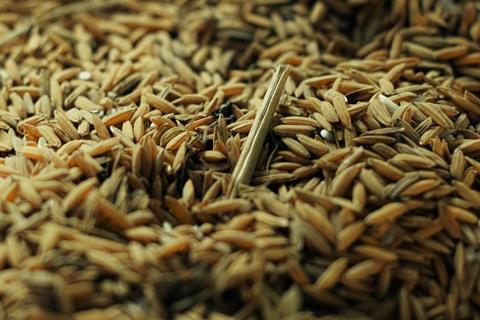
Now, researchers have developed a rice husk derived biochar catalyst that can completely degrade the antibiotic levofloxacin within just four minutes under mild conditions. The study, published in Biochar, provides both a promising wastewater treatment strategy and new mechanistic insight into how cobalt oxide based catalysts activate peroxymonosulfate, a powerful oxidant used in advanced water purification.
“Antibiotic residues in water are difficult to remove using conventional treatment methods,” said corresponding author Dr. Jiafang Xie of the Institute of Urban Environment, Chinese Academy of Sciences. “Our goal was to design a catalyst that is fast, efficient, and more suitable for real water environments, while also understanding what actually drives the reaction at the active site.”
The team used rice husk, an abundant agricultural byproduct, to prepare activated biochar rich in oxygen containing functional groups. They then loaded cobalt oxide, Co3O4, onto the optimized biochar surface. The best performing material, named RHBA800@25Co3O4, combined the porous structure of biochar with well dispersed cobalt oxide nanostructures.
Strong performance
When used to activate peroxymonosulfate, the catalyst achieved 100 percent degradation of levofloxacin within four minutes at neutral pH. The system also showed strong performance against several other antibiotics, including ciprofloxacin, tetracycline, and sulfadiazine.
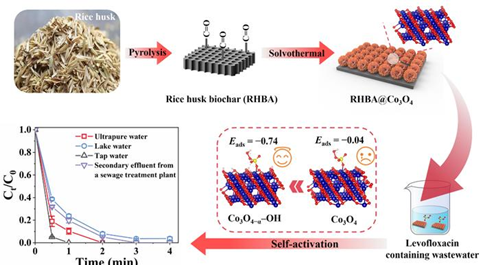
Importantly, the catalyst remained effective in practical water samples. In tests using lake water, tap water, and secondary effluent from a sewage treatment plant, the system still removed most or all levofloxacin within minutes. The researchers also tested a self designed fixed bed reactor and found that the catalyst maintained stable performance during 72 hours of continuous operation.
Active sites
Beyond performance, the study addresses a long standing question in catalytic water treatment: what are the true active sites in Co3O4 based peroxymonosulfate activation?
Using in situ Raman spectroscopy, in situ FTIR, X ray photoelectron spectroscopy, electron paramagnetic resonance, and density functional theory calculations, the researchers found that lattice oxygen in Co3O4 plays a critical role. During the reaction, lattice oxygen helps induce the formation of a surface intermediate described as Co3O4−α−OH, which binds peroxymonosulfate more strongly than ordinary Co3O4 and accelerates electron transfer.
“This finding helps explain why the catalyst works so quickly,” Dr. Xie said. “The biochar support improves dispersion, but the transformation of lattice oxygen and the formation of Co3O4−α−OH are central to the activation process.”
Degradation process
The degradation process involved both radical and non radical pathways, including sulfate radicals, hydroxyl radicals, and singlet oxygen. The researchers also examined the breakdown products of levofloxacin and found that toxicity was substantially reduced. In antibacterial tests using Escherichia coli, the untreated levofloxacin solution created a clear inhibition zone, while the treated solution showed no antibacterial effect.
The work suggests that waste derived biochar materials can be engineered into high performance catalysts for removing persistent antibiotics from water. By turning rice husk into a functional environmental material, the study also supports circular economy approaches to pollution control.
“Our catalyst links agricultural waste valorization with advanced water treatment,” Dr. Xie said. “We hope this study will support the development of safer, faster, and more sustainable technologies for treating antibiotic contaminated wastewater.”
Topics
- Agricultural runoff and eutrophication
- AMR in the Environment
- antibiotic contamination
- Antibiotics
- Antimicrobial Resistance
- Bacteria
- biochar
- Chinese Academy of Sciences
- circular economy
- Clean Water
- cobalt oxide based catalysts
- Escherichia coli
- Institute of Urban Environment
- Jiafang Xie
- levofloxacin
- One Health
- peroxymonosulfate
- rice husk
- Waste Management
- Wastewater & Sanitation
- wastewater treatment
- water purification



No comments yet