
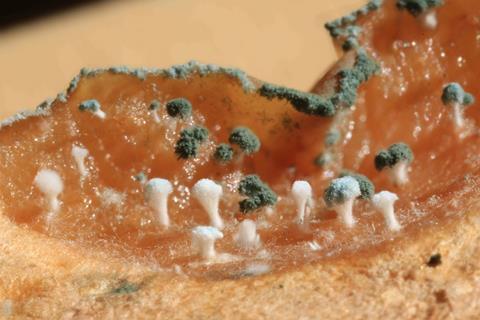
Apples are widely valued for their flavor and nutritional benefits, but they remain vulnerable to fungal decay during storage. Blue mould, caused by Penicillium expansum, is a common postharvest disease that can lead to substantial losses; the fungus can also produce patulin, a toxin that may contaminate apple products.
Sanitation and fungicides help control infection, while concerns about fungicide use have encouraged interest in other approaches. Salicylic acid, a natural plant signaling compound, has been shown to strengthen disease resistance in apples. However, researchers still do not fully understand how it changes the fruit’s metabolism after infection, particularly which phenolic compounds accumulate or decline. Clarifying these changes could help explain how salicylic acid slows blue mould and guide future strategies for protecting stored apples.
Why blue mould matters
A study published by Youming Shen’s team, Chinese Academy of Agricultural Sciences, reports that salicylic acid slows blue mould development while reshaping phenolic metabolism in infected apples.
To examine that response, the team selected 72 healthy ‘Fuji’ apples and assigned them to three groups: fruit treated with salicylic acid and then infected, fruit infected without salicylic acid, and an uninfected control. The treated apples were immersed in a 5 millimolar salicylic acid solution for 30 minutes; control fruit received water. Researchers then inoculated small wounds with P. expansum spores and measured lesion growth. By day 10, the smaller lesions in treated fruit showed that the treatment had significantly delayed disease progression.
Tracking metabolic changes
Next, the team collected tissue from healthy fruit, lesion margins and newly decayed areas. Using a method that detects a broad range of molecules, they found 103 secondary metabolites that differed across the tissue groups. Pathway analysis highlighted changes in flavonoid and phenylpropanoid production, both involved in making phenolic compounds. Many of these compounds were more abundant in salicylic acid-treated infected tissue than in untreated infected tissue.
Phenolics linked to resistance
The researchers then used targeted chemical analysis to measure 12 phenolic compounds in a broader sample set involving apples from different production regions and 50 fungal strains. At infection margins, several compounds, including caffeic acid, rutin and procyanidin B2, rose relative to healthy tissue, while others, including chlorogenic acid and procyanidin B1, fell. Finally, they compared compound concentrations with lesion size. Higher levels of procyanidins B1 and B2 and chlorogenic acid in healthy tissue were associated with smaller lesions. Some compounds measured at infection margins, however, increased as lesions expanded, suggesting that their accumulation could also reflect an ongoing response to infection.
Towards better postharvest protection
Together, the findings show that salicylic acid treatment changes the fruit’s chemical response as it limits blue mould growth. The results also point to phenolic compounds in healthy apples as possible indicators of resistance.
MICROBIOLOGY NEWS: Register with The Microbiologist for more free articles
Those links are correlations, so further experiments are needed to establish which compounds directly protect the fruit and whether measuring them can reliably improve postharvest disease management across apple varieties and storage conditions.
Topics
- Agriculture
- Apple disease
- apples
- Asia & Oceania
- Blue mould
- Chinese Academy of Agricultural Sciences
- disease resistance
- Environmental Microbiology
- fungal
- fungal infections
- Fungi
- fungicide
- infection
- Microbial Biotechnology
- mould damage
- One Health
- Penicillium expansum
- phenolic compounds
- postharvest management
- Research News
- salicylic acid
- Soil & Plant Science
- Youming Shen




No comments yet