
Biochar is often described as a climate-smart soil amendment because it can improve soil quality while storing carbon for long periods. But once biochar is added to soil, it does not stay unchanged. Rain, drying, minerals, oxygen, and microorganisms gradually alter its surface, chemistry, and environmental functions. For saline soils, where salt stress already limits crop production across many agricultural regions, scientists have had limited information about how biochar changes over time.
A new study published in Biochar provides a closer look at that process. Researchers found that higher soil salinity can slow the aging of biochar, helping it retain more carbon-rich, aromatic structures while reducing microbial colonization, especially by fungi.
“Biochar is widely used to improve saline-alkali soils, but its long-term performance depends on how it ages after entering the soil environment,” said corresponding author Rongjiang Yao of the Institute of Soil Science, Chinese Academy of Sciences. “Our study shows that salinity is not just a stress factor for plants and microbes. It also reshapes the aging pathway of biochar itself.”
To simulate long-term field aging, the team collected agricultural soils with low, moderate, and high salinity from coastal farmland in Jiangsu Province, China. Wheat-straw biochar was mixed into these soils and exposed to repeated wetting and drying cycles. The experiment simulated approximately eight years of natural aging and allowed the researchers to track changes in biochar chemistry, surface structure, mineral composition, and microbial communities.
Clear pattern
The results showed a clear pattern. Biochar aged in high-salinity soil retained higher total carbon, stronger aromaticity, and more surface C-C/C=C carbon structures than biochar aged in low-salinity soil. At the same time, it showed lower oxygen content, lower oxidation degree, and less surface C-O bonding, all indicators of slower aging. By the final aging cycle, the O/C ratio of biochar aged in high-salinity soil was 9.82% lower than that in low-salinity soil. Across the aging process, total carbon content declined by about 20%, mainly due to the loss of labile carbon and mineralization of organic matter.
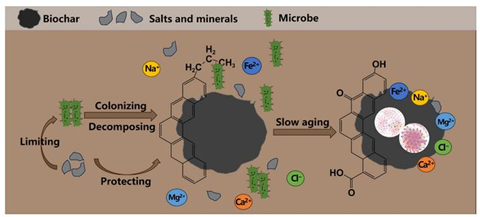
The study also found that salinity strongly affected the living community inside and around the biochar. Biochar can act as a tiny habitat for soil microorganisms, but high salinity reduced microbial activity and diversity within the biochar, with fungi showing particular sensitivity. Because microorganisms contribute to carbon breakdown and surface oxidation, this reduced colonization likely helped slow biochar aging.
Drivers of biochar aging
“Our findings suggest that microorganisms are important drivers of biochar aging, but their role can be limited under salt stress,” said first author Ruoyu Wang. “In highly saline soils, fewer microbes, especially fungi, colonized the biochar, which may have reduced carbon degradation and oxidation.”
The researchers also observed another protective mechanism. Soil salts and minerals accumulated on biochar surfaces, forming a physical barrier that may have restricted oxidation and microbial access. This mineral coating, together with microbial inhibition, helped explain why biochar aged more slowly as salinity increased.
The findings could help scientists and land managers better predict how biochar behaves in saline farmland over time. Saline soils are difficult to manage because salts can reduce water movement, harm soil structure, limit microbial processes, and suppress crop growth. Biochar has been promoted as a sustainable amendment for these soils, but its benefits depend on long-term stability and interactions with soil microbes and minerals.
Saline conditions
“This work improves our understanding of biochar-soil-microbe interactions under saline conditions,” Yao said. “It also provides a scientific basis for using biochar more effectively in saline agricultural fields.”
The authors note that future studies should include additional environmental factors, such as temperature changes and sunlight exposure, and should directly measure carbon transformation pathways and microbial succession under field conditions.



No comments yet